Between Altitudes
Just some thoughts while I put together a book for Dad


There is a point in any long intellectual journey when the frameworks that once held your thinking begin to show their seams. You continue to admire the people who built them; you recognise the precision of their craft and the generosity of their inquiry. And yet, almost without noticing, you find yourself operating at a different tempo, thinking across scales they do not track, inhabiting civilisational coordinates their methods do not map. This past year — one that compressed time in my body even as it expanded time in my mind — made the divergence unmistakable. I realised, with some reluctance, that I now occupy a vantage adjacent to but no longer inside the tribes that shaped me.
The alienation is not personal. It is structural — a series of mismatches in time, civilisation, materiality, and consequence that reveal themselves only when one crosses a certain conceptual altitude.
I. Temporal Alienation: The Acceleration of Horizons
Antikythera operates in cosmic time: evolutionary arcs, billion-year loops, intelligence as a planetary phenomenon. The Singapore civil service operates in long and short time: budget cycles, scorecards, incremental legitimacy. Chinese technopolitics occupies dynastic time: coherence measured not in quarters but in restructurings of entire industrial metabolisms. I now move between these tempos without fully belonging to any of them — a double time produced by illness on one side and planetary computation on the other.
Antikythera’s deep time is exhilarating, but it has the luxury of abstraction. Civil-service time is grounded, but often cannot see past 2030. Chinese time is strategic, but closed in its teleology. My own time has become both shorter and longer than any of these: the horizon is geologic, the urgency is personal. Few frameworks speak comfortably across that split.
II. Civilisational Alienation: The Problem of Universal Altitude
Antikythera writes from a universal vantage — intelligence as a function of matter, computation as cosmology, hemispherical stacks as clean abstractions. But once I start reading the world through Asian civilisational lenses — Chinese coherence, Gulf tri-temporality, Indian half-body constraints, Japan’s quiet deceleration, Singapore’s custodial realism — the universal frame dissolves.
The stacks are not symmetrical.
The sensorates breathe differently.
Civilisations metabolise existential technologies at different speeds, with different anxieties, and with different moral tolerances.
A universal perspective is elegant, but it floats above the surface tension where power, culture, and infrastructure collide. I cannot think that way anymore.
III. Material Alienation: When Consequence is Not Evenly Distributed
For Antikythera, simulations are epistemic tools; for small states, simulations are sometimes the only warning before reality arrives. For them, planetary computation is an existential technology; for us, it is also a civilisational constraint — routing ships, pricing food, redirecting capital, determining whether supply chains pivot away faster than we can absorb. China embraces artificialization as national destiny; Singapore experiences it as an ongoing negotiation with fragility.
Antikythera speaks of intelligence as if consequences fall uniformly across the planet. They do not. The risks accrue unevenly. The floor is closer for some.
IV. Existential Technologies: Divergent Interpretations of the Same Shock
Konior’s distinction between functional and existential technologies is the most honest conceptual tool in the entire Antikythera corpus. But existential technologies — those that rewrite what humanity is — land differently depending on where one stands.
A large civilisation can absorb the shocks of genetic recombination, cognitive infrastructures, xenobodies, synthetic intelligence. A small state must filter each of these through demographic vulnerability, cultural coherence, infrastructural throughput. The planetary view and the custodial view diverge sharply here.
To Antikythera, existential technologies are conceptual revelations.
To a place like Singapore, they are existential calculations.
V. The Clarification: Alienation as Recalibration, Not Rejection
None of this is a critique.
It is simply what happens when altitude changes.
I move slightly above the layer where a single discourse — whether planetary computation, Chinese pragmatism, Gulf futurism, or Singaporean technocracy — can hold my whole field of vision. At a certain point, I am no longer inside any of these frames; I see the curvature of each. What feels like alienation is simply the moment when I realise that no single tribe contains the geometry of my thoughts anymore.
VI. Where I Stand Now
My vantage now is defined by six commitments:
Planetary cognition as fact, not metaphor — intelligence is infrastructural, ecological, and already distributed.
Civilisational pluralism as structural reality — different epistemic traditions produce different sensorates.
Small-state fragility as the ethical horizon — the test of ideas is whether they hold under pressure.
Existential technologies as the hinge of the century — not enhancements, but redefinitions.
Infrastructural realism over conceptual comfort — pipes, corridors, compute, energy, demography.
Temporal duality — deep time as orientation, short time as obligation.
From this vantage, I am not “in” Antikythera, or Chinese techno-optimism, or Singaporean bureaucracy, or Western metaphysics. I am adjacent to all of them, but interior to none.
VII. Problems That Now Belong to Me
At this altitude, I recognise the problems that feel properly mine:
How civilisations metabolise planetary intelligence at different speeds.
How small and mid-sized states maintain coherence under stacked temporalities.
How existential technologies reorder legitimacy, reproduction, learning, and survival.
How to write a conceptual vocabulary adequate to the next hundred years, from Asia outward.
How to name the future before it is claimed by the wrong metaphysics.
These are not Antikythera’s problems, nor China’s, nor Singapore’s.
They are simply where my trajectory has led.
VIII. Closing
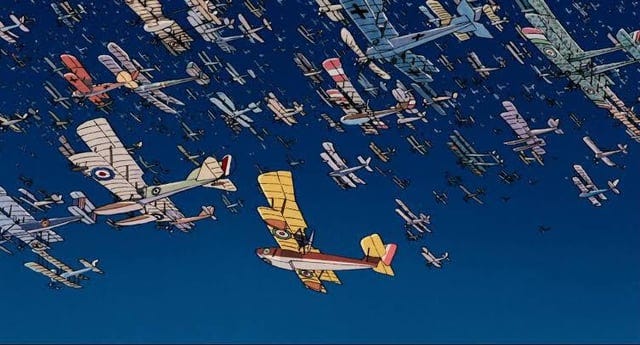
There is a scene in Porco Rosso in which the dead pilots of a lost war rise into a quiet sky, forming a column of planes ascending into the beyond. It is not a metaphor for transcendence so much as a reminder that some eras fly past us and do not wait. The living are left in a lower layer of air, adjusting to what remains.
I suspect I am somewhere in that middle altitude now — not in heaven with the beautiful abstractions, not on the surface with the small certainties, but suspended between them, in air that is thinner, clearer, and unavoidably my own.
And I still have to get that book out for Dad :) It’s a nice problem to have.
Wishing you an early Merry Christmas, and Happy New Year!
cp
Thanks for this, so clarifying. What if this temporal mismatch is the true operating system?
How could anyone possibly claim to know what happens in "billions of years"? I don't even remember what i had for dinner last night... This seems like lots of assumptions that could never be proven...