How Civilizations Digest the Future
Homer, Buddhism, Japan, and the strange forms born from cheap intelligence


Christopher Nolan was asked a question he did not quite answer.
Zhuge Yiyang wanted to know why his Odyssey needed atonement. Homer’s Odysseus returns after war, wandering and catastrophe, but he does not return as a modern man burdened by the need to confess his greatness. Nolan’s does. Had Nolan Christianized Homer?
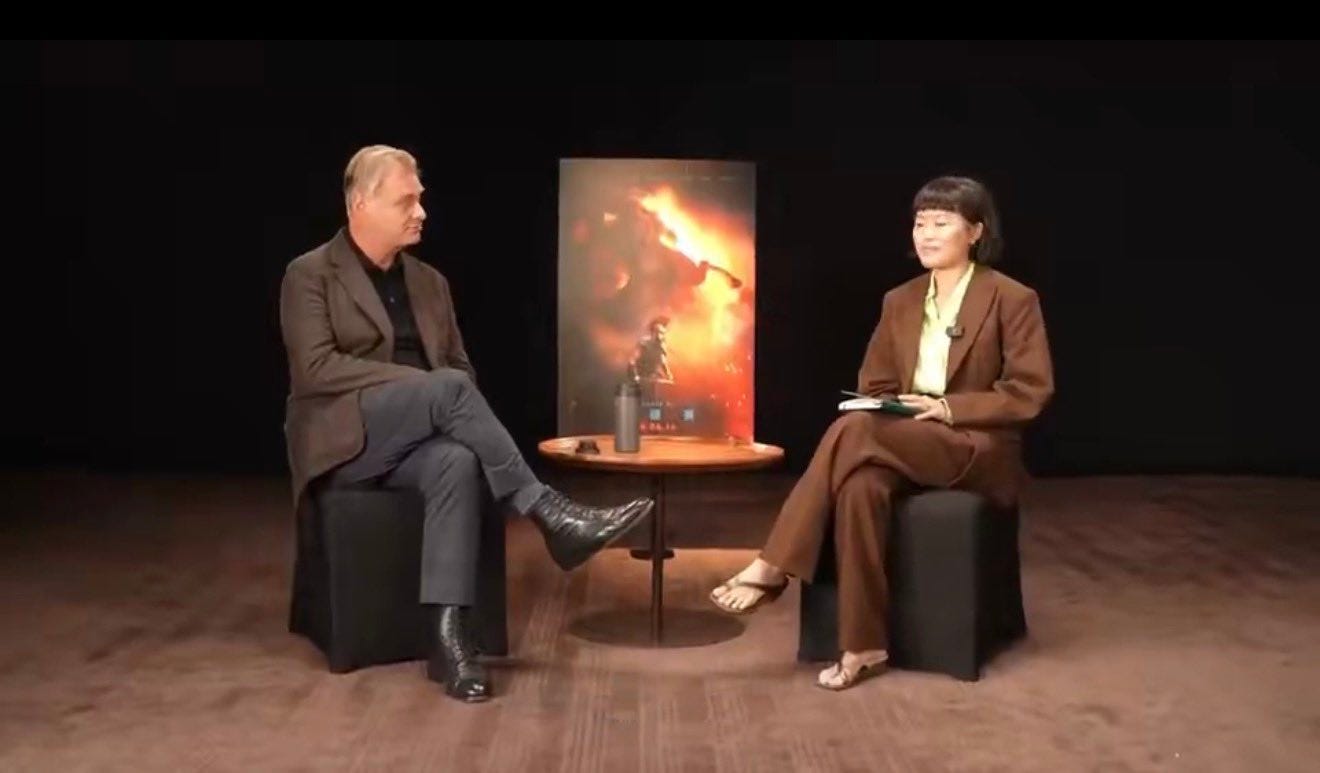
Nolan replied by talking about xenia: the law of hospitality, the obligation to treat the stranger properly because he might be a god in disguise. Once its theological casing was removed, he suggested, xenia was simply the Golden Rule, a truth shared across time.
Zhuge kept pressing. She was not asking whether mutual respect was universal. She was asking how a particular moral sequence—transgression, guilt, confession, atonement, reconciliation—had entered an ancient story that did not originally possess it in that form.
Then Ezra Klein approached the same film from the other side. American society, he argued, is hungry for virtue again: courage, excellence, loyalty, self-command, duty, greatness. Liberalism became very good at defending rights and protecting people from the moral projects of others, but less confident in saying what a good person should become.
Suddenly the three positions locked together.
Nolan performed the translation. Zhuge exposed its genealogy. Ezra identified the hunger that made it necessary.
America wants Homeric virtue, but it cannot swallow Homer raw.
Raw Homer contains courage, cunning, glory, vengeance, household sovereignty, hierarchy and victory. A modern American audience may still want courage and greatness, but it cannot comfortably accept greatness that owes no account of itself. The hero must not merely conquer. He must answer for what conquest has done to him and to others. Strength must be joined to conscience. Victory must pass through responsibility before it can become admirable again.
Atonement is therefore not simply Nolan’s distortion of Homer. It is the enzyme that makes Homeric virtue digestible to contemporary America.
That small act of moral translation is a miniature of a much larger process. Civilizations do not receive traditions intact, like sealed containers unloaded at a port. They break them down, discard some elements, preserve others and recombine the remainder with their own moral tissue. What emerges may be recognizably descended from the original, but it is no longer the original.
A foreign tradition survives not by remaining pure, but by becoming inhabitable.
I had thought I was writing separately about learning systems, civilizational memory, technology and religion. Nolan, Zhuge and Ezra made me realize that they were different rooms in the same house.
The question beneath them all is not simply who invents something first. It is who can give an alien power a second life.
India once gave China Buddhism. The asymmetry is revealing. India became enormously important to China’s spiritual imagination, while China occupied a much smaller place in India’s. Chinese monks travelled towards India as the source of an answer they did not yet possess. They learned languages, sought manuscripts, founded translation bureaus, fought over doctrine and built institutions capable of reproducing the teaching.
The learner studies the source because the learner experiences a lack. The source may hardly notice the distant afterlife of what it has produced.
Yet the forms of Buddhism that endured most powerfully in China were not always the most faithful reproductions of Indian originals. Buddhism became Chinese by entering Chinese language, cosmology, social organization and habits of practice. Chan was not Indian Buddhism carefully preserved under glass. It was Buddhism metabolized so completely that it could eventually travel outward again as though China had become one of its centers.
Japan repeated the process. It received Indian religion largely through Chinese and Korean forms, then turned selected traditions into Japanese disciplines, institutions and aesthetic worlds. The source moved from India to China to Japan, but the tradition did not simply become weaker with distance. At each stage it was translated into another civilizational body.
This happened again with Marxism. A European theory of industrial capitalism became a doctrine of revolution in Russia, then a theory of peasant war, national liberation and state construction in China. The convert was at once more doctrinaire and less faithful than the original believer: more doctrinaire because the universal claim had been consciously chosen as truth; less faithful because it had to work under conditions its founders had not imagined.
Globalization followed a related path. The West often described it as an order of openness, markets and individual freedom. Japan, South Korea, China and other East Asian societies frequently treated the world economy more like an immense examination system. External competition became a discipline for domestic learning. Imported machinery, standards and knowledge were not merely consumed. They were absorbed into firms, ministries, supplier networks and production systems until the pupil could manufacture, improve and eventually export the thing itself.
This is not a uniquely Chinese process. Nor is it proof of permanent Chinese ascendancy. Japan may be its most impressive demonstration—and its clearest warning.
Japan became a conservatory-workshop for the world. Foreign practices that had become ordinary or obsolete in their places of origin were named, taught, refined and preserved with extraordinary seriousness. Chinese literary and religious traditions, European classical music, American industrial organization and a great range of technical and aesthetic crafts found meticulous Japanese afterlives.
The receiving civilization sometimes remembers because it once had to learn consciously what the source could afford to take for granted.
But Japan also shows how a learning system becomes trapped by its previous success. The most apt description remains that Japan reached the year 2000 in 1980 and has been stuck there ever since. It had already built the dense cities, high-speed trains, consumer electronics, precision manufacturing and frictionless daily conveniences that others associated with the future. Then the future changed.
The Plaza-era revaluation and the subsequent unwinding of an export-heavy capital structure struck just as the frontier was shifting from hardware and industrial coordination towards software, networks, platforms, venture formation and organizational churn. Japan did not suddenly lose intelligence, craft or institutional competence. Its learning machinery had become deeply coupled to the architecture of its last victory.
The system that had caught one future became an obstacle to catching the next.
This is why hunger and competition matter. They keep the metabolism open. A society under pressure looks outward, copies shamelessly, tests alternatives and permits yesterday’s arrangements to be displaced. Success does the opposite. It creates sunk capital, incumbent firms, protected careers, honoured routines and social bargains that cannot be altered without injuring those who built them.
Civilizational muscle memory becomes rigor mortis.
The same warning applies to America, although we are much less accustomed to imagining it.
For more than a century, the technological frontier and the characteristic American machinery for producing it appeared almost synonymous. The frontier arrived through universities, laboratories, defence programmes, startups, venture funds, software companies and public markets. When another society produced something important, America could usually recruit the talent, buy the company, reproduce the capability or create a more scalable commercial form.
We therefore assume that whatever the next frontier is, America will eventually be there. Perhaps not first, but in time.
The electro-state complicates that confidence because it creates frontiers before they become legible as sectors.
When electricity, grids, compute, models, manufacturing, logistics and procurement are joined into one dense substrate, they do more than make existing products cheaper. They begin generating new organizational forms. The important unit may no longer be the model, the app or even the company. It may be a continuously operating system of machine cognition embedded in factories, laboratories, supply chains, bureaucracies and households.
This is why the idea of China exporting AI tokens is so arresting. We knew how to imagine China exporting solar panels, batteries, telecommunications equipment and industrial machinery. It was less natural to imagine the same electro-industrial system converting electricity into routable cognition and selling it into the daily operations of the world.
The metaphor should not be pushed too literally. A Chinese model used abroad may run on computers in Virginia, Tokyo or Singapore. But China can still export something more consequential than its electrons: the cost curve and production grammar of abundant intelligence.
Cheap models make it economical to leave cognition running in the background—monitoring, retrying, translating, checking, simulating and coordinating. They make possible organizations composed of one human principal and hundreds of temporary agents, clouds designed for machine customers rather than human programmers, and industrial systems in which intelligence disappears inside the equipment.
The frontier therefore divides: who builds the most capable intelligence; who makes it cheap and dependable; who embeds it throughout production; and who discovers the forms that abundance permits. America could lead the first and miss the fourth. China may build the substrate while constraining mutations that disturb administrative control. The strangest forms may emerge downstream, where Chinese models, American capital and local institutions mix.
Southeast Asia’s apparent weakness as a civilizational furnace may then become an advantage. It often absorbs without fully resolving. Traditions layer, mingle and remain visibly multiple. Chinese, Indian, Islamic, European and indigenous forms coexist without being melted into one unified doctrine.
The estuary does not produce the water flowing into it. It can still create ecosystems that exist nowhere upstream.
Cheap machine cognition entering Southeast Asian firms, households and bureaucracies may therefore produce combinations neither the American platform company nor the Chinese electro-state anticipated. India may generate a different set of forms through language, voice, service delivery and its vast ecology of small intermediaries. Japan may preserve and refine particular human-machine practices with unmatched care. America may provide the frontier intelligence, finance and narrative packaging. China may provide the industrial cost curve.
The future form may belong to none of them individually.
This also changes how I think about the possibility of a Second Axial Age. We keep looking for the next prophet, religion, revelation or taboo. Perhaps we are looking too high and too early.
New moral orders often begin as adaptations to new material conditions. Cheap machine cognition will alter what counts as work, merit, authorship, agency, responsibility, loyalty, dependence and care. Societies will reach backwards into Christianity, Confucianism, Buddhism, liberalism, nationalism and household ethics to make these changes intelligible. The old traditions will return, but as ingredients in syntheses their founders could not have recognized.
Practice may come first. Moral vocabulary will follow. Theology may arrive last.
Nolan’s Odyssey is a small example. A society hungry for virtue reaches back to an ancient source. It cannot accept the source whole, so it inserts conscience and atonement. Zhuge sees the seam. Ezra sees the hunger. Nolan gives America a form of greatness it can once again bear to admire.
The same process is about to occur on a much larger scale as machine intelligence enters the substrate of ordinary life.
The decisive capacity is therefore neither invention nor openness alone. It is the ability to take something foreign, dangerous or unprecedented and turn it into practices people can inhabit without losing themselves. Then, when that successful synthesis hardens, to break it open and learn again.
The birthplace of a tradition is not necessarily its best long-term home. Nor does the greatest learner remain the greatest learner forever. Civilizations can be defeated by what they cannot absorb—but also by what they absorbed too successfully.
Japan supplies the final warning. The danger is not only failing to reach the future. It is arriving early, building it beautifully, and then mistaking it for the last one.
Its hard to read these as they're written by AI :-(
Fucking AI crap