How machine civilisation is born
Three parter: the listed state, the training state & the sixth system

FOREWORD
From risk capital to state form
continuing down the technology path we’re beginning on today will require the efficient formation of trillions and trillions of dollars of risk capital in increasingly weird and obscure situations/structures.
agi will be a financial innovation as much as a technical one.
- Will Manidis
I first read this fragment as a proposition about finance. Artificial general intelligence would require data centres, power plants, transmission lines, chips, fibre, satellites, robotics, laboratories and an industrial buildout whose scale exceeded conventional venture capital. The frontier would have to invent strange leases, special-purpose vehicles, guarantees, joint ventures, public listings, government-guidance funds and other instruments capable of carrying assets whose technical life, economic life and political life did not match.
That is true. It is also too small.
The deeper proposition is that financial forms select political forms. A capital structure is not only a way to fund a project. It decides who commands, who absorbs first loss, who may alter the purpose of the project, whose guarantee makes the risk appear safe, and who will be rescued when the capability becomes too important to fail. The machine does not acquire a body through engineering alone. It acquires one through institutions that can assemble capital, permission, infrastructure and authority around an object that keeps changing.
This sequence began with the SpaceX listing and ended somewhere else. The first question was how markets would form enough risk capital for increasingly obscure technological structures. The next was what the United States government becomes when strategic capacity is privately commanded, politically indispensable and publicly securitised. The Chinese mirror then appeared: not a state-owned SpaceX, but a network of cities capable of acting as investor, landlord, grid planner, training environment, first customer, data broker and political narrator. The final question followed from both. Once America can finance the machine and China can train it, what gives ordinary people a reciprocal claim upon what has been built?
We are watching the birth of machine civilisation.
That claim does not depend on a smooth ascent in AI valuations. There may be one bubble or several. Companies will fail. Capital expenditure will be written down. Data centres will be built in the wrong places, chips will age faster than their financing, business models will disappoint, and the public market will periodically remember that a story is not cash flow. None of this reverses the institutional transformation.
A bubble can alter prices and ownership without removing the infrastructure, permissions, habits and dependencies created during the boom. Bankrupt assets are sold. Contracts are renegotiated. Governments step in. Stronger firms absorb weaker ones. Public authorities inherit systems that private capital could build but could not sustain. What matters is not that every wager succeeds. It is that the wager reorganises grids, capital markets, industrial parks, procurement systems, local governments, legal categories and national strategy before it fails.
A bubble is not the opposite of birth. It may be one of its contractions.
My earlier essays saw machine civilisation largely from above. America 2036 described a United States organised around five coupled systems: power, compute, logistics, money and the kill chain. A Hungry America asked what such a machine would want if it regained strategic capacity without rebuilding a thick public settlement. The Machine, the Middle, and the Mud argued that the machine century begins not when software becomes clever, but when intelligence enters authorised loops and can spend, deny, rank, route and bind. The Forms That Bind looked at the social forms and developmental passages that machine tempo might flatten.
Those pieces named the condition, its operating stack and its human wound. They were still aerial.
The three essays here descend into institutional anatomy.
The Listed State asks how the American machine acquires a treasury and a commander. It begins with SpaceX, but its subject is larger: the United States is learning to house strategic capacity inside founder-controlled firms, convert public missions and permissions into private indispensability, and use public markets as a parallel appropriations system. The market is not merely valuing a company. It is capitalising the government’s growing inability to do without it.
The Training State asks how the Chinese machine learns. Public capital supplies a search budget. Local governments assemble land, power, factories, suppliers, workers, data, customers and regulatory tolerance into territorial learning loops. The locality does not merely support the technology. It constructs the environment in which the technology can discover what it is.
The Sixth System asks what neither form yet supplies. Power, compute, logistics, money and the kill chain can make a civilisation formidable. They cannot make it inhabitable. Settlement is the missing machinery that converts machine surplus into human claim: income, time, competence, transition, care, voice and appeal.
The trilogy therefore moves through three questions:
What finances the machine?
What trains the machine?
What allows human beings to bind the machine in return?
This is no longer primarily an essay sequence about artificial intelligence. It is about emerging governance. The American answer is the listed operator. The Chinese answer is the training locality. The human answer has not yet acquired an adequate institution.
The machine is being born anyway.
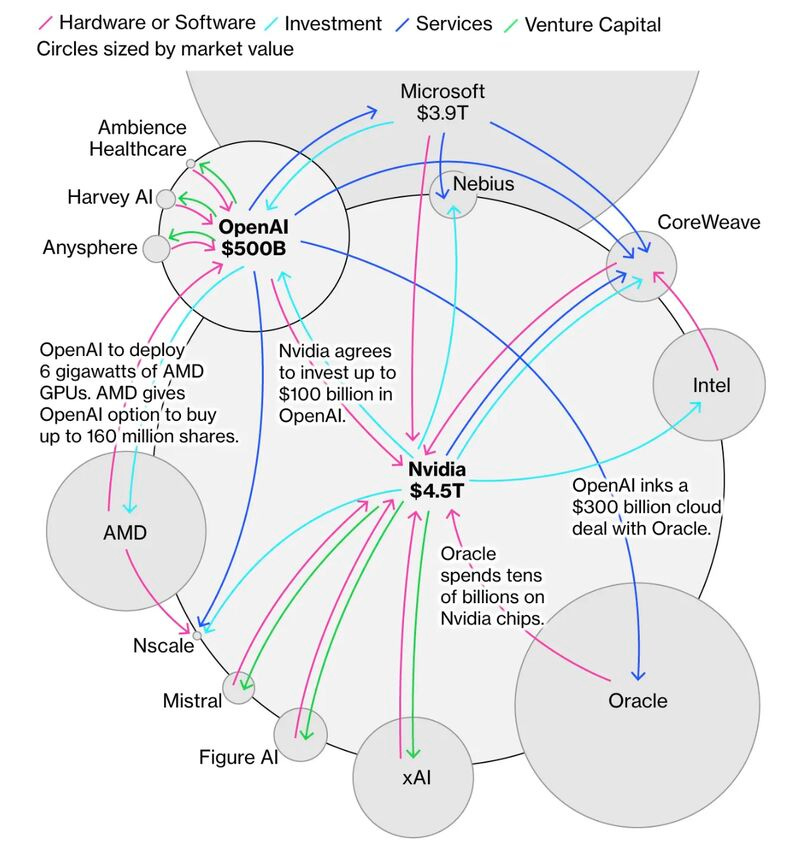
this is very outdated, but still a nice visual seeing how the machine is summoning itself into existence from the future