Metabolic Wars
There's a two by two

A few days ago, in Metabolic Wars, I laid out M.E.T.A. — Mass, Empire, Token, Alignment — as the grammar of planetary metabolism. This week, we roll the dice across a crude quadrant: MAGA win or bust, AI win or bust. But quadrants only provoke. Metabolisms endure.
I. Context
Six months ago, in Intelligence Is Not Enough, we asked whether intelligence itself — the Machine God of large models and datacenters — could anchor growth. It promised productivity gains, but too often delivered bubbles, hallucinations, and a bill for more electricity.
In Petro vs Electro States, we suggested that America had become a late-cycle petro-financial empire, while China was experimenting with an electrostate: exporting electrons, compute, and payments corridors as the new infrastructure of sovereignty.
And in Between Stack and Ritual, we warned that no stack survives without culture, ritual, and legitimacy. Intelligence without coherence becomes brittle, even dangerous.
March 2026 binds these arcs together. The AI bubble has burst into an American recession. Electrostates consolidate, tender by tender, contract by contract. Europe proves metabolically hollow. India is squeezed. The Gulf improvises financial contraptions.
The question is no longer whether intelligence is enough. It is: who can metabolize collapse into endurance, and abundance into sovereignty?
II. The Crude Quadrant
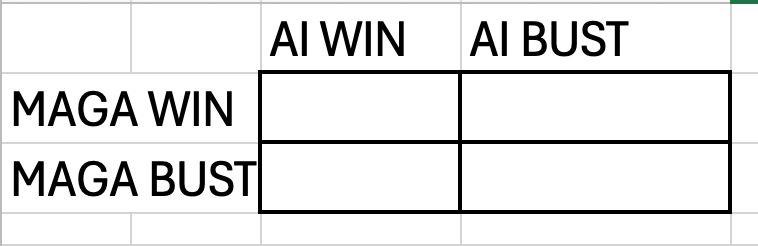
At the end of 2025, a crude 2×2 grid circulated like a meme: MAGA win or bust on one axis, AI win or bust on the other. Four boxes, four futures.
It had the sting of reduction. Could Trump’s MAGA survive? Could the AI boom endure? Throw the dice and history is set.
But quadrants are surface maps. They slice futures into coin flips. Beneath the boxes lie metabolisms: how states digest energy, capital, and legitimacy. And the global system doesn’t sit idly by while America rolls dice — each quadrant triggers different metabolic contortions in China, the Gulf, Russia, India, Japan, Korea, and Southeast Asia.
III. The Four Quadrants as Global Vignettes
MAGA WIN + AI WIN
Empire running hot, petro and hyperscale fused.
U.S.: Datacenters rise like concrete cathedrals in the Midwest. Subsidies gush, oil and gas flare. Stock markets soar; power grids groan. Success feels like overextension.
China: Waits. Knows hype will collapse. Keeps building corridors quietly.
Gulf: Wins twice. Petro booms, electrons in demand. SWFs hedge by buying U.S. hyperscaler debt.
Russia: Marginalized, squeezed by cheap U.S. energy. Drifts further toward Beijing.
India: Choked harder by U.S. demands. Corridors drift east.
Japan/Korea: Compliant satellites, subsidizing AI buildouts. Grumbling under their breath.
SE Asia: Hosts overflow clusters. Profits, but trapped in squeeze.
Charles Gave’s quadrant fits here: financial repression. Capital is forced into state-backed projects. Growth shines but brittles.
MAGA WIN + AI BUST
Politics intact, tech hollow. A petro fortress.
U.S.: Machine God collapses, but MAGA spins it as victory. Tariffs, coal, and oil subsidies expand. GDP stagnates.
China: Smiles. Corridor time accelerates. America preserved as noisy petro-empire.
Gulf: Electrostates stalled, but petro revival buoyant.
Russia: Energy realism revives Moscow’s fortunes.
India: No AI ladder, only tariffs and pressure. Suffocates.
Japan/Korea: Disappointed but compliant.
SE Asia: Relatively stable — petro flows stabilize trade, protests contained.
This is the petro winter quadrant. Empire alive, metabolism dead. Gave’s stagflation world: low growth, sticky energy dominance.
MAGA BUST + AI WIN
Politics broken, Machine God triumphant. The Die by Science, Die by Code quadrant.
U.S.: MAGA implodes, Washington drifts. Silicon Valley ascends, engineers and financiers dictate terms. America becomes platform, not empire.
China: Faces its nightmare rival: a Valley cosmopolis, empire of code. East is Read thinkers already see: China can build corridors but lacks a framework for resisting cosmopolis culture.
Gulf: Courted by Valley platforms, but prefers ballast and contracts. Experiments with energy-backed stablecoins.
India: Room to maneuver. Without MAGA choke, Delhi leans on platform sovereignty (Aadhaar, UPI). But risks recolonization by Valley.
Japan/Korea: Thrilled — AI without MAGA baggage. Still tethered to U.S. utilities.
SE Asia: A generation raised inside Valley platforms. Hedging becomes cultural.
Intoxicating but corrosive: sovereignty dissolves into platforms, rituals erode, legitimacy migrates to code.
MAGA BUST + AI BUST
Collapse squared. Empire falters, Machine God shatters.
U.S.: Recession deepens, layoffs mount, no petro or AI rescue. Legitimacy frays.
China: Drawn into propping up U.S. peripheries — Gulf monarchies, ASEAN, Latin America. But has no imperial doctrine. Stack Wars warned us: stacks without rituals fracture.
Russia: Flails. Irrelevant without MAGA energy markets.
Gulf: Petrostates panic; SWFs bleed. Electrostates falter on low demand.
India: Stranded — no U.S. carrot, no AI ladder. Turbulence sharpens.
Japan/Korea: Adrift. No MAGA anchor, no AI boom. Anxiety spikes.
SE Asia: Disorder at the margins. Protests escalate, corridors stall. Quiet volatility tips into unrest.
This is the most dangerous quadrant. China improvises an empire it doesn’t want, propping resentful peripheries without legitimacy. The vacuum fills with resentment, not coherence.
Ghost footnote (Dwarkesh):
Dwarkesh would object here: “You’re giving too much probability mass to bust scenarios. Scaling hasn’t run out of road — continual learning is unsolved, but that doesn’t mean AI stops delivering. Bust isn’t a quadrant, it’s a low-probability tail. More likely, AI ‘wins’ unevenly: it embeds in code, logistics, finance, while sputtering in governance or legitimacy. Don’t box it as binary. Model it as bleed and creep.”
Editorial aside:
This critique is fair. “Bust” here is not prophecy, but stress test. The purpose of treating it symmetrically in the quadrant is not to claim equal odds, but to surface what fragility looks like if hype burns faster than adoption. Reality may well live in Dwarkesh’s bleed and creep — AI winning in some domains, stalling in others. But quadrants dramatize, and stress tests clarify.
IV. Transition: From Boxes to Processes
Quadrants provoke. They slice futures into neat boxes, each with its own mood, each a caricature of what might be. MAGA alive or dead. The Machine God triumphant or broken. Dice rolled on history’s table.
But the world does not stay in boxes. It leaks. It bleeds. One quadrant shades into another: MAGA’s survival stitched to an AI bust in one domain, while elsewhere the Valley thrives even as Washington stumbles. Peripheries experience futures diagonally — the Gulf in “AI win,” India in “AI bust,” Europe in “MAGA bust” all at once.
That’s why a crude quadrant, however stimulating, is never the end. It’s an aperture. A way of staging tension before turning to what matters: the processes that endure beneath binary outcomes.
This is where dispatch enters. A memo collapses the boxes into a single vantage point — not because one quadrant “won,” but because reality metabolizes fragments of each at the same time. A memo forces us to see contracts, corridors, layoffs, gold flows, not as thought experiments but as lived metabolism.
So here is the dispatch, written as if from March 2026. It does not tell us which quadrant prevailed. It shows us how metabolisms are already weaving pieces of all four into one contested fabric.
V. Memo from March 2026
The Machine God Recession
The U.S. entered recession not through oil shocks or financial crises, but through the collapse of the AI bubble. Datacenter capex padded GDP, but pilots failed, adoption plateaued, costs refused to fall. Layoffs cascaded. The Machine God delivered stranded concrete, not growth.
In a Virginia town, the lights flicker during a summer brownout. Locals mutter that the new datacenter outside town gulps more water and power than the whole county, but no jobs came with it. What was promised as the Machine God’s temple feels, on the ground, like a parasite.
Gold Corridors
Beijing seized the moment. In December, it invited partner states to deposit sovereign gold in Shanghai and Shenzhen, anchoring RMB settlements. Not Bretton redux, but corridor finance: gold as ballast, electrons as lifeblood, contracts as sinew.
For the first time in half a century, trade cleared outside the dollar’s chokehold.
Time Sovereigns vs Immediates
MAGA America runs on quarters and elections.
Electrostates run on 2049 contracts and 2050 visions.
China knows collapse is dangerous; it prefers controlled demolition. That’s why it props Washington in odd ways: liquidity swaps, trade continuity. Not to save empire, but to stop peripheries from burning too fast.
The Anomaly Node: Israel
Conflict reignited in late 2025. Pipelines and compute cables disrupted. Infrastructure itself became hostage. Israel revealed what anomaly nodes do: destabilize corridors they cannot themselves control.
Europe as Failed Metabolist
Ukraine hardened into Europe’s problem. America moved on. Europe was exposed as metabolically hollow: no petro reserves, no electro capacity. Institutions intact, metabolism broken.
In Germany, chemical plants that once ran on cheap Russian gas now flicker on half-shifts, their output replaced by imports. In France, protests over energy bills echo as loudly as protests over pensions. In Brussels, committees argue Eurobond frameworks while the grids strain in silence. Europe’s metabolism survives on paperwork while its arteries clog.
Bessent Contraptions: Stablecoins & Compute Credits
Crisis breeds contraptions. And 2026 has been nothing if not improvisation.
Gulf sovereign wealth funds quietly bought into hyperscaler debt — not for love of Silicon Valley, but to hardwire tomorrow’s electron offtake into their balance sheets. ASEAN birthed the first “compute credits” — tokens redeemable not in gold or oil, but in GPU time, corridor by corridor. Stablecoins surged back as banks tightened, clearing trades faster than SWIFT could blink. In the Gulf, pilots for energy-backed stablecoins appeared — contracts where every dirham was a dispatch right, every ledger line a miniature corridor.
These are financial bricolages: half-mad, half-brilliant, sometimes both. They look fragile up close, but together they sketch the nervous system of a new order. If the empire is faltering, someone must keep the liquidity moving. If electrons are to flow, someone must mint the tokens. That is how metabolisms survive collapse — with hacks that look insane until they become infrastructure.
In a Dubai boardroom, a banker slides a token across the table — not a coin, but a contract for “GPU hours,” a promise that electrons will be available when code demands them. It looks ridiculous, like a casino chip. Yet everyone knows the balance sheets now hinge on such contraptions.
India Under Pressure
Washington cannot stop China, so it slows India. Tariffs, export controls, conditional finance — not to crush, but to choke. Delhi feels the squeeze with every semiconductor license delayed, every trade negotiation dragged out.
Yet India is not just a junior electrostate-in-waiting. Its strength lies in platform sovereignty: Aadhaar, UPI, the rails that tie identity and payment across hundreds of millions. If Delhi can braid platforms into corridors, it could still claim metabolic agency.
But here’s the rub: platforms do not lay cables, nor do they anchor grids. India’s capacity to turn platforms into durable sovereignty is untested. Its bureaucracy misfires; its states fight over procurement; its politics wastes time. Washington knows this. So does Beijing. India talks in the cadence of a great power, but its metabolism is still unresolved.
A young graduate in Delhi stares at his Aadhaar-linked screen. Payments, ID, job applications — all braided together in a seamless platform. It feels like sovereignty in miniature, until he realises the semiconductor jobs he hoped for are still waiting on export licenses from Washington.
Quiet Dependents: Japan, Korea, SE Asia
Korea: Slapped with Hyundai arrests, resentful but bound by security and chips.
Japan: Koizumi promises renewal, but remains petro-electro client.
SE Asia: Protests flare, but corridors remain intact. Quiet volatility continues.
Nothing changes until Washington retreats over the horizon.
China’s Stumble (and Recovery)
Even electro-sovereigns falter. An inland solar–compute corridor in Sichuan ballooned into a stranded asset: idle datacenters, bankrupt contractors, unsellable electrons. The headlines were celebratory abroad — proof, said critics, that China’s corridors were just Potemkin megaprojects.
But Beijing metabolized the failure, swapping provincial debt for central control, folding the corridor into a longer plan. That is China’s real strength: not perfection, but absorption. It can stumble, waste, overbuild — and still fold the mistake into sovereignty.
Still, no doctrine is foolproof. For all its discipline, China has no real experience propping up resentful peripheries. East is Read voices remind us: China can build corridors at home, but legitimacy abroad is another metabolism altogether. A stumble at home is manageable; a stumble overseas could unravel more than debt.
Policy Takeaway
For policymakers, the implication is clear: sovereignty in this cycle rests on metabolic resilience, not ideological positioning. Three priorities stand out:
Diversify metabolisms — hedge energy, compute, and financial inputs so no single choke can collapse the system.
Institutionalize liquidity hacks — treat stablecoins, corridor credits, and swap lines as part of the sovereign toolkit, not as fringe contraptions.
Convert infrastructure into legitimacy — ensure that corridors, grids, and platforms are politically and socially anchored, not just technically delivered.
In short: states that can integrate material capacity with institutional trust will endure. Those that can’t will keep playing quadrant roulette.
VI. Closing Dispatch: The Goddess Returns
The quadrant still hovers, crude and binary, a gambler’s map of futures diced between MAGA and the Machine God.
But beneath that surface, Progress still stands: a winged goddess, gaze heavy, carrying two children. One child radiant — abundance: corridors lit with electrons, gold anchoring RMB settlements, dispatch rights stretching into mid-century. The other fragile — collapse: bubbles gone to ash, recessions gnawing, petrostates burning down their own legitimacy.
The quadrant provokes; the goddess explains. Analysts reduce possibility into boxes; history insists on twins. Progress never births one without the other. Abundance and collapse arrive together, and sovereignty belongs to those who can metabolize them — to take collapse as ballast and abundance as leverage.
That is the war of our time: not MAGA versus Valley, not AI’s triumph or bust, but the metabolic struggle to endure and to transmute.
And if one truth remains after all the dice have been thrown, it is this: intelligence alone was never enough.
If America’s crisis is metabolic in the most literal sense — a petro-civilisation trying to live off code and culture while its oil scaffolding rots beneath it — then China’s is no less metabolic, only inverted. Where Washington hoards the scarce, Beijing floods the abundant. One writes scarcity into contracts and sanctions; the other wires abundance into grids and surplus machines. The United States is the last petro-civilisation, its legitimacy tethered to the barrel and the dollar. China is the first electro-civilisation, its bet that electrons, batteries, and compute can replace oil as the dispatch right of our century. Between them, the world’s metabolisms split. And caught wobbling between, India must find a corridor of its own.