No Successor
On craft, apprenticeship, and what cannot be uploaded

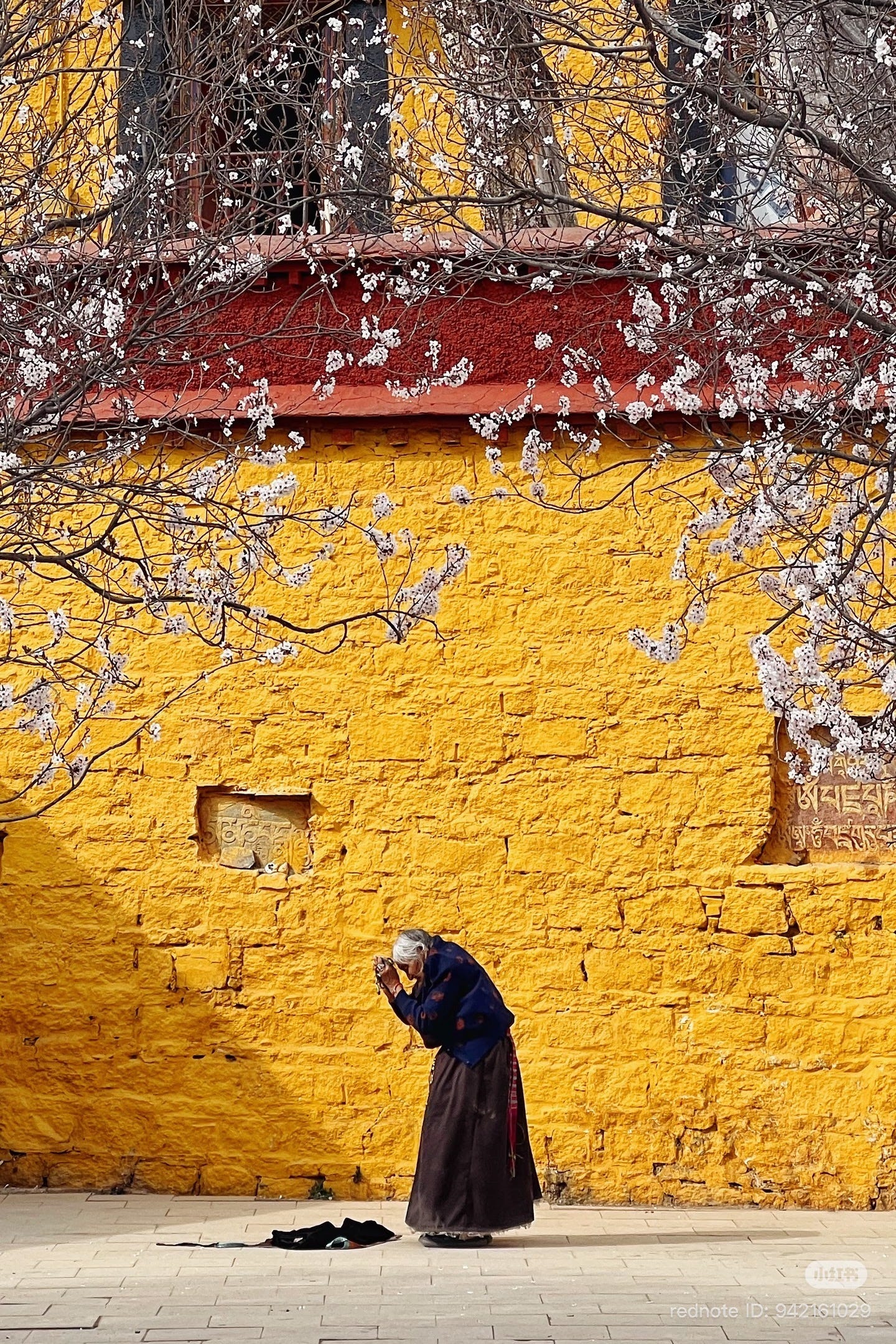
On the way to Shanghai, I watched a documentary about the Potala Palace.
It was the sort of film one watches half in travel fatigue, half in longing. The plane moves through one world; the screen opens into another. Men on scaffolds. Hands on wood. Pigments ground and applied according to inherited rules. Stairways, beams, ritual rooms, painted ceilings, surfaces repaired not because anyone imagined permanence, but because the work had been received and would be passed on.
The documentary did not sentimentalise eternity. The people in it knew perfectly well that lives are brief. A craftsman works on a beam and leaves. A restorer learns the old mixtures and one day forgets a face, a name, a season. The building remains not because any individual defeats time, but because a chain of attention holds.
That was what moved me.
Not immortality. Continuity.
There is a particular happiness in seeing a craft that knows how it travels. The hand does not need to invent itself from nothing. The apprentice does not merely consume instruction; he stands near a form long enough to be altered by it. He learns what cannot be adequately said: pressure, timing, restraint, the moment when a colour is not ready, the point at which repair becomes desecration, the difference between confidence and obedience.
A craft carried this way has a mercy modern life has largely lost. It tells the practitioner: you are not the whole story. You received something. You keep faith with it. You leave it in a condition that allows another hand to continue.
Later, in London, Shanghai, Suzhou, and the other clever rooms through which one now moves, I found myself unexpectedly irritated.
There were brilliant people everywhere. Economists, scientists, policy minds, founders, technologists, global health veterans, Chinese theorists of artificial intelligence and money, young people building strange new institutions at the edge of science. The conversations were alive. The future was not arriving as a slogan. It was sitting across tables, wearing ordinary clothes, exchanging cards, making claims too large for the room and sometimes exactly the right size for history.
And yet, underneath the pleasure, a small resentment rose.
Why is no young creature beside me learning the ropes?
Not attending the meeting. Not taking minutes. Not absorbing “content.” The ropes.
The little arts by which serious work is actually done. How to read the temperature of a room before speaking. How to tell when a clever person is performing intelligence rather than carrying consequence. How to leave a sentence unfinished so that someone else can enter it. How to identify the real decision inside a ceremonial discussion. How to let vanity pass without feeding it. How to distinguish a signal from a mood. How to preserve a dangerous thought without turning it immediately into a framework. How to know when a powerful person is asking for analysis, and when he is asking for permission. How to see that a beautiful idea is not yet ready for public weather.
These are not competencies. They are not modules. They are not “knowledge assets.” They are ropes.
They are learned by proximity.
Modern institutions are not good at this. They are very good at many other things. They can produce leadership programmes, competency frameworks, knowledge-management systems, slide decks, mentoring schemes, repositories, training calendars, onboarding packs, recorded webinars, AI summaries, searchable archives, and after-action reviews. They can preserve the artefacts of competence. They can store documents, tag concepts, map networks, and measure participation.
But they often cannot inherit judgment.
This is not because younger people are worse. It is not because elders are always wiser. Many senior people have nothing to transmit except habits of self-protection. Many young people see more clearly than those above them. Every generation mistakes some of its exhaustion for wisdom.
The problem is more structural.
Modern institutions have become suspicious of apprenticeship because apprenticeship is inefficient, unequal, slow, and difficult to justify. It depends on attention that cannot be easily counted. It requires a young person to stand near someone better for long enough to be formed, and an older person to permit that nearness without domination. It depends on trust, timing, repetition, minor embarrassment, correction, overheard judgment, and shared exposure to consequence.
No one knows where to put this in a workflow.
So we produce training instead.
Training teaches the visible part of a craft. Apprenticeship transmits the hidden relation between action and consequence. Training explains what to do. Apprenticeship teaches what a situation is asking. Training can be scaled. Apprenticeship must be endured.
This distinction matters more now because machines are beginning to master the visible part of competence.
An AI system can produce the briefing note, the summary, the literature scan, the meeting brief, the options paper, the polite email, the synthesis that sounds as though someone has lived with the material. It can produce the fifth draft without having suffered through the first four. It can imitate the surface of achieved boredom: the sober paragraph, the balanced caveat, the reasonable conclusion, the sentence that allows a meeting to proceed.
This is useful. It is also dangerous.
For a long time, societies used difficult artefacts as evidence of seriousness. The person who could produce the paper had usually encountered the problem. Not always; there were always frauds, courtiers, stylists, and clever people who could write fluently around ignorance. But effort still left marks. Drafting forced contact. Revision produced modesty. Friction gave weight.
When the artefact becomes cheap, the signal changes.
The question can no longer be only: who wrote this?
It must become: who can sign it?
Who has been changed enough by the problem to bear consequence for the answer? Who knows where the bodies are buried? Who remembers the failed version from ten years ago? Who has heard the objection that does not appear in the minutes? Who knows which sentence is too smooth because reality is rougher than that? Who has enough scar tissue to distrust the beautiful answer?
This is where apprenticeship returns, but in a different form.
The old apprentice learned by helping produce the artefact. The new apprentice may have to learn by standing near answerability. The machine may assist with production. It may even improve it. But someone must still learn judgment under consequence. Someone must still see how a serious person hesitates before signing. Someone must still learn that the real work begins after the document is ready.
That cannot be uploaded.
It can be described, but description is not transmission. A recipe is not taste. A map is not orientation. An archive is not obedience. A model trained on the works of a master may reproduce the master’s style, but it cannot place a young person beside the master at the moment when the room turns, the easy answer fails, and a small act of restraint preserves the future.
The loss of apprenticeship is therefore not nostalgic. It is institutional.
A civilisation can preserve knowledge and still fail to transmit judgment.
This is the uncomfortable threshold. We have never had more ways to store, retrieve, summarise, and recombine what people know. We have never been better at preserving traces. Yet traces are not lineage. Lineage requires a living relation between form and responsibility. It requires someone to say, not only “this is how I do it,” but “this is why I did not do the easier thing.”
I used to think this meant one needed a successor.
The word carries an old gravity. A successor is the one who receives the flame. The heir, the disciple, the young creature at the elbow who watches, absorbs, rebels properly, and eventually carries the work onward. The fantasy is beautiful because it is simple. One life pours into another. One craft continues through a recognisable line. The teacher is spared the humiliation of dispersal. The work does not vanish into air.
But perhaps the fantasy is also cruel.
It asks too much of the young. It asks one person to carry a whole weather system: temperament, method, duty, wounds, timing, language, and burden. It mistakes continuity for replication. It turns transmission into possession. It makes the elder anxious and the younger unfree.
Most modern work will not continue this way. The rooms are too fragmented. Careers move too quickly. Institutions rotate people too often. The old houses of craft have been replaced by platforms, projects, fellowships, postings, networks, chat groups, short contracts, and professional identities assembled in motion.
No one person comes after us.
This may be a grief. It need not be a failure.
A method can travel without a dynasty. A standard can lodge in someone who never calls himself a disciple. A question can become part of another person’s private discipline. A phrase can reappear years later, altered but alive. A young officer may remember not the full framework, but the rule that heat is not signal. A scientist may remember that the loop matters more than the paper. A policymaker may remember that some efficiencies are too socially expensive to accept. A reader may carry one sentence into a decision the writer never sees.
This is not succession in the old sense.
It is distributed afterlife.
One person carries a knot. Another carries a warning. Another carries a tone. Another carries permission to stop. Another carries the memory that competence without consequence is dangerous. Another carries the small discipline of asking, before analysis begins: what real decision is hiding inside this?
No heir. Many residues.
The task, then, is not to secure a successor. It is to leave the work in forms that can travel without asking one life to become another.
This requires a different release.
One must admit the grief of transmission. There is no need to pretend it does not hurt when no one has stood close enough to inherit the ropes. It does hurt. Especially when one has spent decades acquiring a craft that institutions needed but did not quite know how to house. Especially when the rooms remain alive and the body begins to speak of finitude. Especially when the young are clever, abundant, accelerated, and often unaccompanied.
But the grief must not become a claim.
The world does not owe us an heir. The young do not owe us the shape of our own unfinished longing. A craft is not honoured by turning it into a burden placed on one chosen back.
What remains is lighter and harder.
Teach when the moment is real. Place residues where they may germinate. Let a younger person learn one knot without inheriting the rope. Let a room be altered without requiring proof. Let the work travel badly, partially, unexpectedly. Release the fantasy that everything essential must arrive intact.
The Potala Palace remains because it belongs to a world that still understands direct continuity. Many of us no longer do. We work in institutions that forget even as they archive. We live among machines that can reproduce outputs without receiving discipline. We move through rooms where intelligence is plentiful and apprenticeship scarce.
So we must learn a smaller art.
Not succession.
Transmission without possession.
Continuity without an heir.
Residue without control.
The work was real if it changes what someone can notice. The craft survives if, somewhere, someone pauses before the smooth answer and asks where the scar is. The lineage continues if judgment, however dispersed, remains answerable to reality.
No one person comes after me.
That is not the end of the chain.
It is the end of the chain as fantasy.
"a civilisation can preserve knowledge and still fail to transmit judgment." So well put — I'll borrow it for an upcoming essay!
The distinction between training and apprenticeship you draw—training teaches what to do, apprenticeship teaches what a situation is asking—is the same wall the expert systems builders hit in the 1980s. They could capture the rules but not the judgment about when the rules didn't apply. We called it the AI winter and haven't climbed over it since. We've scaled around it.
What strikes me about this piece is the grief you name without sentimentalising. The distributed afterlife framing—no heir, many residues—is the honest version of what most institutions pretend doesn't apply to them. Residues over dynasties. That's a harder release than most serious practitioners manage.
I have an essay coming in a few weeks that approaches judgment from a different direction—why no civilisation imagined a god who dispensed judgment to the living. Your line about the Potala Palace holding not through immortality but through a chain of attention is the same argument, from the craftsman's end rather than the philosopher's.