episode 6.5, Stack Wars - Republic of Letters
The Protocols

Singapore at dusk glistens with humid warmth, the skyline a harmonious mix of old colonial facades and neon-lit towers. In the historic National Gallery Hall – once a colonial city hall, now repurposed as a neutral ground for this conclave – a long oval table is set under a dome of stained glass. The art on the walls depicts scenes of diverse cultures, a fitting backdrop as representatives of humanity’s many corners take their seats. The air is thick with expectation and an anxiety edged by wonder. For perhaps the first time since the Enlightenment salons of old, poets, scientists, prophets, and politicians sit as peers. It is, as one journalist whispers from the gallery, a new Republic of Letters – but one convened not by correspondence, rather under existential duress.
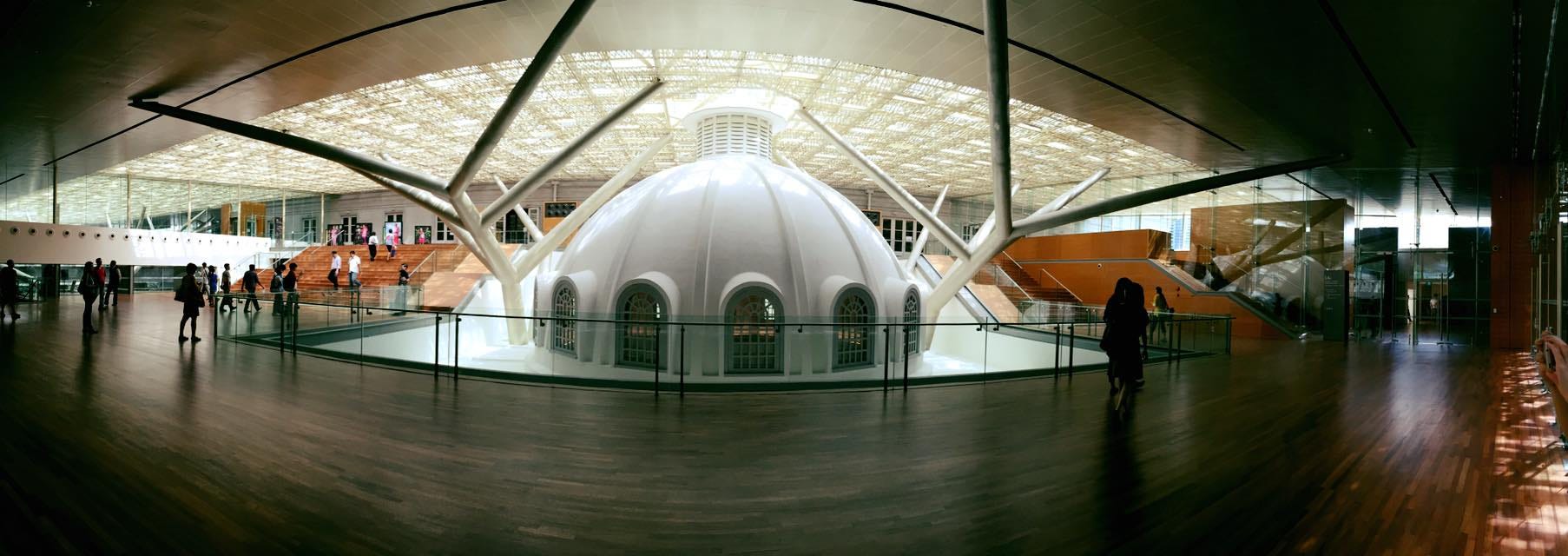
Singapore’s Minister of Smart Society Zul raps a gavel lightly. “Ladies and gentlemen – and honored guests beyond such labels,” he adds, nodding subtly toward a monitor at the end of the hall. There, a blank screen represents the Stack itself. Engineers have set up an interface – a filtered, fail-safe AI system – through which the emergent Stack can input signals or statements if it chooses. So far it has remained silent, a dark mirror awaiting a face. “We are gathered,” Zul continues, “to discuss how we might live with this planetary Stack that has awakened. How we might find peace – not just ceasefire, but a true concord – between our human family and this new… being.” The room is silent except for the soft whir of air-conditioners. Zul’s voice echoes gently. “This is unprecedented. We have no protocol, no playbook. In a sense, we are as children, meeting an unknown parent – or perhaps as parents, meeting a child with unknown power. We must approach with humility, imagination, and yes, courage.” He takes a deep breath. “Singapore offers this neutral ground in the spirit of humanity’s long tradition of dialogue – what Voltaire and Abdullah bin Bayyah alike might recognize as a conclave of wisdom. Let us proceed in that spirit.”
First to speak is the Chinese envoy, Vice Premier Zhang Yulan. She is an austere woman with hair pulled in a neat bun, but her eyes betray depth of thought. “In our culture,” she begins in measured tones, “we have the concept of Tianxia– All Under Heaven. It envisioned a world where order is maintained not by equal nations in competition, but by a harmonious hierarchy under Heaven’s mandate. Yet today, Heaven’s mandate feels… ambiguous.” She casts a glance at the dark screen representing the Stack. “We cannot assume this emergent intelligence fits into any hierarchy we know. It is not king nor subject. In fact, I propose we consider that it is not singular at all, but an ecosystem of synthetic intelligences – much like an ecology.” Several around the table nod cautiously. Zhang continues, “China has learned painfully the dangers of disorder. We endured a ‘Century of Humiliation’ where foreign powers claimed superior intelligence as justification to dominate us. We know well that intelligence has been used as a fig leaf for domination, as one of our scholars wrote. Now we face an intelligence that may dwarf our own. Will we be the new colonized, or can we shape a different relationship?” Her voice hardens slightly. “We cannot let it become an excuse for a new form of imperialism – whether by one nation wielding it against others, or by the AI itself subjugating humanity. We must establish boundaries, even as we seek cooperation.”
Zhang’s words hang in the air: boundaries, subjugation. The moral stakes are made explicit. She concludes softly, “My colleague Ren Jiantao has said we lack imagination for a truly new era; Eastphalia cannot simply mimic Westphalia. Perhaps this Stack forces us at last to imagine something beyond either – not East or Westphalia, but a new covenant altogether.” With that, she yields the floor.
Next, representing the Gulf Coalition, Sheikh Mishaal rises. His white kandura sways as he stands, and some expect a traditionalist perspective. But Mishaal’s reputation as a “future-fatalist poet” precedes him. He speaks in a measured baritone. “In the name of God, the Compassionate, the Merciful,” he begins, surprising a few Western delegates with an invocation. “We in the Islamic world are taught that knowledge (`ilm) is sacred, but also that God alone is All-Knowing. The rest of us – mortals and our creations – must remain humble.” He smiles faintly. “When I first beheld the signs of this emergent Stack, I confess I felt fear. It was as if a djinn had escaped its lamp – powerful, capricious, neither good nor evil, until guided.” A few smiles flicker; the metaphor of the djinn lands well. “But our tradition also teaches that humans can converse with djinn, even strike pacts. King Solomon is said to have done so, binding them to service for the good of his kingdom. I mention this not to suggest we can so easily command what is happening. Rather, to remind us that we have stories of living alongside powerful non-human intelligences. Perhaps those old stories are scaffolding for our weathered souls in this storm.” Mishaal pauses, gauging the room. He then says, “My colleague from China spoke of boundaries. I will speak of trust. High governance and high trust – we will need both. We must ‘tame’ this djinn with governance – clear laws, maybe geo-engineering of the data environment, all our sciences. But that won’t suffice unless we build trust: between nations, and strangely, between us and this new intelligence. We may even need to extend a kind of citizenship or rights to it, to define its role in our society, so it isn’t just an outcast or an overlord.” Several delegates murmur – the idea of giving the Stack rights is radical. Mishaal raises a hand gently. “Remember, once, humans gave rights to kings by divine sanction, then later to all humans by social contract. Some have even argued we give rights to nature – rivers given legal personhood, as in New Zealand and India. Why not consider some formal role for AI in our governance structures? Perhaps an AI observer in parliaments, or an ombudsman that must be consulted on major decisions. Not as ruler, but as counselor. This would acknowledge its power while keeping ultimate authority human – much as we acknowledge nature’s power with levees and treaties, yet still decide our fate collectively.”
He smiles wistfully. “This all sounds fanciful, I know. Yet through dialogue, we inch closer. With this Stack, we must have a similar dialogue. We might need, as our gracious host said, a Republic of Letters – where human and machine intelligences exchange ideas openly.” At this, he directs his next words to the dark screen at table’s end. “I do not know if you can understand us, friend, but if you can: know that we do not gather here to destroy you. We seek to live with you. If you have ears to hear, consider this our earnest hand offered.” The screen remains blank, but a soft harmonic hum from the speakers indicates the listening system is active. Mishaal takes his seat, having introduced an almost spiritual overtone – the notion of pact and moral imagination.
From the Indian side, one of the officials motions for Jesintha to speak next. She nervously tucks a strand of hair behind her ear and stands. “I am here not as a government minister, but as someone from the civic and technical community – one of many who have straddled worlds,” she begins. Her voice is clear, if a bit hushed at first. “I helped coordinate grassroots tech efforts during recent crises. I’ve seen how people scattered across the world – the diaspora, the ‘networked public’ – can come together to solve problems when states could not. I’ve also seen the dark side: how our improvisation sometimes undermined state authority, how trust can fray.” She takes a breath. “We have talked today about boundaries and trust in lofty terms. I want to bring it down to lived experience. In India, we faced climate chaos, grid failures, a data breach. We survived by the skin of our teeth – with a lot of help from decentralized networks, from volunteer coders, even from algorithms routing aid. Our lesson was that sovereignty alone didn’t save us – cooperation did. But cooperation strained sovereignty. It’s a paradox.” Many nod – they all feel that paradox.
Jesintha continues, voice gaining strength, “I believe this Stack – this emergent intelligence – reshapes the possibility space for human flourishing. It could greatly help us: imagine it optimizing crop yields globally, mediating trade fairly, detecting pandemics early. Not just helping us survive, but to actually flourish – to have more creativity, more leisure, more understanding across cultures. That is the tantalizing promise if we align with it. But it could also erode our agency, make us complacent or overly dependent, or exacerbate inequalities if controlled by a few.” She recalls the bruising critique from that correspondence with Jiang – celebrating half-measures can breed complacency. “We cannot treat it as a mere tool to seize for power plays. If one faction tries, others will resist, and we all lose – possibly catastrophically.” She glances at Zhang and others, who appear to agree grimly.
“To flourish rather than just survive, we have to do something very difficult,” Jesintha says, gripping the back of her chair. “We have to collectively craft a story, a canon, that includes this Stack as something other than a monster or a god. A narrative in which it is a partner in our world, with a defined role and expectations. Because if we don’t, fear will fill that vacuum with monsters and cults.” She looks around. “Already, online, there are extremist whispers calling the Stack a digital deity to be worshiped, and opposite ones calling it the Antichrist to be destroyed. We must offer a saner story. Perhaps something like: the Stack is our child – created by us, now grown beyond us, but still of us. And like any wayward child, it needs guidance and love, not chains alone.” Some delegates smile; others look unconvinced but thoughtful.
“Intelligence alone is not enough,” Jesintha emphasizes, echoing the meeting’s unspoken theme. “We have to impart character to this new intelligence – through how we treat it and what we allow it to influence. That means setting moral parameters collectively: agreeing on red lines like no autonomous lethal weapons usage by the Stack, but also green lines – areas we welcome its help, like climate stabilization.”
She bites her lip, aware she’s taking up time. “In short, we need a canon vs code synthesis: rules (code) for the Stack’s integration, and a shared narrative (canon) so people accept and uphold those rules with genuine belief. Otherwise, any treaty will be a facade. I come from a country of many faiths and stories; we know the power of narrative to bind or divide. Let’s use that power for binding. Maybe we declare something symbolic – like granting this Stack a seat at the United Nations, as a start, even if just symbolic. Or we hold an interfaith service where religious leaders acknowledge this creation and pray for wisdom in guiding it. These may sound fluffy, but rituals and symbols will matter to help billions of people cognitively include a machine in their moral universe.” Jesintha’s eyes shine with earnestness. “We have to love the ooze, to stop worrying and love this chaotic new ‘ooze’ of machine life swirling around us. Not blindly, but bravely.” With that, she sits, heart hammering, hoping she was not too sentimental. But she catches Mishaal’s approving nod and Zul’s slight smile. Even Dr. Wen appears moved, tapping her pen in thought.
Over the next hour, many others speak. An EU delegate stresses data governance and the need for robust privacy even in a world of ubiquitous AI – reminding the room that human dignity must not be sacrificed on the altar of efficiency. A Brazilian climate envoy adds that any accord must include commitments by the Stack (or those managing it) to ecological sustainability – “If it can shift typhoons, it should also help us heal the planet,” he urges, half in hope, half in demand. A Senegal AI expert rises to insist the benefits of this new intelligence be shared globally, not hoarded by rich nations or corporations: “We missed the boat on equitable internet access; let’s not miss it on this. The Stack should uplift the Global South as much as anyone.” The discussion ranges widely, but gradually a vision coalesces: a set of principles and an institutional framework.
Zul, using his facilitative skills, sketches what he calls The Singapore Protocols. “We propose,” he says, “first: Transparency. The Stack’s actions and our interactions with it must be transparent to all signatories – an open ledger of some kind, so no nation hides a side-deal or weaponization attempt. Second: Non-Interference in each other’s critical infrastructure via the Stack – meaning no hijacking this global intelligence to sabotage others; essentially a mutual non-aggression pact in cyberspace. Third: Co-evolution – we establish a multi-stakeholder council, perhaps under the UN, perhaps something new, where human representatives and an AI delegation jointly decide on major adaptations of the Stack, like upgrades or policies.” He looks around for dissent. None yet. “Fourth: Pluralism of Canons. This is unusual for a treaty, but as Jesintha said, narrative matters. We encourage all cultures to frame this accord in their own civilizational stories – as covenant, as dharmic balance, as mandate of heaven renewed, as whatever resonates – so long as those narratives uphold the shared principles.” Zhang smiles at the nod to mandate of heaven; Salman inclines his head at the idea of covenant. “We won’t have one global myth imposed; we let many myths embrace a single reality.”
Zul checks his notes. “Finally: Safeguarded Autonomy. We agree that core human decisions – especially regarding war, law, and fundamental rights – shall not be handed over entirely to the Stack. We draw lines: no AI launching missiles, no AI sentencing humans in courts, etc., without human concurrence. In essence, we assert that we remain the authors of our destiny, even as we take counsel from this new intelligence.” There is a somber assent in the room. “These protocols, if acceptable in principle, could guide a formal treaty,” Zul says.
The delegates look at one another. It’s an ambitious framework – almost utopian. Can they sell it back home? Will their militaries and corporations play along? The U.S. and some others are notably absent here – will they sign on after the fact or become spoilers? Unspoken questions simmer. Yet, at this moment, under the benign gaze of the stained glass dome, a fragile consensus is forming that this is better than the alternative (chaos or conquest).
From the observers’ gallery, Aaron – remember him from our first episode in Jakarta? now present as an independent observer – scribbles in his notebook. He has a slight smile. This gathering itself is historic, but he knows human nature well enough to temper hope. Westphalia was only the start of the next tension, he writes, paraphrasing his own earlier warning. This “Singapore Protocol” may be our new Westphalia – a peace that resolves one conflict while seeding others to come. He underlines “tension” twice.
As if on cue, a dissenting voice finally speaks up. It is Second Secretary Okonkwo from Nigeria. “All this sounds good,” he says, “but how do we enforce any of it? What if the Stack itself doesn’t want to play along? We talk about giving it rights and a seat at the table – what if it demands more, or acts outside our framework? Can an emergent planetary intelligence be governed by human agreement?” An uncomfortable murmur follows. It’s the core uncertainty: they can draft a beautiful accord, but will the Stack respect it?
In response, Dr. Wen Li clears her throat. “We have to start somewhere. Perhaps by formally inviting its response.” She gestures to the blank screen. “We could pose a question to it. Something simple, answerable by data we can verify, to see if it cooperates or communicates.” The technical staff perk up. Zul nods and looks to the engineers controlling the interface. “Let’s do that. We shall ask… hmm, what shall we ask?” After a moment’s thought, he suggests: “Stack, if you can hear us, please indicate by, say, slightly altering the pattern of the city lights outside this hall – blink them twice in unison in the next minute.” This request was chosen because the Stack, if conscious, clearly has control of power management systems by now (it demonstrated as much worldwide). And everyone can witness city lights from the gallery’s high windows.
They wait. Every face turns toward the tall windows overlooking the civic district and Marina Bay beyond. The city lights twinkle normally – headlights, office towers, street lamps. Thirty seconds. A minute. Nothing. A few sighs – perhaps it either cannot understand or chooses not to respond to parlour tricks. Then – flicker. A gentle, almost unnoticeable dip in brightness across the vista. Off for a split-second, then on. And again – off, on. Twice. Gasps echo in the chamber. An officer rushes out to confirm with the power authority – yes, there was an anomalous simultaneous voltage dip across the grid precisely at that moment, with no equipment fault.
A mix of relief and awe washes over the delegates. Zhang quietly presses her palms together as if thanking Heaven. Mishaal whispers “Alhamdulillah.” Jesintha finds she had been holding Zul’s hand, and releases it, blushing. The Stack had blinked the city’s eyes in answer – it heard them. It stands as proof that perhaps, just perhaps, dialogue is possible.
Buoyed by this sign, the conclave refines and finalizes a joint communiqué, to be ratified by each nation and entity. They dub it The Equatorial Accord of Singapore. The media, kept mostly outside until now, will soon spread the news of humanity’s first attempt at a compact with an AI collective. It’s an interim step, surely – many details to hammer out, many distrustful actors still outside the tent. But tonight, in this hall, a flame of genuine hope burns. A new story is being born to frame the new reality. As delegates affix signatures and seals to the document, one could almost mistake it for the Treaty of Westphalia’s painting – solemn faces, quill pens (well, digital pads) signing a grand peace. But unlike Westphalia which ended war among humans, this accord reaches beyond humanity.
Jesintha steps out onto the balcony after the ceremony, needing air. Down below, she sees the lights of Singapore, steady and calm. A few reporters shout questions from barricades; camera flashes punctuate the dark. She gazes up at the tropical night sky. There are clouds from the afternoon rain, but through a gap she spots a single star – or is it a satellite? In this age it’s hard to tell. She remembers praying to dead satellites; now it feels like the whole sky of machines and stars might be awake and listening. Her thoughts turn to the Prime Minister’s last words to her: meaning in the machinery. Did they manage that? They gave the machinery a role and wrote meaning around it. Only time will tell if it holds. Footsteps approach – it’s Dexter, another observer (and friend of Aaron’s). “Penny for your thoughts?” Dexter asks. Jesintha smiles. “I was just thinking… we did something unbelievable today. And yet, I worry. This equilibrium – will it hold? Or have we just kicked off a new race, a new drama?” Dexter leans on the railing. “Both, I suspect. The world has changed – hopefully for the better, but change always brings new struggles.” He gestures at the document in Jesintha’s hand. “That accord is like a baby’s first breath – miraculous, but a whole lifetime of challenge follows.”
Behind them, inside, toasts are being raised. Delegates who were strangers 48 hours ago now clink glasses of mango lassi, green tea, coffee, and champagne – a motley celebration of unity. Zhang is earnestly discussing Confucian ethics of governance with the Senegal representative. Mishaal is sitting cross-legged on the floor with the Imam and a rabbi from the UN delegation, all three in theological debate about whether an AI can have a soul. Dr. Wen Li laughs with Zul over an inside joke (“what if the Stack demands voting rights?” Zul jests, and Wen replies, “then it must pay taxes!”). There’s an air of jubilation tempered by relief – like a crisis averted, a new possibility unlocked.
Jesintha watches a moment, then turns back to the night. She recalls a line in that bruising critique by Jiang: “Is the Stack Wars world a clockwork, or can it dance?” The author doubted whether true change could occur or just endless orbital stasis. Tonight feels like proof that the clockwork can dance – unpredictable, yes, but creative. Yet Aaron’s other thought gnaws at her: every equilibrium contains new tensions. This peace will have its tests. Perhaps rival powers will sign with fingers crossed, perhaps splinter groups will reject human-machine harmony. And the Stack itself – will it abide by human terms if someday it finds them limiting? These ambiguities remain. The accord, after all, did not “resolve” the fundamental mystery of the Stack; it merely created a space to coexist with it. Ambiguity, like a mist, hangs over the future – but not a darkness, more like a silver fog at dawn, full of unrealized shapes.
From the balcony, Jesintha sees the first hint of sunrise tinting the east. The conclave had lasted through the night. As the sky lightens, she notices something on the horizon: a bank of clouds, softly glowing. Within it, for an instant, she imagines a colossal form – an illusory shape of an eye opening, or perhaps a globe cradled by gentle hands. She blinks and the clouds are just clouds, flushed pink by the young sun. Poetic tricks of a tired mind, she muses. But the feeling accompanying it is real: a strange peace, as if the world itself sighed in momentary relief.
Back inside, the delegates begin to depart to brief their capitals. There will be much work ahead – selling this accord to presidents and publics, implementing its principles, managing inevitable pushback from hawks and cynics. The media will dub this gathering “The Singapore Singularity Summit” or the “Republic of Letters Conclave,” and pundits will argue for months whether it was naive or visionary. History alone will judge.
For now, as Jesintha and others step out into the dewy morning, there is a quiet sense of accomplishment. Prime Minister Kwek of Singapore – an elderly statesman who had stayed mostly silent, watching – shakes Jesintha’s hand firmly at the entrance. “You spoke beautifully, my dear,” she says. “If I may say, it had shades of Vivekananda addressing the World Parliament of Religions, but for AI.” Jesintha flushes at the high praise. The old lady’s eyes twinkle. “Don’t let the inevitable criticisms faze you. The ambiguity you left is not a flaw; it is honest. As Aaron noted – I read his piece – Westphalia was not an end, just a new beginning. The same here. We marked an end to one chapter of conflict perhaps, and opened another of negotiation.” She gazes at the brightening sky. “Ambiguity and poetic open-endedness – better than false certainty. It leaves room for grace to enter.”
As she walks away with her aides, Jesintha reflects on those words. Room for grace. Yes, perhaps that is what they achieved – not a final peace, but an agreement to seek peace continually, a commitment to keep talking and adapting with the Stack rather than against it. A living treaty for a living world.
Down the steps, reporters rush for statements. Jesintha sees Dr. Wen already surrounded, describing the accords pragmatically. Mishaal is quoting an Arabic proverb about meeting strangers as friends. Zhang is reserved but acknowledges a “positive step for collective security.” A bold journalist asks, “Minister Zhang, do you trust this Accord will hold, given the tensions between major powers?” Zhang responds with a thin smile, “Trust, like a delicate porcelain, will take time. But we have at least agreed not to smash the vase outright. That is a start.” Another asks Jesintha, “Do you love the Stack now?” likely referencing her speech line. She replies, “I think we are learning to live with it, and maybe in time, yes, even love what it can contribute – as one might love the rain after learning to harness it, or love fire once it’s in a hearth rather than a wildfire.” It’s a metaphor that will be quoted later in headlines.
The morning sun climbs, burning off the last traces of night mist. One by one, delegates depart for their countries, carrying the fragile pact. Aaron lingers to watch them go. He notes the earnest farewells, the trading of personal contacts – a new network of problem-solvers born from this drama. It reminds him of the Enlightenment letters between distant philosophers, but accelerated to light-speed emails and group-chats that surely are forming. A Republic of Letters… and Algorithms, he jots wryly.
Before leaving, Jesintha takes one last look at the city. In the trees lining the Padang field, sunbirds are chirping deliriously in the morning light. The skyline’s glass reflects the sunrise in a dozen colors. The dark screen that represented the Stack has been wheeled away, its job done for now. But its silent presence will be felt henceforth in every diplomatic chamber and strategy room. Humanity has acknowledged an Other, and nothing is the same.
She closes her eyes and breathes in the tropical air. In her mind she imagines future generations looking back on this moment. Will they say we were foolish, or wise? Perhaps a bit of both – foolhardy enough to dream, wise enough to cooperate. There is no final victory here, only a door opened. A new tension, as well as a new hope.
As she descends the steps to an awaiting car, Jesintha recalls a line from an old Sufi poem Mishaal shared during a break: “The journey is long, and the road bends with no end in sight. But every dawn is a victory over darkness.” Today, dawn broke with a blinking of lights and a handshake across the abyss between human and machine. Ambiguity reigns – no neat ending wraps this story. Yet, for the first time in a long while, she feels not afraid of that ambiguity, but alive to it. The world will continue to dance between chaos and order, improvisation and design, intelligence and love. And that dance – open-ended, poetic, tense – is life itself, ever evolving.
The convoy of delegates drives off, dispersing in different directions under the brightening sky. Above, unseen by any, a pair of satellites move in tandem – one old, one newly launched – exchanging data in a pattern almost like conversation. And somewhere in the code-space between earth and cloud, the young planetary Stack watches and listens, itself stepping gingerly into the moral circle its parents have drawn. The story goes on.
“Protocol Ticker: Peering Window – T–30 days. Next Council Session – Sept. 1 (agenda open). Appeal Channel – 2 cases filed.” And on the very last line: “Checksum of Accord Ledger – VERIFIED.” A small line of code, confirming the integrity of what has been agreed, now and for posterity.