The Dashboard Cannot Discover

The first strange thing about the new management dashboard is not that it is wrong.
Wrong would be comforting. Wrong would let managers laugh, correct the hallucinations, complain about the consultants, and return to the familiar world in which human judgment still proved itself by catching the machine’s mistakes.
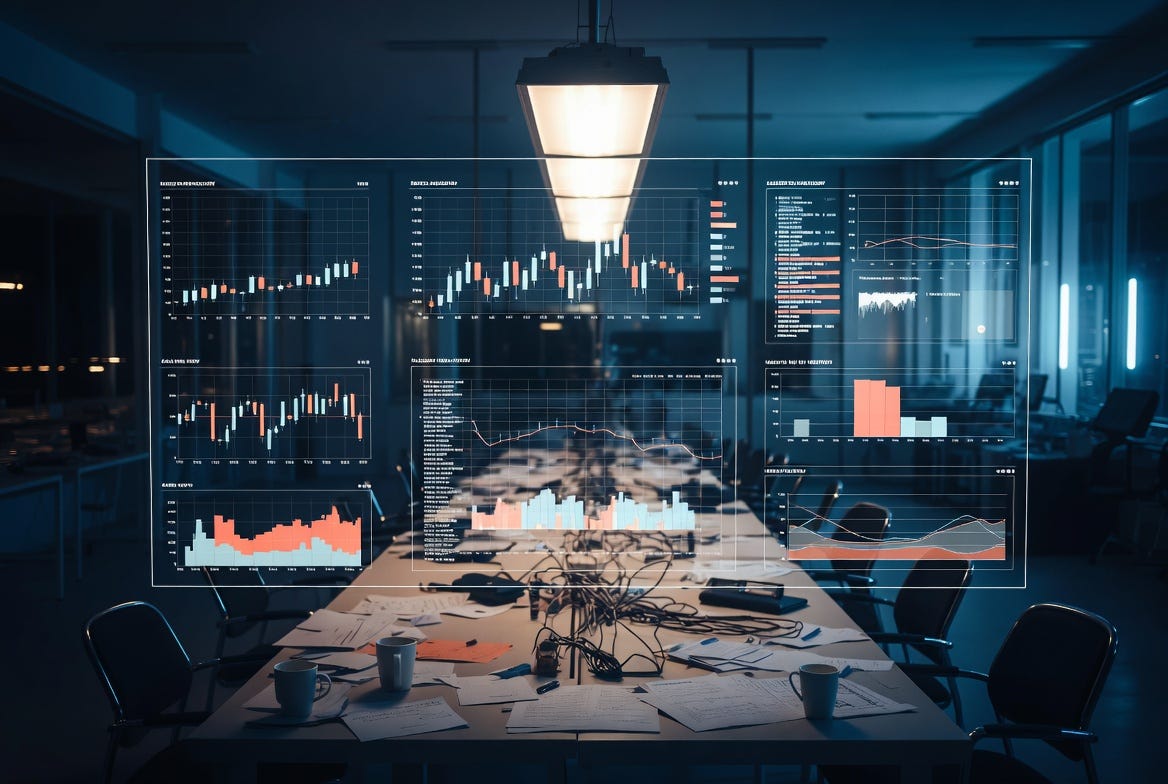
The disturbing thing is that the dashboard is often right.
The weak team is weak. The delayed project is delayed. The customer complaint is real. The rising employee is rising. The meeting probably was unnecessary. The manager has likely been spending too much time translating information a model can now summarize in seconds.
Nothing obvious has gone wrong.
And yet something has been displaced.
A company is not only a set of builders and sellers, with a layer of measurers sitting uselessly between them. That is the fantasy of the impatient executive: that most people exist to observe, report, delay, and obscure. Some of this is true. Organizations are clogged with ritual, alignment theatre, and human middleware. Some managers are bad routers with authority. Some meetings are a tax on life.
But the dangerous thing about a half-truth is that it knows where to wound.
Middle management is not valuable because managers are noble. It is valuable because firms are not machines that already know themselves. They are living arrangements for discovering what they are doing.
A manager is the place where partial realities meet: the customer’s anger, the junior’s uncertainty, the supplier’s excuse, the engineer’s suspicion, the finance constraint, the old mistake nobody wrote down, the thing the dashboard cannot yet see because it has not become a metric. The manager does not merely measure these things. She absorbs them, compares them, argues with them, carries them into a room, and decides which of them matter.
That is not measurement.
That is discovery.
Price works the same way. A price is not only a number. It is the compressed surface of a vast sensory apparatus: currency, banking, corporations, insurance, risk, speculation, credit, logistics, time, trust, failure. The number appears clean because the world beneath it is dirty. Price discovers because many actors remain exposed to consequence.
The mistake of central planning was not that planners lacked numbers. They had numbers. The mistake was believing the numbers could replace the encounters through which economic knowledge is formed.
A firm can now make the same mistake about itself.
It can keep the dashboard and lose the encounter.
AI makes this irresistible. It summarizes the meeting, scores the team, detects the delay, maps the workflow, flags the underperformer, identifies the customer risk, and produces the operating review before anyone has had to suffer through the material long enough to become serious. The centre sees more, faster, with less dependence on the awkward, biased, expensive humans who used to carry local reality upward.
For a while, this looks like intelligence.
The firm becomes flatter. The CEO has better tools. The manager has more direct reports. The reports are cleaner. The red flags arrive earlier. The language improves. The operating cadence tightens. The company congratulates itself for removing bureaucracy.
Then, quietly, the firm begins to forget how it learns.
The eliminated layer was not only overhead. It was apprenticeship. It was memory. It was the place where young people learned how the business actually worked, not as a process map but as a field of consequences. It was where judgment was formed by repeated exposure to ambiguity. It was where someone learned that a customer’s calm sentence was more dangerous than a complaint, that a supplier’s cheerful confidence meant panic, that a technically correct answer would destroy trust, that the metric was improving because the work had been displaced somewhere less visible.
The dashboard can report the residue of these judgments.
It cannot reproduce the conditions that formed them.
Financialisation did something similar to industry. It did not simply destroy factories. It taught firms to see themselves through measures that were locally intelligent and strategically blinding: return on equity, asset-light models, quarterly margin, inventory discipline, capital efficiency, outsourcing gains. None of these numbers was stupid. That was the trap. They showed something real while hiding other realities: tool-chain competence, supplier depth, shop-floor memory, process improvisation, the dignity of boring production, the slow accumulation of people who know why something fails before the failure is visible.
The West kept the balance sheet and lost the factory.
Decades later, it discovered that the “low-value” layer had been the learning layer.
AI may do the same to white-collar firms. It may let them keep the dashboard and lose the judgment. It may let them extract the recipe and fire the cook. It may preserve the appearance of coordination while hollowing out the human ecology through which coordination becomes wise.
This is not an argument against AI. AI can remove drudgery, widen memory, and let more people see patterns once trapped inside hierarchy. It can help juniors learn faster, managers orient better, and firms recover knowledge that used to disappear into email, meetings, and fatigue.
But that is only the good version if AI enlarges the field of judgment.
The bad version is different. It uses AI to concentrate sight upward. It turns measurement into command. It gives the centre a clearer map and calls that management. Drucker understood the danger long before AI arrived. Measurement, for him, was meant to help people govern their own work, not become the instrument by which the superior dominates the subordinate. Reports and procedures should be tools for the people doing the work, not verdicts on their worth.
The question is not whether AI can measure more. Of course it can.
The question is whether measurement remains inside a living practice of judgment, or becomes a substitute for it.
A company without managers is not necessarily a company without bureaucracy. It may become something worse: a company where bureaucracy has been made invisible, automatic, and harder to argue with. The human manager could be petty, vain, foolish, protective, wise, corrupt, generous, tired, or brave. But she was there. She could be confronted. She could be persuaded. She could learn.
The dashboard does not learn in the same way.
It updates.
That is not nothing.
But it is not the same.
The opposite of central planning is not the market.
The opposite of central planning is preserved contact with reality.
Price is one way of preserving that contact. Management is another.
Destroy either, and the numbers may improve for a while.
They simply stop learning what they mean.