The Listed Frontier
What a planet becomes an asset class

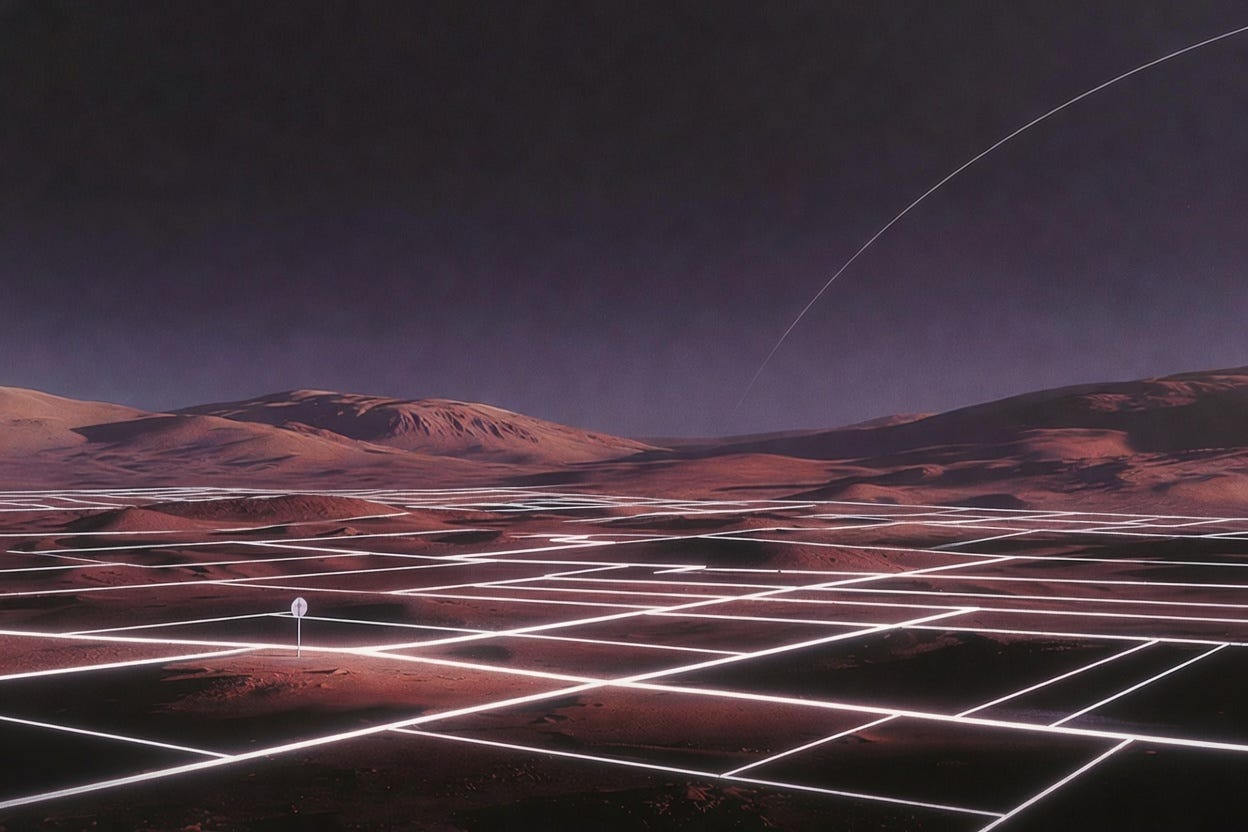
There is a moment when a fantasy stops being fantasy not because it has become real, but because it has become financeable.
Mars has not been settled. Asteroids have not been mined at industrial scale. The Moon has not become a manufacturing base. But the legal, financial, and ideological machinery for treating extraterrestrial terrain as future property is already being assembled. The dream is no longer simply exploration. It is not even merely colonisation. It is the conversion of the frontier into an asset class before the frontier has become a society.
That is the deeper significance of Rainer Zitelmann’s New Space Capitalism: The Entrepreneurial Path to the Stars, published in June 2026 with a foreword by Newt Gingrich. The book presents itself as a defence of private enterprise in space. Its official framing is direct: private spaceflight, led by firms like SpaceX, will succeed where state space programmes became bureaucratic, and the real breakthrough will come only when there is a legal framework for buying and selling land on celestial bodies.
Read conventionally, the book is an optimistic manifesto for space capitalism. Read more coldly, it is a primary-source document of the new American frontier imagination.
Its argument is simple. NASA and other state agencies opened space, but then stalled. Bureaucracy, cost-plus contracting, political pork, institutional caution, and regulatory constraint smothered the future. Entrepreneurs restored momentum. Musk, above all, changed the tempo. Reusable rockets, vertical integration, fixed-price contracting, Starlink, Starship, and eventually Mars settlement form the new sequence. The state should step back. Private capital should step forward. Property rights should provide the incentive structure. Space, the book insists, must become open to ownership, exchange, risk, profit, speculation, and settlement.
This is not a small claim. It is not merely that companies should launch rockets more cheaply. It is that capitalism must be allowed to perform the constitutional work of expansion.
That is where the book becomes revealing.
It says “private enterprise,” but the thing it actually imagines is not private in any simple sense. Space capitalism requires launch licensing, spectrum allocation, export control, defence demand, NASA procurement, treaty interpretation, liability frameworks, index inclusion, public-market liquidity, tax treatment, and ultimately some recognised authority capable of saying which claims are valid and which are not. The state is rejected as operator, then immediately required as guarantor, registrar, treaty interpreter, insurer, tax legislator, and shadow sovereign.
Space capitalism does not abolish the state. It rebundles the state around the company.
This is where the SpaceX IPO comes in. SpaceX’s Nasdaq debut on 12th June 2026, and its rapid addition to the Nasdaq 100 from 7 July, were not only financial events. Reuters reported that Nasdaq had relaxed entry requirements and that JPMorgan estimated index inclusion could draw around $4.3 billion in passive inflows. SpaceX had reported a $4.9 billion net loss the previous year, yet its inclusion could still force immense passive demand from funds tracking the index.
That is the listed frontier.
Not merely a company raising money, but a company whose frontier promise becomes embedded into the retirement accounts, ETFs, benchmarks, and passive flows of the existing financial system. The risk of Mars, Starship, Starlink, defence integration, orbital infrastructure, and eventual off-world settlement is no longer borne only by venture capitalists and true believers. It is absorbed into the machinery of public capital.
The public market becomes treasury.
The fantasy becomes balance sheet.
The frontier becomes index weight.
Newt Gingrich’s foreword says the quiet part loudly. His imagination is explicitly American-frontier: wagon trains, scouts, settlers, private initiative, mapped terrain, tax incentives, risk-taking, and the legal structures necessary for ownership. He even argues for aggressive tax treatment: complete write-offs for space manufacturing and tourism, and decades without taxes on profits from space manufacturing and tourism. In other words, the state should not own the frontier; it should subsidise, protect, and legally enable those who do.
This is the old Homestead Act grammar translated into rockets and securities.
The 1862 Homestead Act turned land into a settlement machine. It made a continental project administratively legible: survey, allocate, occupy, improve, own. The frontier was moralised as liberty, but operationalised as title. Zitelmann’s book wants something analogous for space. The afterword makes the comparison explicitly: without property rights, settlement slows; with recognised claims, incentives appear.
But a planet is not a prairie. And even the prairie was never empty.
The romance of frontier capitalism depends on a productive forgetting. It remembers the settler, the homesteader, the entrepreneur, the speculator, the engineer, the inventor. It forgets the cavalry, the surveyor, the treaty, the court, the land office, the army, the tax regime, the extinguished prior claims, the violence that made title believable. A claim becomes property only when enough institutions agree to treat it as real.
This is the missing centre of the space-capitalist imagination.
The Outer Space Treaty says outer space, including the Moon and other celestial bodies, is not subject to national appropriation by sovereignty, use, occupation, or other means. The Moon Agreement goes further in a more redistributionist direction, describing the Moon and its natural resources as the common heritage of mankind and envisaging an international regime to govern exploitation when feasible. The Artemis Accords, by contrast, preserve the language of the Outer Space Treaty while developing operational devices such as safety zones, due regard, and resource utilisation. NASA describes those zones as temporary and tied to actual operations, not formal territorial sovereignty.
This is the hinge.
The old law says: no sovereignty.
The new practice says: no interference.
Between them sits the future of property.
A safety zone is not a deed. A mining operation is not a country. A habitat is not a state. A resource claim is not sovereignty. But political order often begins in these in-between forms. First comes a functional exclusion. Then a logistical dependency. Then an insurance requirement. Then a liability rule. Then a registry. Then a financing instrument. Then a secondary market. Then a court or arbitration mechanism. Then a security guarantee. By the time anyone asks whether sovereignty has arrived, the system may already be operating.
This is why the phrase “private property in space” is both too crude and too honest.
Too crude because no serious legal order can simply hand Mars to a company like a suburban lot. Too honest because settlement at scale will require durable exclusion, transferable claims, enforceable contracts, inheritance, collateral, insurance, taxation, dispute resolution, police power, and ultimately some recognised relationship between land, law, and force.
The frontier is not opened by rockets alone.
It is opened when law, capital, violence, and narrative agree that a claim is real.
Zitelmann’s book wants private property because it understands, correctly, that exploration alone does not create settlement. Scientific missions can visit. Flags can be planted. Robots can map. Governments can demonstrate. But human settlement requires a metabolic system: energy, shelter, labour, food, repair, reproduction, waste processing, credit, expectation, and time. A colony is not a mission extended indefinitely. It is a system that can continue after the original sponsor stops paying.
The book’s strongest instinct is that without an economic engine, there is no settlement.
Its weakness is that it imagines property as a market solution rather than a sovereignty problem.
Property is not merely the right to use. It is the right to exclude, transfer, finance, defend, and inherit. Those rights do not float freely in the vacuum. They require a legal and coercive surround. A Mars land claim held in a real estate investment trust would not be “private” in the pure libertarian sense. It would be a stack of Earth-based recognitions: corporate law, securities law, contract law, treaty interpretation, tax treatment, insurance underwriting, enforcement jurisdiction, and geopolitical tolerance.
Before Mars becomes a city, it may become a prospectus.
Now that, that is the astonishing thing.
The new frontier does not have to be physically occupied before it becomes financially active. Claims can be securitised in anticipation. Infrastructure can be capitalised before completion. Scarcity can be narrated before settlement. Future exclusion can be priced before it is enforceable on the ground. A planet can enter the market first as story, then as option, then as balance-sheet asset, then as territorial practice.
This is not science fiction. It is the normal behaviour of capitalism when it encounters a new domain.
Railways did this. Mines did this. Cables did this. Oil concessions did this. Carbon markets do this. Data centres do this. AI compute now does this. The machine does not wait for reality to mature. It creates a forward claim on reality, prices it, trades it, then reorganises institutions so that the claim becomes harder to dislodge.
This is what SpaceX represents in its most advanced form.
SpaceX is not just a rocket company. It is a vertically integrated frontier operator. It builds launch capacity, satellite infrastructure, broadband networks, defence-relevant systems, crew transport, lunar and Martian ambitions, and a myth of civilisational continuity. It is contractor, platform, infrastructure provider, military-adjacent actor, public-market object, and settlement imaginary. Its valuation is not only about revenue. It is about being treated as the company through which a future domain becomes reachable.
That is why the state cannot simply discipline it as an ordinary vendor.
A normal contractor can be replaced. A frontier operator becomes infrastructurally entangled. Once a company becomes the route, the state becomes dependent on the company’s continued functioning. It may still regulate, bargain, threaten, or investigate. But it cannot easily break the operator without damaging its own future options.
This is the deeper political economy of the listed state.
The charter is asset.
The public market is treasury.
The launch stack is territorial access.
The network is jurisdictional atmosphere.
The founder is envelope.
The state is guarantor.
And the frontier is collateral.
The contrast with China clarifies the form. The American imagination concentrates around the heroic operator: SpaceX, Musk, Starship, Mars, the IPO, the public market, the legally liberated frontier. The Chinese model is less mythic but more ecological: local governments, industrial parks, state-owned spillovers, private firms, subsidies, supply chains, launch startups, satellite manufacturers, applications, standards, and patient learning loops. It is not that China lacks frontier ambition. It is that the machine is trained through territorial-industrial absorption rather than narrated through the sovereign entrepreneur.
America wants the listed frontier.
China builds the training ground.
The American model asks: which company can open the frontier?
The Chinese model asks: which ecosystem can absorb and reproduce the capability?
Both models need the state. Both deny this in different ways. America denies it through libertarian myth: the entrepreneur escapes bureaucracy. China denies it through administrative modesty: the ecosystem is just development, not empire. But both are machine-civilisational forms. They differ in choreography, not in seriousness.
What Zitelmann and Gingrich give us, therefore, is not a complete theory of space. It is something more valuable: the dream-image of one faction of American power.
The dream is this:
NASA opened the path but could not continue. The entrepreneur returned motion to history. The frontier waits. The law must catch up. The state must stop obstructing. Capital must be allowed to flow. Property must become possible. Settlement will follow. Humanity will be saved by those willing to risk, build, own, and expand.
It is a beautiful dream if one looks only from inside the wagon.
From outside, it looks more ambiguous.
The frontier always arrives with a moral vocabulary: liberty, abundance, destiny, progress, humanity, survival. It also arrives with accounting devices: deeds, shares, concessions, claims, leases, options, bonds, indices. One language warms the blood. The other moves the money. The genius of frontier capitalism is that it binds them together. It gives investors a civilisational alibi, and gives civilisation a financing mechanism.
This is why “space capitalism” is not just about space.
It is part of a broader American response to late institutional exhaustion. When the domestic social contract becomes too blocked, the frontier returns as escape hatch. If the middle class is trapped, go outward. If politics is paralysed, build elsewhere. If Earth is overregulated, find a new jurisdiction. If democracy is slow, let companies move first. If the state cannot command legitimacy, let capital prefigure the next state.
Mars becomes the place where America can imagine itself innocent again.

The Only Reason to Explore Space, Marko Juvic, Palladium Magazine, 2023
No welfare state. No inherited bureaucracy. No land politics except the ones newly written. No old nations. No voters yet. No thick society. No memory. Only machines, settlers, engineers, capital, risk, and law to be invented.
This is the dangerous purity of the space frontier.
It imagines a society before society arrives.
But settlement is precisely the return of the social. Bodies get sick. Equipment fails. Children may be born. Labour divides. Accidents happen. Waste accumulates. Authority hardens. Exit becomes expensive. Charisma decays into administration. The company town discovers politics. The frontier camp becomes a jurisdiction. The mission becomes a city. The city asks who rules.
At that point, the question will no longer be whether capitalism can reach Mars.
The question will be what kind of political form capitalism has carried there.
That is the question the celebrants of space capitalism do not yet want to face. They can imagine rockets, markets, tourists, asteroid mines, lunar factories, Martian settlements, and tax holidays. They can imagine titles and tradable claims. They can imagine enormous upside. What they cannot yet imagine is the ordinary brutality of political life after arrival: dependency, hierarchy, labour discipline, medical triage, rationing, policing, birth, debt, inheritance, revolt.
They can imagine the frontier as asset.
They cannot yet imagine the frontier as home.
This matters because any serious settlement requires more than property. It requires absorption. The frontier must absorb human bodies, not just capital. It must absorb illness, age, dependence, conflict, grief, and reproduction. It must absorb the slow burden of maintenance. A launch company can open a corridor. A financial market can capitalise expectation. A treaty regime can authorise non-interference. But none of these yet makes a common world.
That is the sixth system question.
Power, compute, logistics, money, and the kill chain can all extend outward. Rockets can move mass. Satellites can move signal. Markets can move capital. Defence systems can move force. But settlement asks something harder: can a system receive life without reducing it to payload, customer, labour input, or asset claim?
The file travels without ache.
The body receives weather.
Space capitalism understands the first sentence. It is magnificent at it. It can move designs, code, claims, models, contracts, orbital data, launch schedules, capital flows, and mythic images across vast distances. It can make a planet legible to markets before any human lives there permanently.
But the second sentence is the test.
The body that arrives on Mars will not be a metaphor. It will require air, pressure, warmth, food, shelter, consent, medicine, repair, companionship, and law. It will not live on upside alone. It will not be comforted by index inclusion. It will not be governed adequately by a prospectus. It will ask, eventually, who is responsible when the company is no longer enough.
This is why the listed frontier is such a powerful and dangerous form.
It may be the only way America knows how to move again.
It may also be the way America exports its unresolved contradictions beyond Earth: the fusion of liberty and enclosure, risk and subsidy, anti-statism and state guarantee, settler myth and financial engineering, charismatic founder and passive capital, frontier romance and asset discipline.
Space capitalism is not the end of sovereignty.
It is sovereignty before it admits its name.
And that is what makes this moment worth watching. Not because Mars is near. It may not be. Not because the book is right in all its claims. It is too innocent about power, too impatient with the state, too trusting of property, and too enchanted by the entrepreneur. But it identifies the real hinge: there will be no durable space settlement without a legal-economic order.
The question is whether that order will be treated as politics or smuggled in as capitalism.
The first would require argument.
The second requires only a listing.
The Star-Sea and the Land Registry
The Chinese counter-image is not the deed. It is the voyage.
“我们的征途是星辰大海” — our journey is the sea of stars — is by now one of the most resonant phrases in Chinese space imagination. Its genealogy is already revealing. It echoes the Japanese space opera Legend of the Galactic Heroes, where the older form was closer to “my conquest is the sea of stars.” In Chinese circulation, the phrase became “our journey.” The pronoun changed. The civilisational unit changed with it.
The American frontier imagination asks who can claim, own, finance, and defend the new terrain. Its grammar is cadastral: parcel, title, incorporation, index, tax treatment, tradable claim.
The Chinese star-sea imagination asks who can carry the journey across generations. Its grammar is pedagogical and infrastructural: launch base, engineer, astronaut, child, relay, national humiliation overcome, technological threshold crossed. The stars are not first encountered as property. They are encountered as distance, endurance, and proof that the civilisation has not been left behind.
This does not make the Chinese imagination innocent. “征途” is not a soft word. It carries expedition, campaign, mobilisation. The star-sea can easily become empire by other means. But it is not the same empire-form as the listed frontier. America dreams of a company opening the frontier and asking the law to recognise its claims. China dreams of a national machine crossing the heavens and asking history to recognise its return.
One turns Mars into a prospectus.
The other turns space into a civilisational curriculum.
The difference is not capitalism versus socialism. China has commercial space firms, subsidies, local-government ecosystems, and private capital too. America has NASA, defence procurement, export control, launch licensing, and state guarantee. Both are state-capital machines.
The difference is the first moral image.
In America, the frontier becomes ownable before it becomes inhabitable.
In China, the star-sea becomes collective before it becomes political.
Neither has yet answered the sixth-system question: can space become a home rather than a claim, a mission, a market, or a monument?