The Listed State
SpaceX and the securitisation of American power

This essay follows the arguments in America 2036, A Hungry America, The Addressless Operator, and The Machine, the Middle, and the Mud.
SpaceX’s initial public offering is not merely a corporate event. It is an American state form becoming visible.
The United States is learning to build strategic capacity inside privately commanded firms, convert public missions and regulatory permissions into private indispensability, and use public markets as a parallel treasury. These firms remain private in law, public in consequence and increasingly difficult for government to replace.
What the market is listing is not merely a company. It is the government’s growing inability to do without it.
Call this the listed state.
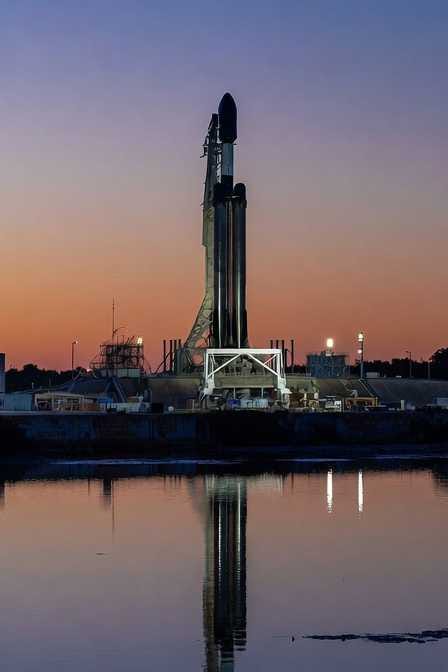
SpaceX raised $75 billion in its initial offering and another $10.7 billion when its underwriters exercised their overallotment option, bringing the total to $85.7 billion - the largest IPO in history. It sold only about five per cent of its outstanding shares. Public investors received an economic claim on the company but little meaningful authority over it: SpaceX’s dual-class structure leaves Elon Musk with overwhelming voting power and an effective veto over his own removal as chief executive and chairman. Within a week of the listing, its bankers were preparing an investment-grade bond offering of at least $20 billion to refinance debt incurred after SpaceX absorbed xAI and to support expansion into data centres, computing hardware and power infrastructure.
In one movement, a company spanning rockets, satellite communications, artificial intelligence, data, spectrum and speculative future infrastructure gained access to a public treasury while preserving concentrated private command.
The mechanism is recursive. Public missions and permissions create private capacity. Private capacity creates government dependence. Government dependence supports valuation and credit. Valuation finances more capacity. The loop closes when the state can no longer easily replace the institution it helped make financeable.
This is not ordinary privatisation. It is state formation through listed operators.
The charter is the asset
Finance normally begins by stabilising the noun.
Project finance funds a power station, data centre, pipeline or contracted stream of payments. Venture capital tolerates a less certain object, but still assumes that the company is trying to become some identifiable thing. Structured finance separates known exposures and assigns them to different claimants: land here, chips there, power contracts elsewhere; senior debt above, first-loss capital below.
Each method can carry uncertainty inside a category.
The path towards artificial general intelligence creates a harder problem. The category itself may not survive.
Perhaps frontier models remain the scarce asset. Perhaps models commoditise and electricity becomes scarce. Perhaps the decisive layer becomes semiconductor manufacturing, proprietary data, distribution, robotics, autonomous laboratories, satellite connectivity or defence integration. Perhaps the thing now called an AI company becomes a cloud utility, an industrial system, an intelligence service or something for which corporate language does not yet possess a stable noun.
This is ontological risk: not merely that a project may fail, but that the identity of the thing being financed may change before its financing matures.
The more precisely finance binds itself to the present architecture, the more vulnerable it becomes to a change in that architecture. A twenty-year power asset may support chips whose economic life is measured in years. A data centre may be built around a model family displaced within months. A company that appears to sell intelligence may discover that its decisive assets are energy connections, government permissions, satellite infrastructure or distribution.
Conventional finance responds to complexity by slicing the object more finely.
SpaceX offers the opposite answer: stabilise command over the unstable object.
Put launch, Starlink, X, xAI, computing infrastructure, spectrum, data, government relevance and future businesses behind a corporate boundary that can continue moving. Management need not decide permanently which activity is the core business and which is merely subsidising it. The hierarchy itself remains revisable.
The corporation becomes a warehouse for ontological risk.
Finance writer Byrne Hobart describes markets as a search for the natural owners and warehouses of residual risk. Every structure leaves some exposure that nobody particularly wants: illiquidity, timing mismatch, first loss, uncertain collateral, the awkward position between debt and equity. Finance works by finding a balance sheet willing and able to carry that residue.
The AGI buildout produces an uglier residue. It combines short-lived hardware, long-lived energy systems, uncertain demand, rapidly moving technical architectures, geopolitical restrictions and technologies whose most important uses may not yet have names. There may be no natural holder for that bundle.
SpaceX warehouses it inside command.
This resembles a conglomerate, but the old conglomerate promised diversification. Weak returns in one business might be offset by strong returns elsewhere. SpaceX promises something more ambitious: recombination. Credibility, capital, data, technical capacity and political access accumulated in one domain can be redirected into another before outside investors fully understand why.
Diversification distributes exposure. Command rearranges it.
The public is not simply purchasing a portfolio selected by Musk. It is purchasing his continuing authority to decide what belongs inside the portfolio and what the portfolio is ultimately for.
The asset is not the plan. It is the power to replace the plan.
A charter without a charter
Will Manidis supplies a useful ancestor. In his account of the Dutch Republic, the VOC share was not merely a fractional claim on trading profits. It made state-commercial capacity divisible and investable: the company traded, governed, enforced monopolies and made war through powers formally delegated by the state.
SpaceX is not a new VOC. It has no explicit sovereign charter. Its delegation is more dispersed - and therefore harder to see.
SpaceX’s public significance accumulates through launch licences, spectrum rights, procurement relationships, government contracts, security relevance, infrastructure access and the gradual consolidation of capabilities the state cannot quickly reproduce. Its acquisition of large blocks of spectrum and the regulatory waivers enabling flexible terrestrial, satellite and hybrid use enlarged the range of communications functions that could be gathered inside one privately commanded architecture.
No single document declares SpaceX a public instrument. No ceremony transfers a piece of sovereignty. Instead, indispensability accretes.
A government customer needs launch capacity. A military needs the communications layer. A national AI strategy needs computing infrastructure and power. A regulator approves another component. Banks accept the resulting institution as investment grade. Investors assign a larger valuation. The company uses that valuation to acquire another part of the stack.
Each transaction looks commercial. Together they become constitutional.
This is a charter without a charter.
The charter is not a document. It is the accumulated permission to become difficult to replace.
The public market is the treasury
Private capital can support technological strangeness. It cannot by itself provide trillions of dollars across power, compute, semiconductor fabrication, communications, robotics and physical infrastructure.
The frontier must eventually reach the great pools of boring money: pension savings, insurers, sovereign funds, mutual funds, public equities and investment-grade bonds.
Nicolas Colin and Marieke Flament describe the United States as the world’s destination for surplus savings. Manufacturing surpluses, oil rents, domestic retirement money and institutional flows converge upon American assets because few other markets are sufficiently deep, open and liquid to absorb them. Increasingly, the machinery distributing those flows does not require every marginal investor to form an independent judgment about the underlying company.
That is not merely an advantage in valuing existing firms. It is an advantage in financing attempts.
Congress appropriates tax revenue to named programmes. Public markets appropriate the future to investable stories.
The congressional system is political, slow, contested and formally public. It must specify an object, defend a budget, name an agency and return periodically for authorisation. The market can mobilise global savings around a corporate charter whose defining virtue is that it does not need to specify the final object in advance.
This creates something like a parallel appropriations system.
Washington need not nationalise the entire AI buildout, raise its full cost through taxation or settle the technical architecture bureaucratically. It can provide strategic missions, public contracts, regulatory permissions, export protection and political urgency. Markets fund much of the construction.
By securitisation, I do not mean that the United States has literally issued shares in its sovereignty. I mean that capabilities performing state-critical functions are housed inside private firms and then translated into claims that global investors can own.
The state supplies the mission. The firm supplies the command. The market supplies the fiscal capacity.
This allows America to conduct industrial strategy without always admitting that it is planning. The apparent decentralisation lies among investors deciding whether and at what price to participate. Inside the firm, the allocation among rockets, models, data centres, satellites and future acquisitions may be intensely centralised.
The market chooses the commander - or more precisely, prices access to a commander it can no longer easily remove.
The feedback loop is powerful. A story produces a valuation. The valuation supplies acquisition currency and borrowing capacity. That financial capacity acquires infrastructure, data, talent and adjacent businesses. The enlarged institution becomes more strategically useful. Strategic usefulness strengthens the original story.
Market capitalisation becomes capital expenditure.
The market is not merely predicting the technological future. It is giving the company the means to purchase enough of that future to make the prediction partially true.
Indispensability is the guarantee
There is no formal promise that the American government will rescue SpaceX or protect its shareholders from loss. Indispensability instead functions as political credit enhancement.
Investors can reasonably infer that an institution embedded deeply enough in launch, communications, strategic computing or military workflows will receive continuing contracts, regulatory attention and unusual political concern for its continuity. Government need not guarantee the company’s securities for dependence upon the company to affect its cost of capital.
America is learning to capitalise its own dependency.
There are two layers to this.
The first is character. Manidis has written about founder hagiography as a secular version of the lives of saints. The founder performs renunciation, sleeplessness, suffering and absolute devotion. The display supplies a moral answer to why one individual deserves extraordinary authority and wealth: because he endures what ordinary people cannot.

In finance, this mythology performs a more precise function. Character becomes collateral.
Reusable rockets support claims about artificial intelligence. Manufacturing speed supports claims about orbital computing. Previous impossibilities overcome become evidence for future impossibilities. Achievement in one domain lowers the narrative discount applied to another.
This is not necessarily fraud. Musk’s companies have built difficult things. That is why the mechanism works. Real execution and mythology reinforce one another until the founder’s judgment becomes an investable asset.
But character is only the junior layer of the structure. The more durable layer is national indispensability.
Henry Farrell, drawing on Quinn Slobodian and Ben Tarnoff’s account of “Muskism,” describes the combination of vertically integrated production and future mythology that can be converted into financial and political capital in the present. Their more disturbing claim is that the state may permit a private firm to develop a capability so essential that it later has to purchase pieces of its former capacity back through contracts.

At that point the founder story can weaken while the institution remains difficult to abandon.
Character supports the equity premium. Dependence supports the institution.
Or, in the language of structured finance: character is the equity tranche; indispensability is the senior claim.
The same concentration of command that allows the company to move quickly also makes correction difficult. A normal company can replace a failed strategy or chief executive. A company whose public value rests partly upon unified command - and whose strategic value makes sudden disruption costly - has fewer clean exit routes.
The state may come to dislike the founder while remaining unable to leave the firm.
That is not private independence from government. It is mutual captivity.
The operator crosses the membrane
Musk’s period in the Trump administration is not a colourful biographical interlude. It is a specimen of the listed state crossing back into the old state.
In February 2025, the White House told a federal court that Musk was a White House employee and senior adviser, not an employee or administrator of the US DOGE Service, and that he possessed no formal authority to make government decisions. He could advise the president and communicate presidential directives. The legal insistence upon limited authority sat awkwardly beside Musk’s public identification with DOGE and the enormous political importance attributed to his programme.
That ambiguity is not incidental. It reveals the form.
The industrialist used to own the plant. The platform founder owned a network. The operator of machine civilisation occupies the point at which models, capital, law, infrastructure, distribution and executive authority are bound into real-world consequence.
His scarce competence is permission synthesis.
He assembles data access, procurement authority, regulatory tolerance, political urgency, infrastructure, capital and legal ambiguity until a system can act. He does not need to dominate every institution. He needs to stand where institutions connect before slower systems understand that they have become one operating loop.
This figure is addressless because no single institutional description contains his power.
To capital he is a founder. To the state he is an adviser or partner. To the locality he is an applicant. To the regulator he is a file. To the court he is a vendor or private citizen. Each description may be legally correct. None describes the complete machine.
DOGE showed such an operator crossing the membrane. The federal government appeared not as a settled constitutional inheritance but as another poorly integrated operating system: too many interfaces, excessive latency, duplicated functions, incompatible databases and insufficiently direct links between executive intention and administrative consequence.
One need not admire DOGE’s results to notice the change in grammar. A privately formed operating logic - speed, direct command, software-mediated visibility, data integration, hostility to inherited interfaces - was turned inward upon the state.
This was not simply a businessman entering politics. It was the operator of state-critical private systems attempting to refactor the public system that had helped make his private capacity possible.
The financial and political loops were not separate. Industrial capacity produced access. Access produced missions and permissions. Missions and permissions strengthened the capacity that markets financed.
The operator did not merely capture the state from outside. He moved through it.
Body and interface
To understand the listed state without reducing it to Musk, pair him with Peter Thiel.
Musk’s characteristic institution is the vertically integrated enclave: rockets, satellites, factories, models, data centres and physical systems gathered under concentrated command. His project is to shorten the distance between technological conception and industrial execution by pulling more of the relevant stack within the walls of the firm.
Musk builds the body.
Thiel’s characteristic institution is the interface.
Palantir does not need to own the army in order to alter how the army sees, integrates information and acts. In 2025, the US Army consolidated dozens of arrangements into an enterprise agreement allowing it to purchase as much as $10 billion in Palantir products and services over ten years. The agreement did not oblige the Army to spend the full amount. Its stated purpose was to reduce procurement friction and accelerate access to data integration and AI tools.
That is not the transfer of the Army to Palantir. It is something more technically intimate.
The private system becomes part of public cognition: how information is assembled, prioritised, displayed and converted into tempo. Remove it suddenly and the host loses capacity. Retain it and the host acts through a system it does not fully own.
Thiel’s wider importance is also social. Private networks such as Dialog bring together figures from technology, capital, politics, defence, intelligence and academia in off-the-record settings. Dialog is not a secret government, and it would be foolish to treat every private gathering as one. Its significance is more ordinary and durable: it is part of the social infrastructure through which trust, introductions and strategic imagination move across institutional boundaries before they appear as formal policy.
In the American operator room, the fund, defence contractor, university laboratory, law firm, foundation, family office, media platform and government advisory board are not isolated organisations. They are handles through which money, talent, legitimacy, protection and timing can be routed.
Musk assembles capability. Thiel makes capability legible and usable to power.
Musk builds the body. Thiel builds the interface.
The old order weakens. The operator room thickens.
The corporate constitution of machine civilisation
By machine civilisation, I mean a society increasingly organised around five coupled systems: power, compute, logistics, money and the kill chain. The term does not refer simply to more factories or more software. It describes an operating stack in which electricity, data centres, cloud systems, payment rails, satellite networks, industrial capacity, legal authorities, sensors and military command reinforce one another.
The old American-led order had excellent scrap value. The dollar could survive more as plumbing than promise. Alliances could persist as procurement clubs, intelligence meshes and basing arrangements. Openness could be narrowed into selective access. Industrial policy could expand beyond subsidies and factories into a struggle to keep the century’s decisive systems operable on American terms.
SpaceX is an early corporate location at which the layers converge. Launch and satellites are logistics. Starlink is communications infrastructure. xAI and the data-centre build are compute. The whole requires huge amounts of power. The IPO and bond market provide money. The communications and computing layers sit increasingly close to national-security functions.
Palantir occupies another part of the same stack: the cognitive layer through which data becomes administrative or military vision. DOGE was the logic of that stack turned inward upon the state.
The listed state is not the whole of American machine civilisation. It is its emerging corporate constitution: the form through which strategic capacity can be privately commanded, publicly financed and politically integrated without becoming a conventional national champion or state-owned enterprise.
This helps explain why the distinction between markets and planning has become inadequate.
China capitalises state discretion. America securitises operator discretion.
China can use state banks, public firms, procurement, local governments and industrial plans to sustain a technological direction after market belief weakens. Its strength is persistence. Its danger is that errors become political and fiscal commitments whose reversal requires bureaucratic recognition and permission.
The American sovereign firm can turn belief into valuation, valuation into credit, credit into infrastructure and infrastructure into strategic importance. Its strength is speed and recombination. Its danger is reflexivity: if belief weakens, valuation falls; if valuation falls, financial capacity contracts; if capacity contracts, the future that justified the valuation becomes harder to build.
China can persist after belief fades. America can move before bureaucracy understands.
Both concentrate discretion. They differ in who exercises it, where error becomes visible, who bears the loss and how correction can be imposed.
Machine capacity without public settlement
The harder problem is what the listed state does to the republic around it.
America may rebuild decisive capacity without rebuilding a thick public settlement. It can keep strategic systems operable while leaving more of ordinary life expensive, provisional and thin. In A Hungry America, I described this as learning to build shells faster than settlements: operational systems capable of decisive action appearing before the public bargains and institutions that might govern them, distribute their benefits and absorb their costs.
The listed firm is one such shell.
It can assemble technical operators, capital, permissions, infrastructure and strategic continuity at extraordinary speed. But the public encounters it through fragmented roles.
As taxpayer, the public helps support government demand. As ratepayer, it supplies electricity and physical infrastructure. As pension saver, it may become an investor. As worker and user, it adapts to the systems being deployed. As citizen, however, it possesses remarkably little authority over the institution’s direction.
Public ownership does not necessarily democratise command. It may simply make resistance financially incoherent. The worker may fear automation while his retirement account owns the company building it. The ratepayer may resent a data centre while the local government depends on its investment. The state may fear the founder while the military depends upon the capability.
Everyone holds a claim. Nobody holds the whole.
Manidis has argued that earlier strategic sectors understood, however imperfectly, that public importance generated reciprocal obligations. Defence contractors knew their existence depended upon public authority. Telecommunications companies accepted common-carrier duties. Oil companies faced the claim that strategically vital resources could never be treated as wholly private. The AI industry increasingly speaks the language of foundational infrastructure without yet accepting an equivalent settlement.
The asymmetry is clear.
The firm invokes public necessity when accumulating power, land, electricity, contracts and regulatory support. It invokes private property when command is questioned.
The public supplies the conditions. The operator retains the discretion.
This is not the retreat of the state. It is the state becoming selectively formidable and constitutionally elusive.
The listed state can be more effective than the bureaucratic state it supplements. It can move faster, attract talent, recombine capital and technology, and survive political turnover. That is precisely why the danger cannot be reduced to corruption or failure.
The danger is that it works.
It may produce a government stronger in operation and thinner in address: able to launch, compute, integrate, surveil and strike, but increasingly unable to say where public authority ends and private command begins.
Machine civilisation arrives before its public settlement.
The state changes address
The financial innovation of AGI may therefore be constitutional before it is technical.
Building the machine requires institutions capable of carrying ontological instability: institutions able to absorb new businesses, discard old hierarchies, move capital across technological domains and alter their own purpose without dissolving.
America’s answer is not a ministry and not quite a national champion. It is a listed operator surrounded by public missions, private rooms, market liquidity and strategic dependence.
Such a system can mobilise global savings without nationalising the project. It can pursue industrial strategy without admitting to comprehensive planning. It can acquire infrastructure without housing all relevant expertise inside the civil service.
But it also changes the address of government.
From department to contract. From appropriation to valuation. From public doctrine to private room. From formal delegation to accumulated dependency.
The firm remains private in law, public in consequence and sovereign in its internal command. Investors can trade exposure to its future but cannot direct it. Government can contract with it but may not be able to replace it. Regulators can govern individual transactions while missing the constitutional significance of their accumulation. Citizens can experience its consequences without knowing where political responsibility begins.
The danger is not that this arrangement fails. It is that it works well enough to become normal.
The republic is not simply being privatised.
It is being listed.