The Map Starts Acting
China’s electro-social state, America’s hydrocarbon-silicon republic, and the old technologies gaining machine tempo

The Old Technologies Become Executable
I. The base catches the superstructure
The easiest way to misunderstand the new industrial politics is to begin with factories. This is forgivable. Factories at least have the decency to look like production. They have gates, shifts, roofs, loading bays, security guards, machinery, waste heat, accidents, unions or the absence of them. They let the mind rest in the old distinction between the people who make things and the people who talk about them. But the industrial party of the machine age does not always look industrial. It may look like a venture fund, a satellite company, a border analytics contractor, a missile-drone startup, a chip foundry, a cloud region, a crypto exchange, an AI lab, a battery supply chain, a humanoid robot demonstration, a defence procurement office, a data-centre campus in a county that used to understand its own weather. Its factory may be a rack. Its smokestack may be a power-purchase agreement. Its shop floor may be an API.
Nor is it really a party. This is the first correction. The Chinese Industrial Party was never a party in the formal sense, and the American one has not yet become one. The Chinese version has been described more accurately as an internet subculture and intellectual scene devoted to engineering, economic development and international rivalry, whose public voices treat technological progress as the decisive measure of social progress and state legitimacy. It is not organised as a party; it is a style of seriousness.
The American equivalent is even less coherent. Peter Thiel’s political theology is not Marc Andreessen’s founder libertarianism, which is not Elon Musk’s sovereign improvisation, which is not Palantir’s civilisational statecraft, which is not Anduril’s defence-industrial romance, which is not crypto’s hostility to monetary bureaucracy. These forces do not share a complete programme. They share an injury, an enemy and a style of impatience. They believe the existing superstructure patronises builders while depending on them. That is enough to make a bloc in motion. It may not be enough to make a regime.
The industrial party is not merely pro-business. Business usually wants taxes lowered, regulations eased, labour disciplined, subsidies preserved, competitors checked and courts made friendly. The industrial party wants something less transactional and more metaphysical. It wants the polity to admit that the base was right. It wants the forms of legitimacy — school, media, bureaucracy, party, constitution, law, public morality, elite prestige — to be rearranged around the truth of production. The older Marxian language is useful here, though perhaps against the grain of its usual users. The industrial party begins as a force of the base. It discovers that the base alone is humiliating. Someone else still writes the songs, appoints the judges, educates the children, defines the citizen, narrates virtue, allocates shame, governs speech, decides what a serious person is allowed to say in public. Eventually the industrial party wants the superstructure.
For a while this complaint could be contained. China’s version helped give the Party what it needed: steel, ships, drones, batteries, railways, robots, machine tools, export discipline, infrastructural grandeur and a way of saying that national humiliation would be answered not by argument but by production. America’s version gave the liberal order software, platforms, fortunes, climate optimism, data centres, surveillance capacity, weapons systems, campaign money and the faintly comic promise that every social problem had a founder somewhere waiting to solve it. Both industrial parties were useful. Both eventually wanted more.
This is where the two stories diverge. The Communist Party of China understood the industrial party’s usefulness but denied it sovereignty. It could praise engineers, fund laboratories, command supply chains, electrify the economy, automate factories and turn industrial competence into patriotic proof. But when the adjacent techno-commercial class began to acquire the features of a rival superstructure — money, platforms, celebrities, education pathways, financial infrastructure, moral glamour, public discourse, youth aspiration — the Party struck. Alibaba was fined $2.75 billion in 2021 and later completed what Chinese regulators called a three-year rectification process; the same regulatory wave followed the scuttling of Ant Group’s $37 billion IPO after Jack Ma’s public criticism of China’s regulatory system.
It is too easy, especially from outside China, to describe this as a crackdown on technology. It was not. It was a decision about which technologies would be allowed to become political. Payments, credit, platforms, tutoring, games, celebrity economies, online publics, even comedy: these are not merely sectors. They are possible ministries of meaning. They organise debt, aspiration, family anxiety, humour, shame, teenage fantasy, sexual style, class mobility, linguistic play and the hierarchy of attention. The Party did not suppress technology as such. It reclassified acceptable technology. Hard tech was patriotic. Platform sovereignty was dangerous. Industrial competence was good. Superstructural autonomy was intolerable.
China therefore produced a strange but effective division of labour. Its industrial party is permitted to serve the civilisational metabolism. It may build, automate, electrify, export and arm. China is now the central industrial robot market: the International Federation of Robotics reported that China’s operational stock reached 2.027 million industrial robots in 2024, with 295,000 new installations that year, more than half of global demand. But the industrial party may not define the civilisation. That right remains with the Party. The Party is not merely another institution within the Chinese stack. It is the superstructural proprietor. It reserves to itself the authority to say what building means, what sacrifice is for, what youth should desire, what wealth owes, what history teaches, what Chineseness requires, which humiliations must be remembered and which humiliations must be forgotten.
The Chinese Industrial Party wanted a superstructure worthy of the forces of production. The CPC answered: you may help us build the forces of production; the superstructure is not yours.
America’s industrial party had a different apprenticeship. It first sought legitimacy inside the liberal mainstream. It wanted to be admired by universities, flattered by presidents, celebrated by newspapers, understood by regulators, forgiven by labour, praised by climate politics and treated as the glamorous engine of an open global future. For a while it received much of this. The Obama years were probably the high moment: the hoodie, the app, the platform, the TED talk, the social graph, the global citizen, the founder as progressive magician.
Then came the experience, partly real and partly mythologised, of betrayal. Antitrust, AI safety, crypto enforcement, labour fights, taxation, platform moderation, DEI, environmental review, scepticism of billionaires, hostility to founders, suspicion of defence work, the general sense that liberal culture wanted the products of technology but not the authority of technologists. The industrial party decided that this arrangement had become intolerable.
Trump gave it a way out. The easiest mistake is to make Trump the source. He is not the source. He is the membrane-break through which the bloc becomes visible. He gave the builders permission to say that the institutions which had patronised them were not merely slow, hypocritical or unfair, but hostile to civilisation. In return they brought him something more useful than ideology: money, networks, software, AI infrastructure, drones, data systems, crypto rails, procurement ambition and an impatience with procedural life that could be redescribed as courage.
China kept its industrial party in the base. America is discovering what happens when the industrial party enters the superstructure.
II. China’s electro-social state
China’s stack is often described as an electro-state: batteries, EVs, solar, hydro, coal, nuclear, ultra-high-voltage transmission, rail, ports, grids, factories, industrial robots, smart cities. That is right, but still too material. It names the apparatus, not the settlement. The more precise phrase may be electro-social state: a political form that tries to absorb surplus aspiration through electrified infrastructure, urban comfort, productive discipline and Party meaning.
The Chinese machine civilisation is not cleanly green. Its data centres and factories still rely heavily on coal in many regions. The point is not carbon purity. The point is that China’s machine civilisation is organised through grid, factory, rail, battery, city and sensor. It is electro in the civilisational sense: it imagines coordination through infrastructure. It wants to move people, power, goods, signals and desires through planned corridors. Its instinct is not merely to compute. It is to absorb.
The human problem begins there. A society can produce astonishing capability and still fail to produce recognised necessity for its people. China can fill its factories with robots, its roads with electric vehicles, its cities with sensors, its ports with cranes, its laboratories with AI models and its diplomacy with the confidence of industrial proof. Yet the young person emerging from university may still experience the whole achievement as a civilisation that no longer knows what to do with him. In March 2026, official data showed urban unemployment among 16-to-24-year-olds, excluding students, rising to 16.9 per cent; unemployment for 25-to-29-year-olds also rose to 7.7 per cent.
This is the gap between machine surplus and human remainder. Machine surplus is easy to admire. It appears as output, yield, speed, export share, compute, robots per worker, turnaround time, deployment rate. Human remainder is harder to name because it is not only unemployment. It is the humiliation of being over-educated for available dignity. It is the discovery that the national future is magnificent in the aggregate and stingy in the first person. It is the young graduate whose country can build a hypersonic missile, a drone swarm and a world-class battery supply chain but cannot provide a credible answer to the question: what kind of life am I supposed to inhabit?
Imagine the graduate not as a statistic but as an atmosphere. She is in Xi’an, or Chengdu, or Changsha, not because Beijing is irrelevant but because Beijing has become too good at being Beijing: too political, too expensive, too watched, too disciplined, too serious. It is two in the morning. She has eaten well, posted lightly, scrolled too much, laughed at something she would not send to a parent, and felt for a moment that the future still has rooms in it. There is high-speed rail, cheap food, music, light, alcohol, jokes, costume, flirtation, a table of people who studied too hard and are trying to become unserious again. None of this is trivial. It is the texture of a society trying to stay alive beneath its own project.
The Party understands at least part of this. Its answer is not only repression. It is comfort. In April 2026, Chinese authorities announced a plan to build “youth-development-oriented cities”, with measures for employment, housing, healthcare, education, childcare and public services, and with a framework to be widely established by 2030 and mature by 2035.
This is easily mocked as administrative lifestyle management, but that would be a mistake. Comfort is a serious political technology. So is urban charm. So is a subsidised apartment near a transit line, a cheap café, a night market, a music district, a city festival, a youth hostel for graduates looking for work. One of the more revealing scenes in contemporary China is not the Party congress, the chip fab or the military parade, but the young professional leaving Beijing on a Friday evening to become young somewhere else. The capital kept command and lost play. The youth economy did not disappear. It got on the train.
But this vibrant unseriousness exists by permission. The joke, the night market, the dating app, the livestream, the stand-up club and the local music scene are tolerated so long as they remain lifestyle rather than politics. The moment play crosses into interpretation, the electro-social state remembers what else its infrastructure can do. A joke can become a case. A punchline can become a regulatory event. In 2023, comedian Li Haoshi, known as House, made an oblique reference to a People’s Liberation Army slogan during a stand-up performance; the company that represented him was fined millions of yuan and performances were suspended.
Comfort is a pardon, not a right.
That small scene says something larger about China after Xi. The usual Western question is whether China will liberalise. This is too narrow. It assumes that politics is always the first way a society breathes again. Sometimes the first thing to return is not freedom but desire. Not democracy. Not revolution. Not manifestos. Play. Waste. Nightlife. Romance. Costume. Comedy. Religion. Weird art. Bad music. Good food. Road trips. City pride. Fantasy. Flirtation. The right to make a slightly stupid decision and not have it immediately folded into the national mission.
China may not first need a new ideology. It may need somewhere to be young.
This is why second- and third-tier cities matter. Not because they will automatically liberate China from Beijing, but because they can house forms of meaning the centre cannot safely author. Chengdu, Xi’an, Changsha, Suzhou, Qingdao, Xiamen, Kunming: not all in the same administrative or economic category, not all performing the same cultural function, but all part of a general problem. A command civilisation that has disciplined the future too successfully must find places for unseriousness. The state is trying to build cities where the unnecessary can remain comfortable enough not to become historical. That is too brutal a sentence, but the thought is right.
The danger is that comfort cannot substitute indefinitely for recognition. A young person does not only want a room, a café, a skyline and a festival. He wants a reason not to feel bypassed. She wants an account of why her intelligence, her desires, her erotic life, her anger, her faith, her boredom, her family obligations and her private sense of absurdity are not merely tolerated leftovers beside the national machine. When a society suppresses culture war, it does not abolish it. It stores it. Feminism, masculinity, nationalism, religion, regional identity, sexuality, class resentment, anti-996 fatigue, rural-urban status, overseas identity, admiration and resentment toward the West, Han majoritarianism, minority policy, historical memory, Mao nostalgia, techno-futurism, private grief after zero-Covid — these are not absent. They are under command.
Succession is the event that might turn storage into release. Xi Jinping did not create China’s succession problem, but he remade it. China had built, after Mao, a rough architecture for regularised elite transfer: retirement ages, informal term limits, visible grooming, staged promotions, collective leadership. Xi weakened that architecture. Presidential term limits were removed in 2018; he secured a third term as Party leader in 2022; no obvious successor has been publicly positioned through the older ladder of party, state and military credentials. CSIS argued that Xi’s removal of de jure term limits and refusal to nominate a successor dismantled power-sharing norms around regular transfer of power.
The usual way to discuss this is in elite terms: factions, standing committee seats, Central Military Commission posts, princelings, protégés, purges, rules of retirement, the next Party Congress. That is necessary but insufficient. Succession is not only who takes power. It is what becomes sayable when the organising presence recedes. The Party has concentrated political meaning in Xi so strongly that life after Xi may feel, even without formal liberalisation, like an atmospheric event. The air changes. People test speech. Officials test distance. Artists test stupidity. Businessmen test ambition. Diasporas test return. Police test restraint. Nationalists test the next humiliation. Localities test their room. Everyone asks, often indirectly: how much of what we were saying was belief, and how much was survival?
This is where the overseas Chinese question enters, though it should remain a pressure point rather than a detour. There are many Chinese worlds outside the PRC, and they are not one world: Singapore, Taiwan, Hong Kong remnants, Tokyo, Kuala Lumpur, Bangkok, Melbourne, San Gabriel Valley, new emigrant circles after zero-Covid, churches, business networks, Mandarin internet publics beyond the firewall. They are commercial, religious, cowardly, brave, nostalgic, anti-communist, pro-China, post-China, frightened of China, financially entangled with China and spiritually unable to leave China alone. These worlds may incubate stories of Chineseness that the mainland cannot easily generate under command. But they do so under pressure from older technologies: nation, minzu, family, border, memory, humiliation, return. Xi-era overseas Chinese policy itself increasingly blurs the distinction between Chinese nationals abroad and foreign citizens of Chinese descent by addressing both as “overseas compatriots” and folding them into a civilisational narrative of national rejuvenation.
The post-Xi vacuum will not simply be filled by freedom. It may be filled by anti-communism, Taiwanese constitutionalism, Singaporean administrative paternalism, Hong Kong melancholy, Christian moral politics, Nanyang commercial realism, Silicon Valley exit ideology, Chinese nationalism without the CPC and wounded cosmopolitanism. It will be filled by all the postponed arguments over how to be Chinese after China’s rise.
III. America’s hydrocarbon-silicon republic
America’s machine civilisation is often described as software-heavy, financialised, militarised and globally recursive. That is right, but it misses the base. The American move is often misdescribed as a passage from hydrocarbons to silicon. That is too clean. Silicon does not replace the hydrocarbon order. It gives it a second historical life.
America remains an energy superpower. The Energy Information Administration reported that the United States produced more energy in 2024 than ever before; natural gas accounted for about 38 per cent of U.S. energy production, and crude oil production reached a record 13.2 million barrels per day.
The American AI republic will run through electricity, but much of that electricity will be politically hydrocarbon-shaped. The International Energy Agency projects global data-centre electricity consumption will more than double to around 945 TWh by 2030; the United States accounts for the largest share of that increase, followed by China, and data centres account for nearly half of projected U.S. electricity-demand growth between now and 2030. In the United States, natural gas is expected to play a major role in meeting data-centre electricity demand; the IEA projects natural gas will expand notably to meet data-centre load, especially in America.
This is not a transition from oil to abstraction. It is a translation of energy into command:
hydrocarbons become electricity; electricity becomes compute; compute becomes administrative vision; administrative vision becomes governability; governability becomes greatness.
The old American frontier turned land, fuel and motion into citizens, suburbs, armies and consumption. The new frontier turns fuel into electricity, electricity into compute, compute into models, models into agencies, agencies into executive action, and executive action into the dream of a governable republic. Silicon does not abolish the hydrocarbon continent. It gives the hydrocarbon continent a new mission.
But this second life of the hydrocarbon continent is not autarky. The American republic may be powered by its own gas, oil, substations and data-centre corridors, but its silicon dreams remain entangled in supply chains it does not fully command. The energy base is continental; the machine base is still oceanic. Advanced chips, packaging capacity, battery materials, rare earths, graphite, gallium, germanium, magnets and machine tools pull the American operator back into the world it would like to master. The IEA’s 2025 critical minerals outlook argues that refining concentration remains high and that China is set to supply over 60 per cent of refined lithium and cobalt, and around 80 per cent of battery-grade graphite and rare earth elements, in 2035.
The same is true of semiconductors. The semiconductor supply chain is distributed across the United States, Taiwan, South Korea, Japan, the Netherlands, China and other nodes; CSIS has described the Indo-Pacific as critical to the global semiconductor landscape, with Taiwan, Japan, China and South Korea all playing pivotal roles. The hydrocarbon-silicon republic is powered by Texas gas but haunted by the South China Sea. Its data centres may sit in Virginia, Ohio, Texas or Arizona; its sovereignty still depends on Taiwan, Japan, the Netherlands, South Korea, China and a chain of minerals, machines and routes that no executive order can simply bring home. Greater America therefore begins as a continental fantasy and immediately becomes a maritime problem.
This is why the data centre matters more than the app. The app was weightless ideology. The data centre is where the abstraction becomes territorial again: a demand on gas, water, transmission, zoning, tax abatements, substations, ratepayers and counties. The cloud, which once seemed to float above the republic, returns as load. In May 2026, American Electric Power raised its five-year capital plan to $78 billion, citing data-centre power demand; it expected 63 gigawatts of incremental load by 2030, mostly from data centres.
The data centre is the new frontier fort. It arrives with lawyers, lobbyists, land options, power contracts, water needs, tax promises, security fences and the language of national necessity. It says to the county: your grid is now part of the AI race. It says to the utility: your planning cycle belongs to the model. It says to the environmental review: the future cannot wait. It says to the old hydrocarbon regions: you are not backward; you are the substrate. It says to Silicon Valley: the cloud was always somewhere.
This clarifies the contrast with China. China’s machine civilisation is electro-social: grid, rail, battery, factory, robot, sensor, city, comfort. America’s is hydrocarbon-silicon: shale, gas, cloud, model, border, defence, registry, dollar. China uses electrified infrastructure to absorb people into a commanded social body. America uses energy abundance and compute to make a fragmented republic operable. One builds youth-friendly cities so the future remains inhabitable under Party meaning. The other builds data-centre sovereignty so the state can see, decide and act.
Both are trying to solve a crisis of governability. They are not solving the same crisis.
China’s problem is surplus aspiration after industrial success. It has too much educated desire, too much urban expectation, too much controlled cultural energy, too much productive capacity and not enough legitimate looseness. America’s problem is institutional failure after imperial abundance. It has wealth, energy, capital, software, military power and universities, but cannot reliably turn them into a broad and believable settlement. China’s electro-social state asks: how can surplus humans remain meaningful inside a commanded industrial civilisation? America’s hydrocarbon-silicon republic asks: how can a fragmented republic become governable enough for greatness?
This is why DOGE matters. The January 2025 executive order establishing DOGE framed the project as modernising federal technology and software to maximise governmental efficiency and productivity, including improving government-wide software, network infrastructure and IT systems; it directed agencies to establish DOGE teams and give them access to unclassified agency records, software systems and IT systems, subject to law. Beneath the meme was a recognisable builder fantasy: the state as bad software. Duplicate contracts, ancient systems, untraceable employees, grants without owners, databases that cannot speak to one another, agencies that process rather than decide, citizens trapped in portals, cases, appeals and phone trees. Give the engineers access, and the republic might finally see itself.
The fantasy was not entirely false. That was the problem.
America is peculiarly vulnerable to such a fantasy because its state is both everywhere and hard to locate. The modern American citizen is not ruled by one clean sovereign but by a mesh of recognised claims: tax identity, payroll record, credit score, insurance eligibility, school enrolment, mortgage file, professional licence, immigration status, court order, prescription record, background check. No single node owns the citizen, but each depends on records from the others. This is why American anger can be so intense and so strangely immobilised. Serious rupture threatens access to one’s own life. A clean tyranny says no. A registry state says the case is still processing.
Here the American courts are not an afterthought. They are the superstructure’s most durable machine for converting political force into delay, doctrine, standing, procedure, injunction, appeal and negotiated access. The executable state does not simply roll through habeas corpus, the Privacy Act, the Administrative Procedure Act, FOIA, federalism and state attorneys general. It meets them, fights them, learns them, routes around them, sometimes loses, sometimes wins, and often discovers that litigation itself becomes part of the operating environment. The operator does not abolish law. The operator hires lawyers.
That is the American difference. China’s Party can place itself above law because law is subordinate to the Party. America’s operator must pass through law, buy law, test law, automate compliance with law, overwhelm law, litigate law, and perhaps eventually redesign the conditions under which law appears. This is slower than command and more chaotic than decree. It is also harder to kill. The American superstructure is not weak because it is fragmented. It is resilient because it is fragmented. But fragmentation also makes it hackable. Every jurisdiction, agency, procurement rule, standing doctrine, emergency power, pilot project and public-private partnership becomes a possible interface.
DOGE’s breadth of access quickly became a governance issue. The Government Accountability Office’s April 2026 report on Treasury data controls noted that DOGE’s access to unclassified agency records, software systems and IT systems had led to concerns about sensitive information and data vulnerability. That is the administrative version of the central question. How much must an operator see in order to make a system work? How much should any operator be allowed to see?
Palantir is the more mature form of the same impulse because it gives the operator a metaphysics. It does not merely sell software to government. It offers a theory of Western survival: Silicon Valley lost its way when it retreated into consumer applications and abandoned the hard problems of state, war, industry and national power. In Q1 2026, Palantir beat revenue estimates, with U.S. government revenue rising 84 per cent to $687 million and U.S. commercial revenue rising 133 per cent to $595 million; Reuters reported that its Maven AI system was set to become a Pentagon programme of record, locking in long-term military use.
One should not dismiss this as surveillance capitalism with better prose. It is more interesting and more dangerous than that. Surveillance is part of the story, but the deeper promise is restored operability. The file will not merely be stored; it will be read. The meeting will not merely be recorded; it will be summarised. The ticket will not merely be assigned; it will be routed. The agency will not merely report; it will know. The battlefield will not merely be mapped; the map will act.
This is where “surveillance” becomes too small a criticism. A system that only spies can be hated. A system that makes the state less stupid will be harder to resist. The industrial party’s deepest political advantage is that general dysfunction has become intolerable. Housing, healthcare, procurement, immigration, disaster response, defence acquisition, veterans’ claims, permitting, taxation, school enrolment, benefits administration: so much of American life is mediated through broken or adversarial systems that the promise of an operator carries moral force. It is not only authoritarian. It is therapeutic. It says: you are not mad; the system really is stupid; let us fix it.
Imagine an American veteran whose claim has moved through a portal, an outsourced review, a missing form, a medical code, a password reset, a call-centre script and a case number no human being feels able to own. He does not want a theory of republican liberty. He wants someone competent to tell him whether the system knows he exists. If an AI-assisted operator can make the file move, the operator arrives as relief before arriving as threat. That is the political danger. A system that works a little better may legitimate a system that sees too much.
The risk is that success concentrates rage. Fragmented dysfunction has no face. The insurer blames the employer. The employer blames the market. The platform blames the policy. The agency blames the form. The form blames the missing attachment. The school blames the district. The district blames the state. The state blames federal law. The federal law blames the court. The court blames standing. The phone tree does not blame anyone because it never recognises that you exist. Rage disperses across the patchwork.
The operator changes that. If Palantir, DOGE, Anduril, SpaceX, AI procurement offices, crypto-dollar systems, defence-cloud platforms and administrative AI layers actually make the American state more legible, then the public may discover that what it wanted — someone in charge — is also what makes rage targetable. The operator solves fragmentation by becoming legible as the sovereign. It inherits the blame that used to vanish into the patchwork.
The broader Trump AI programme gives the industrial party its national frame. In July 2025, the White House’s AI Action Plan identified more than 90 federal actions across three pillars: accelerating innovation, building American AI infrastructure, and leading in international diplomacy and security; it also called for full-stack AI export packages for allies. By May 2026, the Commerce Department’s Center for AI Standards and Innovation had announced agreements with Google DeepMind, Microsoft and xAI for pre-deployment evaluations and frontier-AI security research.
This is not libertarianism in the old sense. It is not simply deregulation. It is a bid to define the operating layer of a technological republic. Even the deregulatory impulse begins to rediscover command once frontier capability becomes strategically central. The builder does not really want no state. He wants a state that recognises him as the person who can make the state work.
Then, the dog caught the car.
This is not because the industrial party controls everything. It does not. The courts still exist. Congress still exists, though often more as theatre than legislature. States still exist and will fight. Labour still exists in fragments. Universities still train status. The media still humiliates. The old liberal superstructure has not disappeared. But the builder bloc has acquired what it long lacked: direct access to executive power, a national security justification, a cultural enemy, an AI infrastructure agenda and a public mood sufficiently disgusted with institutional dysfunction to tolerate experiments that once would have seemed absurd.
The American industrial party’s difficulty is therefore not exclusion but responsibility. It wanted legitimacy, then access, then revenge, then the right to operate. Once it helps govern, every pothole, denial, drone error, border scandal, hospital failure, veteran’s claim, hacked database, wrongful classification and unemployment wave becomes harder to blame on “the blob”. The operator inherits the system.
IV. Greater America
“Greater America” cannot mean only a richer, stronger, more militarised America. That would be too small. Greater America is the attempt to turn America’s continental resource base, private capital, military reach and software talent into a new governing layer after the liberal-administrative settlement has lost authority.
It is greater in three senses.
First, territorially. Not necessarily because America annexes land, though the temptation to think territorially will return. It is greater because the interior becomes strategically central again. Texas, Ohio, Arizona, Virginia, Nevada, Pennsylvania, the Dakotas, Georgia, Tennessee: substations, data centres, chip fabs, pipelines, military bases, battery plants, gas fields, transmission corridors. The new Silicon Valley is not a valley. It is a continental machine room. The frontier returns not as free land but as load.
Second, administratively. The old federal state is too fragmented, too litigated, too procedural, too outsourced. AI becomes attractive because it promises to make the state see itself. DOGE, Palantir, procurement reform, benefits systems, border analytics, defence AI, model-security review — all are attempts to turn a patchwork republic into an operator state.
Third, mythically. This is the return of the frontier after the exhaustion of the consumer frontier. The old frontier promised land, ownership, motion, extraction, settlement. The postwar frontier promised suburbs, cars, petroleum, appliances, mortgages, military Keynesianism and television. The digital frontier promised apps, platforms, frictionless markets and global connection. The new frontier promises buildout, acceleration, sovereignty, machine intelligence, restored command. It is not “go west”. It is “scale the stack”.
That is why the hydrocarbon-silicon move matters. It gives old America a new destiny. Oil, gas, pipelines, utilities, counties, substations, military bases and industrial land are no longer residues of a declining carbon order. They become the substrate of AI sovereignty. The continental machine can say to itself: I was never obsolete. I was waiting for a new conversion technology.
China’s electro-social state and America’s hydrocarbon-silicon republic therefore select for different human types.
China selects for the comfortable dependent: urban, educated, monitored, mobile, entertained, credentialed, patriotic enough, locally rooted enough, discouraged from grand politics but allowed small pleasures. The youth-friendly city is a habitat for the post-heroic citizen of an overbuilt project state.
America selects for the operator citizen and the processed citizen.
The operator citizen is the builder, veteran, founder, engineer, analyst, contractor, energy developer, AI procurement person, defence-tech employee, sheriff-technologist, data-centre negotiator — someone who experiences national dysfunction as a systems problem. The processed citizen is everyone else: recognised through files, benefits, credit, insurance, claims, identity, risk scores, eligibility, background checks, border status, school records, health records. The technological republic promises to process him better. It may not make him more necessary.
China offers comfort after usefulness. America offers recognition through operability.
Both are inadequate.
V. The charter also becomes executable
There is, however, a less statist possibility.
It does not refute the machine republic. It stands beside it, as an older rival line of descent. If the Party, the registry, the border, the Constitution and the file can acquire machine tempo, then so can the charter. So can the guild, the merchant association, the arbitration court, the credit ledger, the reputation network, the treaty, the port, the trading post and the commercial league.
Commerce is also an old technology.
This is not a simple thesis-antithesis-synthesis moment, history does not behave like that though the human mind likes this rhythm. But there is some optimism, some warmth, that something is happening again, as it did during China’s mobile-internet revolution fifteen years ago. This optimism is more structural than mood. Perhaps we should be asking whether the same machine environment that lets old sovereign forms become executable might also let old commercial forms become executable. If the machine republic is one answer to institutional failure, perhaps the machine Hansa is another.
The medieval Hanseatic League was not a state, though it sometimes acted with state-like force. It was not a company, though it served merchants. It was not a constitution, though it had charters. It was not a single city, though certain cities such as Lübeck gave it form. It was a cross-border commercial order that allowed merchants, cities and routes to become safer than any single lord could make them. A structural account of the Hansa is useful because it goes beyond romance. It was a practical institutional solution to a practical commercial problem: how to reduce the risks created by tolls, confiscations, arbitrary lords, broken routes and unjust courts. Humanity reduced these risks by establishing what we now call “foundational commerce-promoting institutions”; the Hanseatic League arose when charter cities needed to protect these institutions across routes and jurisdictions.
That phrase matters. “Foundational commerce-promoting institutions” are not declarations of universal liberty. They are not Enlightenment language before the Enlightenment. They are operating arrangements: predictable tolls, recoverable debts, merchant privileges, arbitration, safe passage, fair treatment, commercial courts, standardised rights, and limits on arbitrary violence. The original charters were not abstract rights claims but transactions in concrete rights practices, often purchased from violent authorities with money or commercial advantage.
This gives our optimism its historical seriousness. Modern rights did not descend fully formed from philosophy. They were often bought, tested, copied, modified and spread by people who needed them to make trade possible. A merchant did not first ask for liberty as a metaphysical category. He asked not to be robbed at the next bridge, not to have his goods seized by a lord, not to have his debt made unrecoverable by jurisdiction, not to be judged by a hostile court, not to be excluded from a market after he had already borne the cost of the journey. The abstraction came later. The first thing was to make risk bearable.
The Hansa’s deeper achievement was that it made these arrangements portable. Lübeck Law and the freedom charters functioned like an open-source protocol. A city that modified its own charter and political form according to the rules could qualify for membership; other cities would then grant its merchants corresponding rights. The protocol was not merely legal; it was institutional certification. It told others: this city can be trusted enough to trade with.
That is where the analogy to AI becomes more than decorative. An AI-native Hanseatic League would not simply be a group chat of clever exiles, a DAO with better branding, a startup network state, or a diaspora salon. Properly understood, it would be a cross-border commercial order that lowers the cost of trust among strangers. It would create, test and enforce the basic institutions of AI-age commerce: identity, escrow, compute access, model evaluation, legal templates, arbitration, insurance, reputation, credit, labour matching, procurement standards, multilingual contracting, tax navigation, data-use norms, shared security practices and dispute resolution. It would not need to begin as a state. It would begin as a set of reciprocal rules that make cooperation cheaper than predation.
The machine republic wants the state to see itself. The machine Hansa wants strangers to trust one another.
This distinction is important. The Chinese electro-social state absorbs surplus aspiration through comfort under Party meaning. The American hydrocarbon-silicon republic tries to make a fragmented state operable under builder meaning. The machine Hansa would do something else: it would create positive-growth association under commercial protocol. It would not promise national greatness. It would not promise civilisational rejuvenation. It would promise that a person in Singapore, Shenzhen, Tokyo, Taipei, Dubai, Hyderabad, Jakarta, Bangalore, Mumbai, Berlin or San Francisco could enter a commercial relationship with someone elsewhere, under rules neither fully controls, with less fear of being cheated, stranded, silenced, misclassified or abandoned.
This is not a small thing. The cost of trust is one of the great hidden costs of civilisation. States reduce it in one way: by monopolising violence, standardising law and forcing recognition. Markets reduce it in another: by repetition, price, reputation and exit. Commercial leagues reduce it through membership. They say: you are not trusting the stranger alone; you are trusting the charter behind him, the arbitration system above him, the sanctions around him, the ledger that remembers him, the guild that can expel him, the city that certified him, the route that depends on him.
AI can lower this cost dramatically. It can translate languages, draft contracts, search records, monitor performance, compare jurisdictions, audit ledgers, match parties, flag anomalies, preserve institutional memory, simulate disputes, and make tacit norms more explicit. A medieval merchant needed letters, caravans, ships, fairs, inns, notaries, brokers, kinship, repeated journeys and luck. An AI-native merchant league could give a small firm or even a single person some of the institutional surface once available only to states and corporations. Agents could negotiate preliminary terms, maintain records, check sanctions, compare legal options, evaluate counterparty history and preserve the memory of a relationship after the humans involved have moved on.
This is why China’s experience, the instinctive before-after comparison to the mobile-internet revolution is not silly. Chinese mobile internet did not merely produce apps. It created a commercial life-world: payments, logistics, social commerce, livestreaming, local services, platform labour, food delivery, small merchants, digital trust, urban consumption, new rituals of convenience. It changed how commerce appeared in daily life. An AI-native commercial order might do something similar at a higher institutional level. It would not merely help firms work faster. It could create a new environment in which small teams, city-states, ports, diasporas, technical communities and AI-native individuals cooperate through protocols before larger states know how to classify them.
There is already a faint version of this possibility in conversations about AI-native city-state leverage: new organisational forms, “super individuals”, human-AI-human loops, small global hubs, Singapore or Tokyo-like safe jurisdictions, and a new Hanseatic League of city-states surrounded by older giants. The point is not that the metaphor is exact. The point is that the imagination has shifted from platforms to leagues, from apps to membranes, from sovereign territory to portable association.
This is the strongest answer to the pessimism of the machine republic. The machine does not only make the registry executable. It can also make the charter executable.
But optimism should not be allowed to become weightless. The Hansa was never only a protocol. It was a commercial order that survived by bargaining with violence, paying violence, hiring violence, evading violence, and sometimes becoming violent enough to be taken seriously. Let us be clear on this. Cities that lacked the capacity to defend commerce had to negotiate with lords, “redeeming” rights with money or commercial interest; when single-city arrangements could not protect routes, cities with common needs united and excluded those without the necessary institutions.
At moments, the Hansa had to crowd-fund force. The contract between one city and one lord could not solve the problem of severed routes; when lords and toll-collectors cut up the river or road, commercial cities had to unite, bypass the lords and solve security problems themselves. This is a transformation from single safety contracts into mutual social contracts among parties: pooling capital to build or hire violent organisations powerful enough to rival the state.
That is the part of the analogy that cannot be skipped. A machine Hansa still needs compute. Compute has owners. It needs energy. Energy has territory. It needs chips. Chips have chokepoints. It needs payment rails. Payment rails have regulators. It needs incorporation. Incorporation has jurisdictions. It needs data. Data has sovereignty claims. It needs people. People have passports. It needs trust, but trust alone will not protect it from subpoenas, sanctions, cyberattacks, export controls, asset freezes, visa denials, cloud deplatforming, tax claims, security laws or simple coercion.
The AI-native organisation may be native to the model. It is not native to the cloud. The cloud sits somewhere.
This is where the machine Hansa encounters the machine republic. It may begin as a league of commercial protocols, but at scale it becomes politically legible. China would not see it merely as commerce. It would see an alternative coordination layer: who arbitrates, who funds, who recruits, who stores the memory, who commands loyalty, who can move talent and capital across borders, who can define Chineseness outside the Party’s authorship. America would also not see it merely as commerce if it touched export controls, AI safety, defence-relevant compute, capital flows, sanctions or strategic models. The machine Hansa may want to be beneath politics. It will not be allowed to stay there.
This is not a reason to dismiss it. It is a reason to understand its difficulty. The historical Hansa contributed cross-border commercial institutions precisely because it was not reducible to one city or state. It helped generate neutral arbitration, maritime law and practices that could stand outside a single sovereign’s position. Hanseatic commercial arbitration became influential because the League handled disputes among merchants from different cities and norms, forcing it to find consensus points in fair trade rather than simply applying one city’s interest.
An AI-native Hansa would need a similar neutrality. If it is merely American, it becomes an appendage of the hydrocarbon-silicon republic. If merely Chinese, it becomes a tolerated commercial membrane under Party meaning. If merely Singaporean or Dubaian, it is too small; if merely crypto, too thin; if merely venture-backed, too extractive; if merely legalistic, too slow; if merely technical, too young. It would need enough jurisdictional anchoring to be enforceable, enough commercial value to be attractive, enough neutrality to be trusted, enough technical competence to be useful, enough institutional thickness to survive disputes, and enough political modesty not to invite immediate destruction.
The word “league” matters because it is not “platform”. A platform centralises. A league federates. A platform wants users. A league wants members. A platform extracts. A league certifies. A platform optimises engagement. A league preserves trust. A platform is owned. A league is governed. A platform can ban you. A league must explain why you no longer belong.
The AI-native commercial order will fail if it repeats the platform form. The platform already belongs to the age of executable registries. It sees users, routes behaviour, captures data, adjusts incentives, formats attention and extracts rents. It is a small sovereign without calling itself one. The Hansa would have to be something else: a chartered ecology of mutual recognition, where the rule is not “accept the terms of service” but “join a reciprocal order whose rules can be contested, modified and inherited.”
This is where Zhang Xiaoyu’s optimism deepens rather than softens the essay. In his book Commerce and Civilization, the central contrast is not democracy versus autocracy but zero-growth versus positive-growth order. Zero-growth society is organised by the supreme return to violence; positive-growth society becomes possible when commerce makes the future worth investing in, lowering the relative value of violent seizure. Commerce, in this account, is not a vulgar add-on to civilisation. It is one of the ways civilisation escapes the closed loop in which land, violence and fear dominate all allocation.
Our earlier pessimism begins from selection. Older technologies of boundary, sovereignty and classification recruit machines to select humans faster. Xiaoyu’s optimism begins from positive growth. Commercial institutions can create space in which the future has value again. These are not contradictory. They are rival first causes.
Selection asks: who is recognised, included, excluded, routed, protected, sacrificed?
Positive growth asks: what institutions make tomorrow valuable enough that people choose cooperation over seizure?
The machine age intensifies both questions. The machine republic answers the first by making older sovereign selections faster. The machine Hansa answers the second by trying to make commercial trust faster. The future may therefore not be a simple struggle between democracy and autocracy, or China and America, or acceleration and safety. It may be a struggle between executable sovereignty and executable commerce.
China wants executable sovereignty: Party, minzu, border, history, city, school, sentiment, comfort.
America wants executable governability: energy, compute, registry, defence, law, contract, border, dollar.
The machine Hansa wants executable commerce: charter, guild, arbitration, reputation, credit, escrow, port, league.
The human question remains: which of these forms makes people more necessary to one another?
The machine Hansa has one advantage over the machine republic. It begins from relationship, not command. A registry recognises you because it has a file. A league recognises you because others have obligations to you, and you to them. That is not automatically humane; merchant orders can be ruthless, exclusionary, oligarchic and hypocritical. The historical Hansa itself demanded privileges for its own merchants that it did not always extend equally to others. Xiaoyu calls this a backward aspect of the organisation, though he also notes its wisdom: commercial institutions often matter more directly to commerce than abstract political forms.
Still, relationship is a different beginning from classification. The operator says: I see you. The merchant league says: someone has vouched for you, someone can claim against you, someone must answer to you. The first is legibility. The second is obligation.
This is why the machine Hansa belongs in the essay. Without it, the argument is too dark, not because darkness is intellectually wrong, but because it gives the old technologies of command too much monopoly over the future. It makes the machine age look like a choice between Party comfort and operator recognition. Xiaoyu’s intervention says: there may be another old technology waiting to be accelerated — not the state, not the registry, not the border, but commerce as an institution-building force.
Yet the optimism should remain tragic enough to be serious. The Hansa declined when stronger states learned to integrate commerce and violence more effectively. Modern England’s success came from merchant groups limiting royal power while also enabling a national commercial order built around credit, central banking, stock exchanges and long-term public debt; the broader lesson is that commercial order and violent order eventually had to form an alliance.
The machine Hansa will face the same test. If it remains pure commerce, it may be too weak. If it allies too deeply with state power, it may become merely another arm of the machine republic. If it becomes a platform, it will betray its charter. If it becomes a state, it will inherit the problems it was meant to escape. If it refuses violence entirely, violence may define its limits for it.
The best hope is therefore not a stateless utopia. It is a disciplined commercial league with enough institutional seriousness to bargain with states without becoming one, enough technical competence to make trust cheap, enough civic imagination to resist platform extraction, and enough humility to remember that commerce is not life itself. Commerce creates positive-growth space. It does not automatically create forms of life worth inhabiting. The old merchant order could make strangers trust one another enough to trade. The machine Hansa would have to do something harder: make AI-native strangers trust one another enough to build institutions together.
This is where optimism becomes demanding.
It is easy to say: old technologies become executable. It is harder to ask which old technologies we want to make executable. Party, registry, border and file will not wait for permission. They already know how to recruit machines. Charter, guild, arbitration, league and commercial trust must be built. They do not become executable by default. They require founders, judges, conveners, accountants, insurers, translators, lawyers, ports, cloud contracts, energy deals, security practices, and people willing to accept the discipline of membership.
The machine republic is the path of least resistance because states already exist. The machine Hansa is harder because it must create a new middle layer between individual and state, platform and sovereign, market and empire. It must become a membrane, not an app.
So, Xiaoyu is right that something is happening. He is right that this may be the best moment to build. He is right that the mobile-internet revolution is an inadequate but useful memory: a period when tools became worlds. He is right that an AI-native organisation may be able to produce commercial and institutional forms that were previously too costly to sustain.
But Prof W is also right. Borders, sovereignty, nation, Party, constitution and history are older and stronger than the model. They will not politely stand aside while a new Hansa builds itself. They will recruit it, regulate it, tempt it, tax it, flatter it, infiltrate it, buy it, and if necessary accuse it.
The question is whether commerce can recruit the machine before sovereignty fully does.
That is not optimism against pessimism. It is the next historical contest.
Conclusion
The machine economy does not merely bypass workers. It bypasses dimensions of being human that are slow, tacit, ambiguous, embodied and local: trust, hesitation, obligation, care, boredom, loyalty, embarrassment, tact, grief, neighbourhood knowledge, the ability to know when not to act. These do not compress well. They do not scale cleanly. They are not always productive. They are often inefficient. But they are the stuff from which a livable settlement is made.
The official future has no body. It has users, workers, citizens, consumers, patients, learners, beneficiaries, talent pools, model evaluators, risk categories and edge cases. It has very few creatures. It can describe housing supply but not home, healthcare access but not the fear of becoming a case, education technology but not the dependence of a child on an adult who notices, workforce transition but not the humiliation of having one’s usefulness withdrawn in public. It can describe youth-friendly cities but not the precise moment at which a young person stops believing the future includes him. It can describe AI dominance but not the shame of being governed by a system that finally works and still does not need you.
The industrial parties are right about one thing: a civilisation that cannot build becomes contemptible even to itself. There is a cruelty in systems that moralise but cannot execute. There is a decadence in interpreting the world while letting the bridges rot, the permits stall, the grid fail, the weapons decay, the housing vanish, the forms multiply and the young inherit only credentials and rent. The builders see this. Their anger is not simply false.
But they are wrong if they imagine that building settles the question of rule. Productive forces do not abolish the superstructure; they eventually demand one. China’s Party answered that demand by keeping the industrial party metabolic and reserving meaning to itself. America may answer it by letting the industrial party become superstructural. One system says: build, but do not define the civilisation. The other says: the civilisation has failed because builders were not allowed to define it.
Xiaoyu’s answer is different. It says: do not begin with the state. Begin with the charter. Build the commercial forms through which positive growth can defend itself again. Make trust cheap. Make arbitration portable. Make reputation durable. Make credit and obligation legible without making the person merely a file. Build a league before the old giants close the space.
This is the optimistic answer, and it deserves to be taken seriously. The old technologies becoming executable need not all be technologies of command. The charter can become executable too. So can the guild, the commercial court, the port, the league, the standard, the treaty, the reciprocal right. The same machine tempo that lets the border predict and the registry act may allow strangers to form commercial orders across jurisdictions, not as platforms, but as federated memberships.
Yet optimism does not abolish the old problem. Commerce has always needed protection from violence, and sometimes protection by violence. The historical Hansa did not survive by being morally superior to kings. It survived by bargaining, paying, excluding, sanctioning, boycotting, hiring force and making itself useful enough that even violent powers had reason to tolerate it. A machine Hansa would face the same test. Compute has owners. Energy has territory. Chips have chokepoints. Payment rails have regulators. Talent has passports. The charter becomes executable only where the sovereign allows it, or where the league becomes strong enough to negotiate.
So by 2036, the contest may not be only between China’s electro-social state and America’s hydrocarbon-silicon republic. It may also include smaller machine leagues: Singaporean, Japanese, Taiwanese, Nanyang, Californian, Dubaian, diasporic, commercial, technical, linguistic, partially hidden, partially chartered. Some will become platforms and die spiritually before they fail financially. Some will become state contractors and call it maturity. Some will be toys. A lot will be scams. A few may become real membranes: places where AI-native people and institutions learn to trust one another enough to build.
This gives the human question a sharper form. China offers comfort after usefulness. America offers recognition through operability. The machine Hansa offers trust through membership. All three may fail.
Comfort may become a pardon, not a right. Operability may become recognition without relation. Membership may become exclusion, privilege or platform capture. None automatically solves the human remainder. None automatically builds forms in which people remain necessary to one another.
Metabolic sovereignty is not the possession of capability. It is the ability to convert capability into forms of life that remain worth inhabiting. This is the test both machine republics and machine leagues may fail. China may build an electro-social civilisation whose young people are comfortable, watched, entertained and quietly bypassed. America may build a hydrocarbon-silicon republic whose citizens are more efficiently recognised by systems they cannot understand and cannot escape. The machine Hansa may build a clever commercial order whose members trust one another enough to transact but not enough to live together.
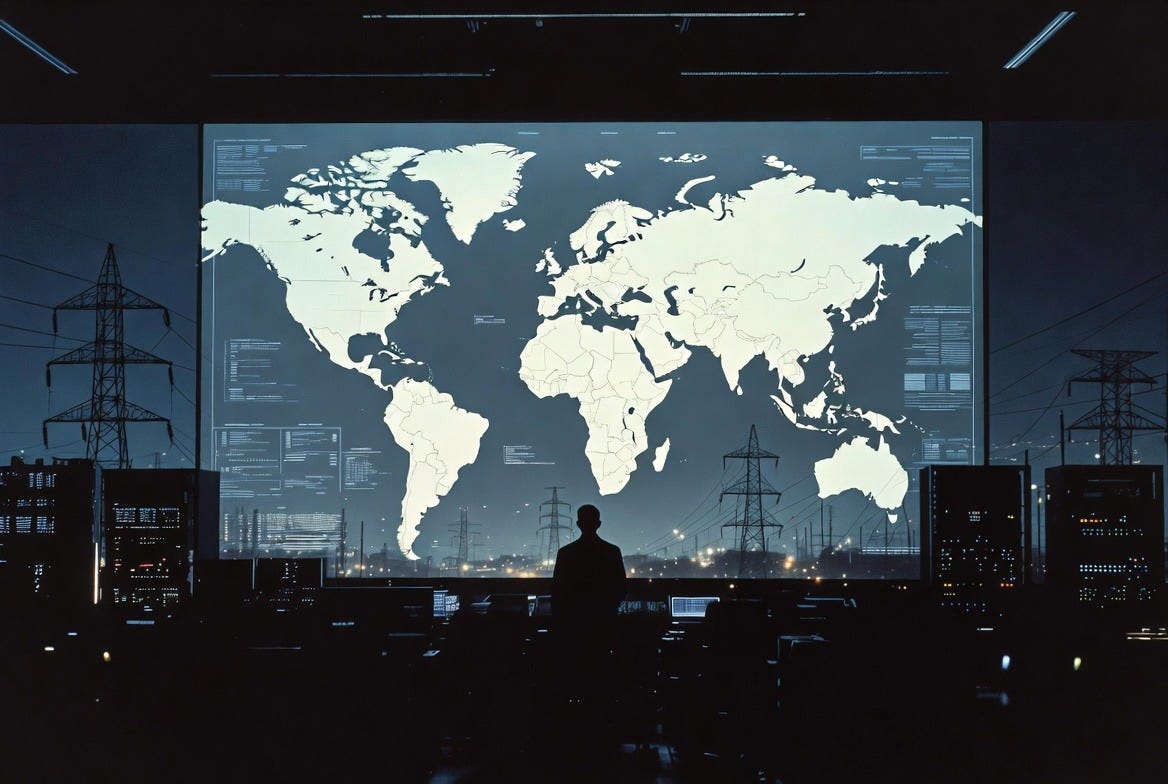
The operator will look at the screen and see the map lit cleanly at last: borders, claims, payments, risks, schools, firms, veterans, hospitals, cities, substations, drones, models, courts, citizens. For a moment this will seem like victory. The system will know where things are. It will know what is delayed, what is missing, what is fraudulent, what is inefficient, what is exposed. The old opacity will look like cowardice. The new legibility will look like mercy.
The merchant will look at a different screen and see the league forming: members, charters, escrows, routes, models, contracts, disputes, credits, ports, cloud regions, arbitration rooms, reputation scores, translation layers, trusted agents. For a moment this too will seem like victory. Strangers will find one another. Obligations will be recorded. Disputes will be settled. Capital will move. Work will assemble. The old loneliness of commerce will look as if it has been solved by protocol.
Then the deeper failure will return, not as philosophy but as an error no dashboard or charter can clear. The system may learn to recognise claims without restoring obligation, to process citizens without making them necessary, to optimise movement without creating belonging, to detect risk without producing trust. The league may learn to enforce contracts without building solidarity, to certify members without forming a common life, to lower the cost of trust without deepening the meaning of trust.
The map will not have absorbed the territory. The charter will not have replaced the home. Recognition is not relation. Membership is not belonging. Operability is not life.
This is the oldest danger in the newest machinery. The machine republic may not fail because it crashes. It may fail because it works: because the file moves, the border predicts, the school sorts, the benefit processes, the drone sees, the model advises, the grid feeds the data centre, and still the human being cannot discover where, in all this competence, he is needed by another human being.
The machine Hansa may not fail because commerce collapses. It may fail because commerce succeeds too narrowly: because the contract executes, the escrow clears, the reputation holds, the model translates, the dispute resolves, the route opens, and still the human being discovers that being trusted to transact is not the same as being needed to live.
The question is not which machine civilisation has more intelligence. It is not even whether sovereignty or commerce recruits the machine first. The question is which forms — republic, Party, city, league, guild, school, family, church, firm, neighbourhood, port — can use intelligence without making human beings less necessary to one another.