The Silver Stack and the Mixed Standard
What China’s layered monetary past reveals about the world that is coming


Chinese lady taking delivery of one metric ton of silver, Shanghai Gold Exchange, Eric Yeung 27 Nov 2025
SECTION 1 — The Return of Monetary Pluralism
On a bright street in southern China, a young woman sits on a stack of silver ingots, scrolling through her phone. Scooters idle nearby, street vendors call out, delivery riders in mirrored helmets hover between stops. She does not look at the silver beneath her feet; she is not meant to. She is resting, quite casually, on seven centuries of Chinese monetary history without needing to think about any of it.
The scene is almost too perfect to analyse directly. But it offers a small aperture into a larger structure: a reminder that beneath the digital surfaces of contemporary life lies a sediment of older practices, older instruments, and older instincts about what makes value credible in a world too large to be governed by a single measure.
Silver—actual, physical, heavy—once wired the metabolism of the world’s largest economy. It served as the reserve asset of the Ming and early Qing, the gravitational centre of a global bullion system, the unit of account for taxes and rents, and the material anchor of long-distance trade. It flowed from Japanese mines and from the Potosí mountain of the Andes into the ports of Fujian and Guangdong not because China was a passive sink for Western metal, but because the scale and density of its commercial life pulled silver toward it, in much the same way digital capital and users now accumulate in the orbit of a large platform.
And here silver sits again, under the weight of an ordinary day. The woman’s phone—its QR codes, payment apps, cloud credit and algorithmic recommendations—belongs to a world of instant settlement and near-frictionless movement. Yet the ingots belong to an older world, one in which value travelled more slowly and trust was verified by weight, assay, and reputation. Both forms coexist without contradiction: a twenty-first-century monetary skin resting on a deep metallic substrate. Past and present are not opposites here; they are layers.
For much of the modern era, the West has imagined the evolution of money as a march toward singularity: the consolidation of diverse tokens into a unified national currency, the rise of central banks, the gold standard, and eventually the dollar order of the twentieth century. Deviations from this path have been read as weakness or immaturity. In such narratives, China’s historical reliance on multiple monetary forms—copper cash, paper notes, and silver bullion—appears as a failure to converge on the European ideal.
But that narrative misses the structure entirely. It treats the Western experience as universal when, in fact, the Western experience is the anomaly.
What China built between roughly 1000 and 1700 was not a defective precursor to modernity but a functional, layered monetary ecology. Copper cash sustained everyday exchange; paper notes circulated through administrative channels; silver settled accounts across long distances and served as the anchor for rents and taxes. These layers coexisted, intersected, arbitraged, and stabilised one another through a network of guilds, local treasuries, shopkeepers, assayers, and merchant institutions—centuries before the term “layered money” would be rediscovered in digital form.
The world we are entering—fragmented, multi-asset, corridor-driven, and increasingly anchored in infrastructure rather than sovereignty—resembles, in its underlying logic, the world this woman inhabits. It resembles, too, the world beneath her: one in which monetary life is not held together by a single standard but by the capacity of different instruments and institutions to coexist without demanding one another’s disappearance.
She is the prologue.
The argument begins now.
SECTION 2 — Europe Might Just Be the Anomaly
It has long suited the West to imagine the history of money as a gradual ascent from confusion to clarity—from the clutter of local tokens and improvised instruments to the clean sovereignty of the modern national currency. In that telling, the gold standard appears not as a contingent artefact of a particular political moment, but as the culmination of a natural evolution. Everything before it is provisional; everything after it, including the dollar order of the twentieth century, is treated as a lingering afterglow of this achievement.
The difficulty with this narrative is that it mistakes a narrow and, by global standards, deeply provincial episode for a universal trajectory. For most of human history, monetary life was not a single system but a dense thicket of overlapping regimes. Coins of various weights and issuers circulated alongside bullion; credit instruments proliferated in forms shaped as much by local custom as by royal decree; and payment systems evolved through practice rather than design. The notion that a single unit, uniformly legible across a large territory, should serve as the final arbiter of value was anything but obvious. Where it did arise, it was typically the result of protracted coercion by states whose capacity for extraction and surveillance far exceeded those of their predecessors.
Premodern China, often cast as an outlier to this imagined progression, is better understood as its clearest counterpoint. Over many centuries, the empire sustained a plural monetary ecology that scholars such as Richard von Glahn and Li Bozhong have reconstructed in fine detail. Copper cash, cheap to mint and familiar to households, remained the backbone of everyday markets. Periodic experiments with paper money expanded administrative flexibility, though always under the shadow of over-issuance. And above these circulated silver: the preferred medium for settlement, long-distance trade, and taxation, whose authority emerged not from imperial decree but from the practical fact that no single instrument could meet the demands of a vast and heterogeneous realm.
What struck European observers as disorder was, in fact, a pragmatic accommodation to scale. A polity that spanned rice deltas, loess plateaus, and semi-arid northern frontiers could not reasonably expect a single currency, minted centrally, to circulate uniformly. Exchange ratios between copper, silver, and paper varied by region because the ecological and economic circumstances that sustained each varied as well. The imperial state intervened—relaunching coinage, adjusting denominations, policing counterfeits—but these interventions never produced the uniformity that later historians would retroactively expect. Instead, they coexisted with much older, decentralised mechanisms of trust, discount, and credit, administered by actors embedded within the daily rhythms of exchange.
The gold standard’s apparent coherence in the late nineteenth and early twentieth centuries was less the natural expression of a universal logic than a reflection of a particular alignment: high imperialism, industrial tax extraction, and the expanding power of fiscal–military states. Even then, its stability was intermittent. It lurched through crises, fractured in the interwar years, and survived only when the United States was willing and able to shoulder a disproportionate share of global risk. Bretton Woods, hailed as the apex of monetary architecture, held together only so long as the world remained small enough—politically and economically—to be stabilised by a single centre.
Seen from a longer vantage, China ceases to be the deviant case. It becomes, instead, one of the clearest examples of how large civilisations manage monetary life when scale, geography, and administrative constraints make uniformity impractical. The coexistence of copper, paper, and silver was not a sign of arrested development; it was a recognition that complexity could be absorbed rather than suppressed. The market, not the state, frequently settled which instrument would be trusted for which purpose. Monetary practice emerged from negotiation rather than decree.
This perspective makes the present moment easier to parse. The global monetary order is loosening into plural forms—offshore dollars, private liquidity instruments, regional currency arrangements, digital payment platforms. Under these conditions, the Western narrative of inevitable convergence becomes less an explanation than an artefact of a historical moment already passing. The world now looks less like the imagined European trajectory and more like the older Chinese condition: differentiated, layered, and governed by the pragmatics of scale rather than by the pursuit of a single measure.
China’s past, in this sense, is not the prelude to modernity’s neat consolidation. It is a reminder that plurality, for most of recorded history, has been the rule.
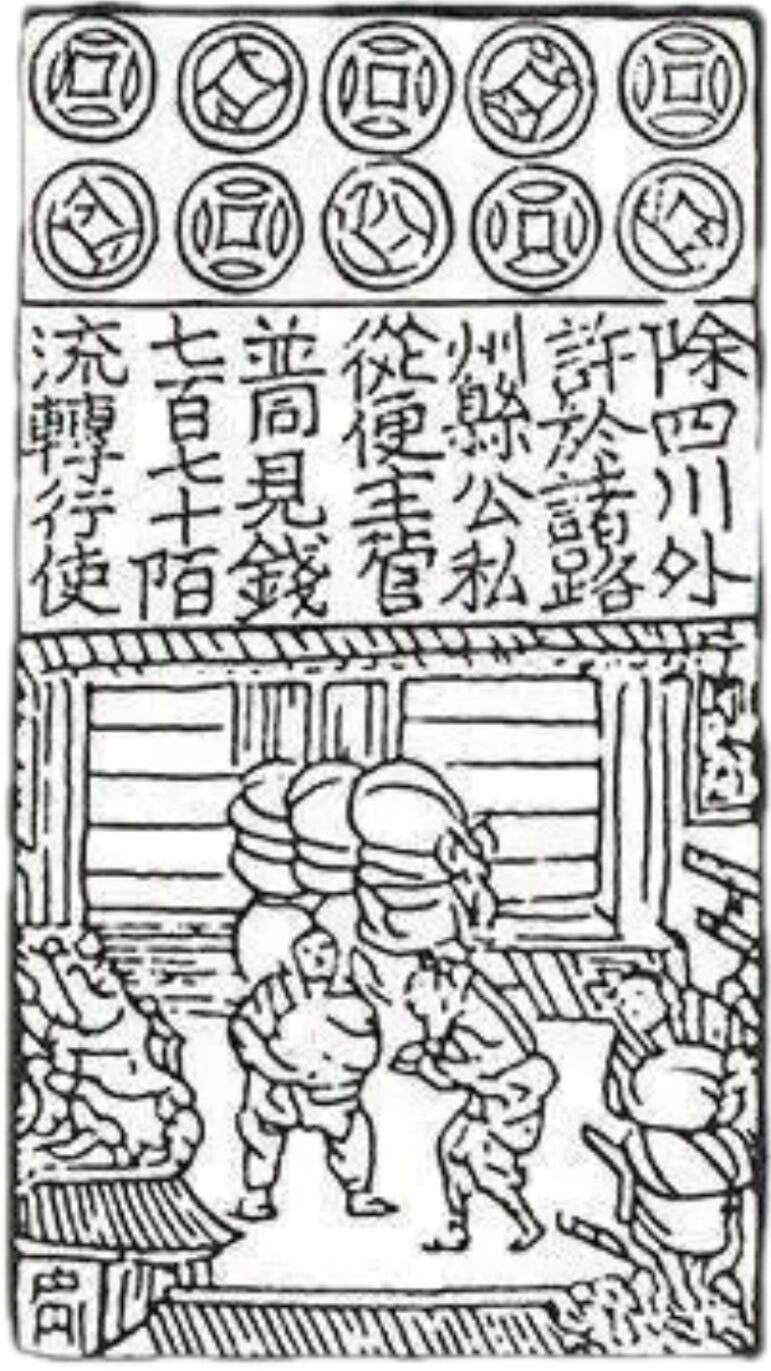
Song paper money
SECTION 3 — The Silver Stack: China’s Multi-Asset Monetary Ecology, 1000–1700
To understand how China’s monetary system functioned across seven centuries, it is necessary to set aside the expectation—still embedded in much Western economic thought—that a currency should ideally be a single, coherent, state-issued object. In China, money behaved less like a unified institution than like a set of overlapping practices whose stability arose not from uniformity but from the capacity of diverse instruments, regions, and actors to coexist without erasing one another. What emerges from the work of von Glahn, Li Bozhong, and other historians is a picture of a civilisation that governed monetary life by managing heterogeneity, not suppressing it.
The ecology did not begin with silver at its apex. In the Song period, a time of extraordinary commercial expansion, everyday exchange depended primarily on small round copper cash coins. Their advantages were straightforward: they were cheap to mint, durable, divisible, and widely recognisable. The Song state attempted to regulate their supply—sometimes with sophistication, sometimes with frustration—but the sheer scale of the empire ensured that cash remained unevenly distributed across regions.
Paper notes circulated alongside copper. Frequently celebrated in later narratives as evidence of China’s innovative spirit, they were in practice a pragmatic response to copper shortages and rising administrative demand. When issuance remained tied to redeemability and the fiscal capacity of the state, these notes could be stable; when over-printed, they quickly lost credibility. Their fate was thus largely determined by the constraints of administration, not by a theoretical ambition to transform monetary practice.
The Yuan dynasty inherited these experiments and extended them with greater boldness. Yet the pattern remained one of oscillation rather than linear progress. Periods of stability alternated with episodes of depreciation; acceptance varied by region; and throughout, merchants and officials continued to rely on metal—particularly silver—for larger or distant payments. Silver’s prominence grew not because it was mandated from above, but because it met needs the other instruments could not reliably satisfy. As copper supply became inconsistent, and as the spread between the nominal and real value of paper widened, silver acquired its authority through portability, durability, and a reputation anchored in the institutions that handled it.
By the mid-Ming period, this emergent hierarchy had cohered into something durable. The empire did not mint silver into coins; it had no sovereign currency in the modern sense. Instead, silver circulated in the form of sycee ingots: moulded shapes of varying weights, assayed and stamped by merchants, guilds, or local institutions whose reputations provided the credibility the state could not. In theory, this should have produced chaos. In practice, it created a decentralised but remarkably effective system of verification and trust. Assayers, brokers, guild halls, pawnshops, escort firms, and long-distance merchants together formed an infrastructure of credibility that imperial decrees alone could not replicate.
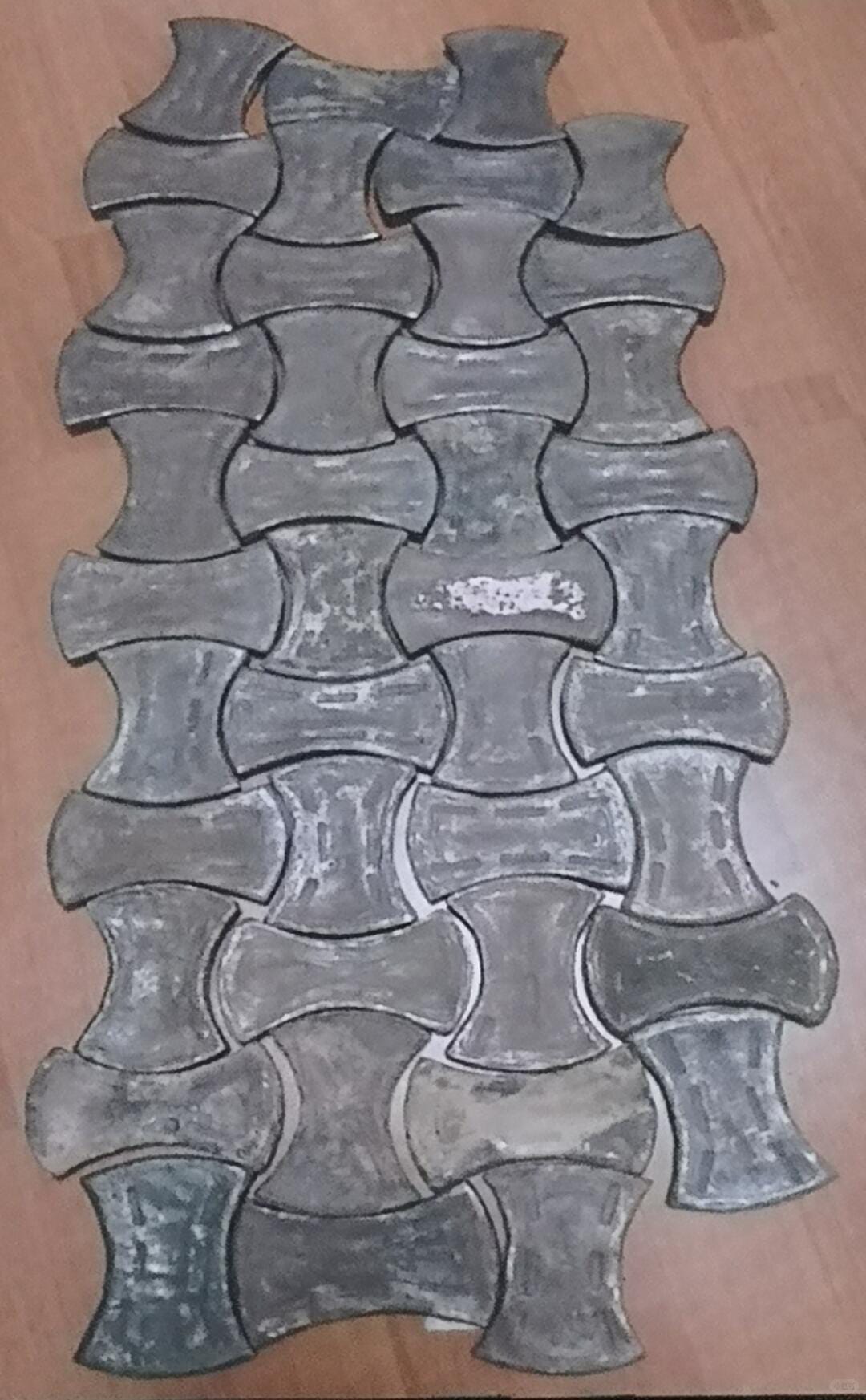
Song sycee silver ingots, sycee transliterates xisi or fine silk, meaning fine silver that could be turned into silver wire for jewellery
Copper did not disappear. Small markets continued to use it, and as official minting waned, private casting and foreign coins filled the gap. Paper, too, never vanished entirely, though its role narrowed. The result was a system in which three monetary forms coexisted, each serving a particular stratum of economic life. Their exchange ratios floated according to local scarcity, demand, and confidence. Rates varied not only between provinces but sometimes between neighbouring counties. Yet this absence of a single authoritative rate did not impede commerce. On the contrary, it allowed regions to absorb shocks—harvest failures, transport disruptions, political disturbances—without precipitating systemic breakdown.
The dramatic inflow of foreign silver in the sixteenth century, from Japanese mines and the Manila galleon trade, did not transform this structure so much as reinforce it. Silver became increasingly used as the unit of account for tax obligations—formalised through the “single whip” reforms—and thus acquired a fiscal centrality it had not previously possessed. Yet even this shift reflected domestic logic as much as global force. The scale of the commercial economy was such that even large silver inflows did not overwhelm it. Prices remained comparatively stable; silver stocks rose gradually rather than explosively. The “silverisation” of the Ming was, therefore, less a story of dependency than of endogenous alignment: the market selecting the instrument that best accommodated the demands of an expanding fiscal and commercial order.
With hindsight, it is tempting to impose coherence on what was in reality a shifting equilibrium. The state periodically attempted to reassert control—through new coinage, crackdowns on counterfeits, or experiments with alternative issues—but these interventions produced only temporary adjustments. The deeper logic of the system lay in everyday routines: a shopkeeper weighing an ingot, a broker adjusting a discount, an official recalculating a tax quota, a merchant balancing copper and silver in response to local scarcity. Monetary order emerged from the interplay of these practices, not from any central plan.
The crisis of the seventeenth century—marked by rebellions, climatic pressures, fiscal strain, and the eventual Ming collapse—is often read as a failure of this plural system. Yet the evidence is equivocal. Silver inflows contracted, but not catastrophically. Exchange ratios fluctuated, but unevenly. The crisis was political and ecological, not simply monetary. When the Qing established itself, the silver–copper hierarchy reasserted itself with minimal institutional reconstruction, suggesting that the underlying system was less fragile than the dynastic cycle might imply.
To describe this long trajectory as proto-modern is to distort it; to describe it as proto-DeFi is to mistake coincidence for teleology. It is more revealing to see it as a civilisation’s accommodation to its own scale. China sustained a plural monetary system not because it failed to unify, but because unification, at that scale, would have been distorting. Flexibility and redundancy—multiple units, floating ratios, decentralised credibility—were not defects but structural necessities.
Silver’s prominence was, in this sense, less a triumph than a settlement: a recognition that stability, in a world too large for a single instrument to dominate, arises from the interplay of many forms. It is a lesson that modern monetary history briefly set aside—and one that the present landscape, with its proliferation of instruments and infrastructures, appears once again to be relearning.
SECTION 4 — The Analogy: Modern Fragmentation and China’s Long Memory
Surveying the contemporary landscape of global finance, it is difficult not to notice how far the world has drifted from the unified monetary ideal that dominated the late twentieth century. The dollar remains pre-eminent, but its authority is now exercised through increasingly diffuse channels: offshore dollar markets, shadow banking liquidity, private credit networks, and a proliferating array of digital instruments that sit adjacent to, rather than within, the jurisdiction of any single state.
Stablecoins track the dollar while operating outside its regulatory perimeter. Central bank swap lines, once emergency provisions, have become routine features of crisis management. Commodity-linked agreements stabilise energy flows without invoking traditional exchange mechanisms. And digital payment systems—domestic and cross-border—now move value through technical architectures that never pass through central bank balance sheets at all. The monetary system has not fractured; it has dispersed.
It is common to describe this as fragmentation, but the term implies a fall from coherence into disorder. What seems to be emerging instead is a form of plurality that has become necessary to manage the scale and complexity of contemporary economic life. The idea that a single instrument should dominate all others, or that monetary stability requires the consolidation of liquidity into one sovereign architecture, begins to look like a notion specific to the geopolitical and technological conditions of the mid-twentieth century—a period in which the world was smaller, more hierarchically organised, and more amenable to centralised discipline.
The comparison with China’s earlier experience is not meant to collapse eras separated by vast differences in technology and political form. But there is a structural rhyme. Both systems—premodern China’s multi-asset ecology and our own expanding constellation of financial instruments—confront a similar problem: how to stabilise value in an environment too large and too intricate for a single authority to oversee in totality. When scale exceeds the capacity of any one institution, multiplicity ceases to be a sign of disorder and becomes a pragmatic accommodation.
If one examines closely the mechanisms through which trust is established today—custody arrangements, collateral hierarchies, clearing protocols, internal ratings, algorithmic stabilisation—the resemblance to older practices becomes clearer. The distributed credibility once provided by assayers, guild halls, escrow networks, and local brokers now reappears in technical form: custody banks that guarantee settlement across jurisdictions, clearinghouses that mutualise risk, platform-level reputational systems that stand in for older commercial bonds. In each case, trust is not monopolised but distributed across institutionally diverse actors.
This is not to say that the analogy is perfect. The technologies that mediate today’s transactions—cloud infrastructures, cryptographic protocols, digital ledgers—bear little resemblance to those that once governed the weighing of silver or the discounting of copper. But the deeper logic is similar. Stability arises not from unification but from the coordination of differentiated instruments, each suited to a particular domain of use.
This makes the present moment easier to interpret. The apparent disorder is, in many respects, the re-emergence of a long-standing pattern: monetary systems tend to become plural when scale exceeds the reach of central authority. Premodern China learned this pragmatically, through centuries of dealing with the tension between administrative ambition and geographic complexity. The modern world is encountering the same tension, though under very different conditions.
The photograph from the opening section—an ordinary woman scrolling through her phone while resting on a pile of silver—captures this continuity more plainly than theory can. The ingots belong to a world in which value was heavy, slow, and dependent on institutions of assay and reputation. The phone belongs to a world in which value moves at the speed of code. Yet the two are not opposites. They are layers, each performing a function the other cannot easily replicate.
This is the force of the analogy: not that the present is becoming like the past, but that both are shaped by the same underlying challenge—how to maintain coherence without insisting on uniformity. The rhyme is enough.

15 KG of 99.99% pure Silver each, she is sitting on roughly US$1.7mil, price as of 27 Nov 2025
SECTION 5 — The Contemporary Return to Plurality
In recent years, it has become common to describe the international system as drifting away from a dollar-centric order, as though what is at stake were a straightforward contest between incumbency and replacement. This framing is misleading. The dollar’s global role is not disappearing; its reach remains immense. What is shifting is the terrain on which it operates and the mechanisms through which its influence is expressed.
For much of the postwar period, the dollar’s authority ran through formal institutions: international banks, correspondent networks, multilateral organisations, and the settlement infrastructures of a world still organised around a few powerful states. Today, that authority is refracted through arrangements that sit far less neatly within the boundaries of national regulation. Offshore dollar markets—eurodollars—create liquidity independently of U.S. monetary policy. Stablecoins replicate dollar-denominated claims in digital form while circumventing many of the frictions of the traditional banking system. Private credit networks operate with the scale and speed of public money markets but without their supervisory frameworks. The result is an informal dollar empire whose borders are perceptible only in moments of stress.
Alongside this offshored architecture is the steady rise of regional systems. Central bank swap lines—initially conceived as crisis tools—now bind monetary authorities together with a regularity that the designers of Bretton Woods did not anticipate. China has established its own network of swap arrangements across Asia, Africa, and the Gulf, not to contest the dollar’s supremacy but to alleviate specific liquidity constraints in trade and investment. Gulf energy flows, long tied to the petrodollar regime, now experiment with settlement mixes that hedge exposure to a single currency. Even within Europe—nominally a unified monetary space—TARGET2 imbalances, divergent bond spreads, and national banking differences reveal the presence of multiple internal regimes.
What binds these developments together is not a coherent alternative to the dollar but a quiet reversion to a more variegated system. Monetary order is becoming a patchwork of overlapping zones—public, private, regional, and infrastructural—each operating according to its own logic. The infrastructures that sustain these zones are often non-sovereign: cloud systems that host digital payment rails; messaging protocols that route transactions; collateral networks that operate below the surface of central bank balance sheets. These systems do not undermine monetary authority so much as dilute the possibility of a singular authority.
It is here that China’s long history offers a useful vantage point. The renminbi has not become a global reserve currency, and China has shown little appetite for engineering such an outcome. Instead, it has pursued a quieter project: the construction of corridors—material, financial, and digital—through which trade, settlement, and investment can move with reduced dependence on a single channel. The Belt and Road’s financial armatures, commodity-linked agreements with Gulf producers, and the role of Singapore as a trusted intermediary all point to a world in which stability emerges from multiple centres rather than from a single one.
This does not herald a neatly multipolar world. It suggests something more intricate: a distributed architecture in which monetary life resembles an archipelago of interconnected nodes. Each node—whether anchored in production, energy, capital flows, or compute—exerts influence within its own domain. None is fully sovereign; each depends on the others for liquidity, credibility, or settlement. The dollar remains a central island in this archipelago, but it is no longer the only one.
The resemblance to China’s older monetary logic is not a matter of instruments but of structure. Just as the imperial economy relied on copper, paper, and silver to perform differentiated roles, the contemporary world relies on a variety of monetary forms whose coexistence reflects the complexity of global production and trade. The system is not anarchy; it is an accommodation to scale.
The shift is subtle but consequential. A world that no longer aspires to monetary singularity must confront the fact that stability will depend on managing connections rather than imposing uniformity. As new layers of infrastructure—digital, logistical, computational—settle atop older forms, the system becomes both more resilient and more dependent on coordination that does not originate from any single authority.
In this respect, the future looks less like the mid-century order of unitary sovereignty and more like the older pattern China managed by necessity: a world in which multiple forms of money coexist, sometimes uneasily, but with enough mutual adjustment to sustain the movement of value across distance.
SECTION 6 — The Civilisational Question
The persistence of monetary plurality in a large polity raises a question that is ultimately civilisational rather than strictly economic. It concerns how societies imagine trust, authority, and the appropriate reach of the state. Premodern China offers an instructive case not because of any unique philosophical sophistication about money, but because it inhabited, over a very long period, the ambiguities of scale that modern states only briefly encountered before attempting to discipline them.
The imperial state’s relationship to money was marked by a kind of practical ambivalence. Officials understood the importance of credible instruments of exchange—the classical texts warn repeatedly against debasement, hoarding, and the miscalibration of weights and measures. Yet the state rarely behaved as though it could fully command monetary life. Its capacity to mint enough copper to meet the demands of the realm was always constrained. Its experiments with paper money oscillated between stability and collapse. And while periodic reforms attempted to bring order to the system, these efforts were typically partial, local, and circumscribed by administrative limits.
This ambivalence reflected not indifference but recognition. Monetary uniformity in a vast, ecologically varied empire would have required a degree of control for which the administrative machinery of any dynasty was ill-suited. The state therefore directed its energies elsewhere—toward maintaining political cohesion, managing agrarian cycles, and negotiating the perennial tensions between centre and province. Monetary coherence, when it existed, emerged not from decrees issued in Beijing but from the practices of the people and institutions who moved money across the realm.
Filling the gap between state intention and material constraint was a diverse world of intermediaries: merchants, brokers, guilds, pawnshops, remittance agencies, escort firms, and the myriad quasi-formal institutions that carried information about trustworthiness and value. These actors did not think of themselves as architects of monetary stability, yet their accumulated routines—assaying ingots, discounting notes, negotiating exchange ratios—formed a distributed infrastructure of credibility more resilient than any singular monetary instrument. Through them, silver acquired its stable place; copper maintained its utility; and the system absorbed large inflows of foreign bullion without destabilising inflation. If this arrangement lacked conceptual clarity, it nevertheless sustained the economic metabolism of the world’s largest polity.
The political form that emerged from this arrangement was neither fully centralised nor decentralised. It resembled a layered system of overlapping authorities, each responsible for a different range of functions. The state set parameters—tax obligations, salaries, official accounts—while leaving large portions of monetary negotiation to actors embedded in local commercial life. It was not a system designed to produce unity; it was one designed to survive heterogeneity.
For much of the modern period, Western thought has struggled to appreciate this sensibility. Monetary sovereignty was made to coincide with territorial sovereignty; a currency was to be the emblem of a state’s authority, and the state’s authority presumed to encompass the entire field of monetary life. Yet this assumption was viable only under the dense institutionalisation and limited technological permeability of the mid-twentieth century. As globalisation, financial innovation, and digital networks eroded the state’s capacity to observe and regulate every transaction, the idea that monetary life could be contained within a single jurisdiction began to fray.
The contemporary world, shaped by an entanglement of public currencies, private credit, digital tokens, and computational infrastructures, resembles the older Chinese understanding of scale more than the modern European one. States remain central, but they operate alongside platforms, consortiums, and infrastructural actors whose influence derives not from sovereignty but from embedding. Under these conditions, the desire for a singular monetary order appears less a necessity than an artefact of a bygone political arrangement.
This, ultimately, is the civilisational lesson of China’s long monetary history: that money is not a moral project of purity but an organisational project of accommodation. It is not the demonstration of a state’s total authority but the residue of its limits. Stability emerges less from suppressing difference than from managing it. The modern pursuit of singularity obscured this older truth. As that desire dissolves, it becomes possible to see once more what China learned through centuries of practice: that monetary coherence need not arise from unity, but from the ongoing negotiation of plurality.

One such intermediary would be Qing equivalent of banks or Piaohao票号, pictured is the Risheng Piaohao in Pingyao 平遥日升昌票号
SECTION 7 — Corridors, Commodities, and Compute
If today’s world is rediscovering the uses—and limits—of monetary plurality, it is doing so through material substrates that differ profoundly from those of earlier centuries. Silver no longer anchors the system; few commodities do. Yet the logic that once made silver central to China’s monetary ecology—the idea that trust ultimately adheres to the material conditions of production, circulation, and verification—has not disappeared. It has migrated. What mattered then was the physical infrastructure of mines, mints, guilds, and caravan routes. What matters now is an assemblage of corridors, commodities, and compute—three domains that together shape how value moves, how credit is extended, and how risk is managed across an increasingly uneven world.
The first of these substrates is the corridor—the physical channels that underwrite contemporary trade. Oil pipelines linking the Gulf to export terminals; maritime routes stitching together the South China Sea, the Malacca Strait, and the ports of the Indian Ocean; rail lines connecting the interior of Eurasia to its coasts. These are not monetary instruments, yet they condition monetary practice. The more economically significant a corridor becomes, the more likely it is to develop its own conventions for pricing and settlement. Thus we see, in the Gulf–China energy trade, tentative but persistent experiments with partial renminbi settlement or hybrid invoicing baskets; in Southeast Asia, local-currency settlement arrangements that reduce reliance on the dollar for routine trade. Their scale remains limited, but their logic is durable: monetary arrangements accumulate around the infrastructural routes through which goods and risk actually move.
A second substrate lies in the commodity infrastructures that sit beneath global production. China’s role in processing rare earths, producing steel and aluminium, and shaping upstream battery and solar-panel supply chains gives it forms of embedded leverage that are not strictly monetary but nonetheless condition the terms on which value is exchanged. These capacities do not translate neatly into reserve-currency status—an outcome that requires institutional architectures China has little appetite to construct—but they do enable regional settlement conventions and collateral arrangements that coexist with, rather than challenge, the dollar system. Influence here is incremental and infrastructural: not a bid for supremacy, but a slow thickening of the conditions under which particular monetary forms make sense.
The third substrate—still poorly theorised, yet increasingly consequential—is compute. As AI models, cloud architectures, and sensor networks become integral to economic coordination, the provision of computational capacity begins to resemble a kind of infrastructural money. It is scarce, rentable, and required for nearly every type of economic calculation. The firms and states that control large clusters of compute—hyperscalers in the United States and Gulf states, semiconductor ecosystems across East Asia, cloud-service operators in Singapore and Shenzhen—shape flows of credit and information in ways that traditional monetary theory has difficulty describing. Computation does not replace existing monetary instruments, but it forms another layer of the system: a substrate that silently governs the feasibility, speed, and reliability of the transactions above it.
These three domains—corridors, commodities, and compute—are not analogous to one another. But they share something with the role silver once played: each provides a material anchor that stabilises particular regions of economic life. They are not standards, but contexts. They determine why certain monetary practices gain traction in one region while remaining peripheral in another. In this sense, they help explain why the contemporary system is not converging on a single architecture. The infrastructures that sustain global production are too varied, too distributed, and too embedded in local conditions to support a universal measure.
What emerges, then, is a system that resembles the ecological logic of earlier large polities—China most prominently—where multiple instruments coexisted because no single one could accommodate the diversity of uses demanded by the world beneath it. The novelty today lies not in the plurality itself but in the technological mediators through which that plurality is expressed. Value moves along fibre-optic cables and cloud services rather than caravans and river barges; collateral is defined by algorithmic criteria rather than by metal content or assay marks. But the underlying problem remains familiar: how to maintain coherence across a world too large and too uneven for a single unit to govern.
Seen this way, the contemporary sense of disjunction is not evidence of disorder. It is evidence of an order that is changing form. As the corridors lengthen and the infrastructures thicken, the monetary system arranges itself around them in ways that bear little resemblance to the centralised schemas of the twentieth century. The resulting architecture is layered, differentiated, and reliant on intermediaries whose power lies not in sovereignty but in infrastructural embedding.
In this respect, the world is drifting—quietly, and without prescriptive intent—toward a condition that China once managed by necessity: a condition in which stability arises not from enforcing uniformity but from accommodating difference. The materials have changed; the scale has grown; the technologies are incomparable. But the logic is recognisable: money finds its form in the infrastructures that sustain it.
SECTION 8 — The Return of the Mixed Standard
The notion of a “standard” in monetary life—gold, the dollar, or any other unit elevated to universal reference—has long been accompanied by an air of inevitability, as though the world naturally gravitates toward a single measure. Yet the history of standards is much closer to the history of settlements: temporary alignments of political will, technological capability, and economic geography. When those alignments shift, the standard that once appeared unassailable reveals the scaffolding that supported it.
What appears to be emerging now is not the rise of a new hegemonic standard, but the return of a mixed standard: a condition in which multiple units of account, collateral types, and settlement channels coexist without any single one achieving uncontested primacy. This is not a novel arrangement. It echoes earlier periods in which silver coexisted with copper and paper in China, or in which sterling, the dollar, and the franc formed overlapping monetary zones in the early twentieth century. But the forces shaping today’s mixed standard are different—less geopolitical than infrastructural, less ideological than pragmatic.
The dollar remains central, but its centrality is increasingly situational. Its infrastructures—Treasury markets, legal regimes, clearing systems—retain unmatched depth and reliability. Yet the range of monetary functions that can be efficiently served by a single instrument has narrowed. Trade finance, for instance, now makes use of commodity-backed credit arrangements tailored to specific corridors. Large corporates manage operational liquidity through stablecoins because they clear faster than traditional rails. Regional payment systems in Asia and Africa reduce exposure to dollar volatility through local-currency settlement mechanisms. And a growing number of states experiment with digital currencies designed not to replace global money but to stabilise domestic payment ecosystems.
What links these developments is the recognition that no single standard can plausibly orchestrate all monetary activity in a world whose infrastructures are so unevenly distributed. The idea that monetary hierarchy maps cleanly onto geopolitical hierarchy—an assumption that underwrote much of the mid-century dollar order—now sits uneasily with the reality that influence flows through channels less visible than formal reserve holdings. The ability to produce energy, refine metals, manufacture semiconductors, operate cloud infrastructure, or control strategic logistics gives states a form of leverage that is not captured by conventional measures of monetary power.
China’s position within this emerging archipelago is distinctive not because of the renminbi’s international reach—which remains modest—but because of the country’s embeddedness in the physical and digital infrastructures that underwrite global production. Its role in manufacturing, its dominance in certain critical materials, and its expanding presence in cloud and compute all give it forms of influence that do not require a reserve currency to exercise. Instead of projecting monetary power outward, China thickens the infrastructural contexts in which particular monetary practices become viable. The result is not an alternative order but a series of parallel conventions that stabilise regional flows.
A mixed standard does not eliminate hierarchy. Some assets will remain more widely accepted as collateral; some currencies will continue to anchor global portfolios; some infrastructures will be more trusted than others. But the relationships among these hierarchies will be more fluid and more conditional than the singular architecture of the twentieth century allowed. The question is no longer “What will replace the dollar?” but “How will different standards coexist, overlap, and sometimes interfere with one another in a system too large for any single unit to govern?”
In this light, the old Chinese system offers something more like a sensibility than a model: an understanding that monetary life tends to organise itself in layers, that coherence is achieved through interaction rather than uniformity, and that instruments persist not because they are universal but because they are legible to the people who need them. The sycee ingot—credible because it could be weighed, assayed, and recognised—served its purpose not as a global standard but as an anchor for particular circuits of exchange. Today, its analogue is not a single instrument but a distribution of anchors: U.S. Treasuries for some functions, industrial metals or energy contracts for others, and compute capacity for a growing set of transactions.
To speak of a mixed standard is therefore not to forecast a return to monetary anarchy. It is to recognise that the coherence promised by the centralised orders of the twentieth century was always provisional. As the material conditions of the world have diversified, so have the monetary forms that mediate them. The result is an order that is unlikely to be singular again—a sober, layered arrangement in which no single measure is absolute and all are contingent on the infrastructures that sustain them.
SECTION 9 — China, Memory, and the Politics of Not Seeking Hegemony
A recurring misapprehension in contemporary commentary is the belief that China must be harbouring a desire to supplant the dollar, and that its apparent reluctance to do so can only reflect either incapacity or strategic dissembling. The assumption is baked into the question: participation in global markets is interpreted as an ambition for monetary hegemony, and any deviation from this trajectory is taken as a failure to meet an expected horizon of power.
Yet China’s behaviour, read closely, points in a different direction. Its financial authorities have shown little urgency in promoting the renminbi as a reserve currency. Capital controls remain in place, not out of ideological attachment but out of recognition that a financial system of China’s size—still in the midst of institutional maturation—cannot be prudently exposed to unrestricted global flows. Offshore renminbi markets exist, but they are maintained with a certain cautious pragmatism. Digital currency experiments address payments efficiency at home rather than reserve ambitions abroad. The country’s swap lines, commodity invoicing arrangements, and cross-border settlement systems are designed to smooth specific frictions, not to declare a new order.
What emerges from this pattern is not timidity but temperament. A civilisation accustomed to managing plurality within its own borders is perhaps less inclined to pursue singularity beyond them. For centuries, China coordinated a large and internally diverse economy without insisting on monetary uniformity. The state governed through layered authority—imperial oversight at the centre, magistrates and guilds at the periphery, intermediaries filling the vast spaces between. Monetary life reflected this structure: coordinated without being unified, elastic enough to accommodate variation without collapsing into incoherence.
In this light, China’s contemporary posture can be read as a continuation of a deeper administrative sensibility. Monetary hegemony demands not only economic scale but a willingness to absorb the world’s crises as one’s own. To supply the world with liquidity is to inherit its volatility; to anchor a global standard is to become responsible for its failures. The United States accepted these obligations under the extraordinary conditions of the mid-twentieth century. China, inheriting neither the same geopolitical environment nor the same institutional architecture, shows no comparable appetite.
This is not to claim that China is disengaged. On the contrary, it is building the material infrastructures—ports, pipelines, industrial supply chains, data corridors, cloud services, compute clusters—through which global value moves. But these infrastructures stabilise flows without demanding that those flows be denominated in a single unit. Influence emerges through participation rather than through the imposition of an external standard. If this can be read as a form of power, it is a power expressed obliquely: infrastructural rather than declarative.
The politics of not seeking hegemony is easy to misinterpret from outside. In traditions that equate international order with competition among dominant currencies, abstention from such competition can appear either evasive or opportunistic. But the emerging global system—with its multiple production centres, differentiated corridors, and distributed technical infrastructures—is not one in which singular monetary authority can be asserted without contradiction. Attempting to discipline such a system from above might generate more instability than it resolves.
China’s approach, then, is better understood as an accommodation to complexity. It is not attempting to supplant the dollar; it is constructing the infrastructural conditions in which diversified monetary arrangements can endure. It builds the channels through which value moves rather than insisting that the value itself take a prescribed form. It declines, in other words, a simplification the world can no longer sustain.
There is a faint echo here of China’s earlier experience managing a plural monetary ecology. The lessons of that era do not map directly onto the present, but they shape a sensibility: careful, incremental, sceptical of grand designs, aware that stability emerges less from domination than from the management of difference. In this sense, China’s memory—its long practice of governing complexity without collapsing it—quietly informs its present posture.
SECTION 10 — Memory, Layering, and the Shape of a Monetary Future
What becomes visible, when one traces the arc from China’s layered monetary past to the heterogeneous present, is that monetary systems develop a kind of structural memory. Not a memory of sentiment or nostalgia, but one embedded in the habits institutions acquire as they adjust to the constraints of their environment. These habits endure long after the circumstances that produced them have changed; they become the quiet grammar through which complexity is managed.
In China’s case, this memory takes the form of layering. Across dynasties, regimes, and territories, monetary life was organised in strata. Copper facilitated daily exchange in markets and households. Paper circulated through administrative channels, convenient for tax and salary payments. Silver settled major transactions, stored wealth, and linked the empire’s regions to one another and to the wider world. None of these layers was fully subordinate to the others; each solved a problem the others could not. The system’s resilience lay not in unity, but in the distribution of functions across instruments with different domains of competence.
Our contemporary system, for all its technical novelty, increasingly exhibits a similar stratification. Sovereign currencies continue to dominate taxation and public debt. Offshore dollars and private credit structures perform many of the functions once monopolised by banks. Digital tokens—stablecoins, platform credits, tokenised deposits—operate where speed, programmability, or cross-border reach matter most. Above these sits a less visible layer: cloud infrastructures, data pipelines, AI models, and compute clusters that mediate the flow of information and credit. Each layer is governed by different logics; each has its own vulnerabilities; none can easily replace the others.
To say the future is layered is not to predict chaos. Properly managed, layering is a source of resilience. Shocks can be absorbed at the level where they occur rather than transmitted across the entire system. Regions and sectors can adopt instruments suited to their needs without requiring universal adoption. No single institution bears the impossible burden of coordinating all forms of value. What layering requires, however, is a sensibility attuned to the idea that coherence arises from interaction rather than from standardisation.
China, because of its long encounter with scale, approaches this sensibility with a certain familiarity. Its historical experience taught it that control is rarely total, that monetary life sits partly inside and partly outside the reach of the state, and that stability depends as much on differentiated practices as on centralised authority. This does not make China an architect of the new system. But it does give it a pragmatism—a wariness of universal solutions—that happens to align with the structural conditions the world is now confronting.
The young lady in the opening scene, absorbed in her phone while resting on a pile of silver ingots, offers a quiet illustration of this layered condition. The silver belongs to a world in which value was heavy, verified by weight, and embedded in physical networks of trust. The phone belongs to a world in which value circulates through code, platforms, and cloud infrastructures at speeds unimaginable to earlier eras. Yet there is no contradiction between the two. They are simply different layers of a long, continuous attempt to make economic life intelligible at scale.
If the twentieth century briefly persuaded many that monetary order could be singular, the twenty-first is revealing the limits of that belief. The coherence that once appeared guaranteed by a dominant currency now depends on a far more intricate interplay of infrastructure, policy, regional practice, and technical mediation. The world is not becoming Chinese; it is becoming too large, too heterogeneous, and too interconnected for singularity to be sustained. In that world, China’s long memory of managing plurality is less a template than a reminder—that stability need not come from one measure, one authority, or one design.
It can arise, instead, from layers.
CP: This multiplicity of future monetary coordination, a money theory of Type one civilisation if you will, has been on my mind for a while. I am grateful to Venkat’s bookclub chats (I think it is 1493?) that poked me to just write something. :)
READING NOTES
Readers wishing to explore the longue durée of China’s economic governance will find von Glahn indispensable, not only for its reconstruction of monetary practice but for its patient refusal of teleology. Austin Dean’s work places China within a genuinely global bullion economy, undoing older narratives in which the Middle Kingdom appears as a passive recipient of Western metal.
For contemporary parallels, Perry Mehrling’s work on the hierarchy of money and the offshore dollar system is essential, while Zoltan Pozsar’s interventions—provocative though they can be—offer a useful account of the material underpinnings of modern liquidity. Speeches by Yi Gang and Zhou Xiaochuan illuminate the quiet pragmatism of China’s approach to financial architecture, and Wang Hui’s writings provide a deeper intellectual background for understanding China as a civilisation accustomed to governing complexity rather than eliminating it.
Together, these works form a composite picture of a world in which monetary life has rarely been singular, and in which the future, like the past, is likely to remain layered.
Great article, with a lot of data for understand the fiscal future. The photograph really says it all.
This piece made me think of the erosion of US-dollar hegemony as a kind of modern reverse of the Ming “single whip一条鞭法” reform. Instead of forcing everyone to convert local resources into a single dominant currency, the global system seems to be drifting back toward a more plural settlement regime, where countries can pay and clear in multiple currencies without routing everything through the dollar. (in the case of single whip, silver was the dominant currency to pay taxes)