The Sixth System
The human claim on machine civilisation

This essay follows Human Surplus and Its Leftovers, The Forms That Bind, The Initiation Crisis, The Machine, the Middle, and the Mud, and Metabolic Sovereignty.
Power, compute, logistics, money and the kill chain can make a machine civilisation formidable. They cannot make it inhabitable.
Power supplies the load. Compute supplies perception. Logistics moves matter. Money clears claims. The kill chain shortens the distance between seeing and acting. Together the five systems allow a polity to build, model, route, spend, deny and strike at machine tempo.
None of them answers the human questions.
Who has a claim on the resulting surplus? How does a young person become competent when novice work disappears? Who carries a household through the transition? Where does someone appeal when a machine-mediated decision touches a job, benefit, bill, permit or body? What makes an ordinary life feel necessary inside a system that increasingly requires fewer ordinary people to operate?
The American listed state offers one answer to the problem of building the machine. It places technological uncertainty inside privately commanded firms and uses public markets as a parallel treasury.
The Chinese training state offers another. It places uncertainty inside territorial coalitions and uses public capital, factories, data and deployment environments to discover what the machine can become.
The form of settlement will differ across the two systems. America must attach public obligations to privately commanded capacity. China must convert publicly organised capacity into secure household claims and independent rights of appeal. Both require the same underlying architecture.
The missing system is settlement.
Settlement is not welfare applied after the machine has finished reorganising society. It is the machinery that converts machine capability into human claim: income, time, transition, care, competence, standing, voice and appeal. It determines whether productivity becomes common room or private command; whether people become citizens of machine civilisation or merely inputs, users and adjustment costs.
Call settlement the sixth system.
What the old settlement did
Industrial modernity was not held together by wages alone.
It bundled production into a larger life sequence: school, apprenticeship, work, colleagues, family, housing, social insurance, citizenship, retirement. The sequence was frequently unequal, coercive and exclusionary. Women, migrants, racial minorities, colonial subjects and people outside standard employment often received weaker claims or none at all.
But the arrangement solved a civilisational problem. It made sacrifice legible.
A person could imagine that present effort might become future standing. Skill could compound. Seniority could thicken. A wage could support a household. Payroll contributions could become healthcare or pension. A junior role could become competence, then authority. The firm required workers, the state required taxpayers and soldiers, and the economy required mass consumers. Ordinary people possessed bargaining power because their participation remained load-bearing.
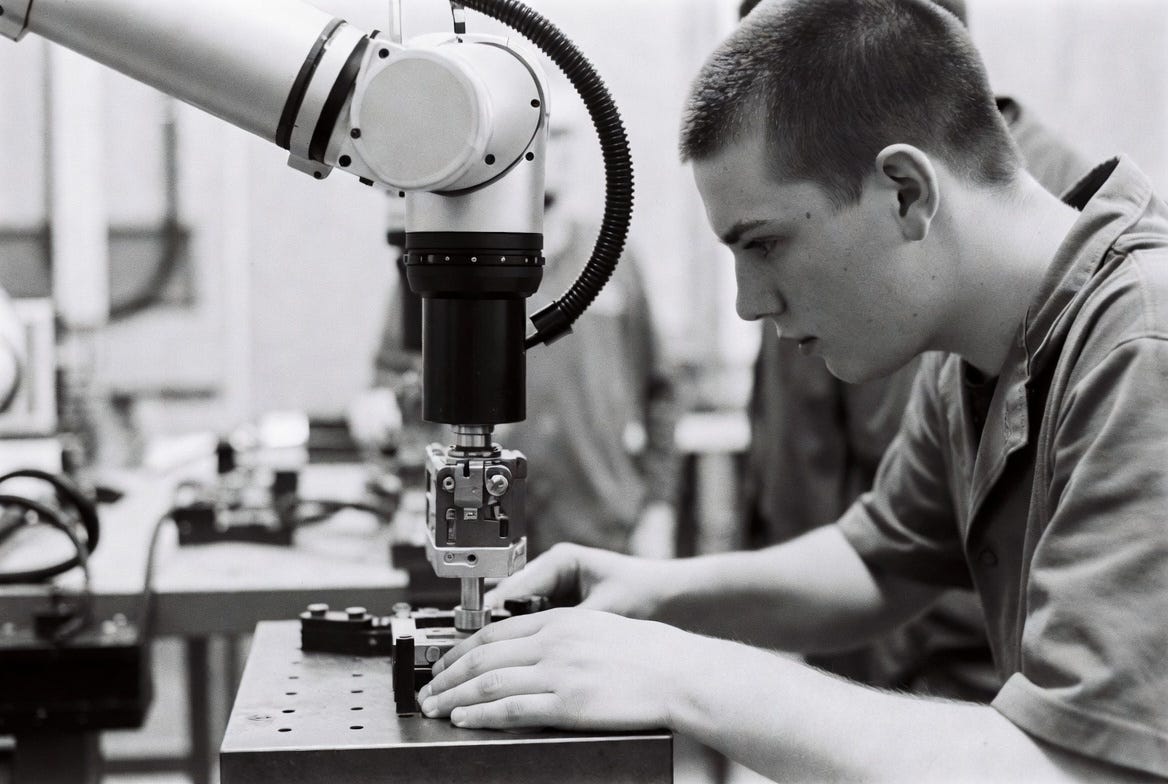
The industrial wage was therefore more than the price of labour. It was the carrier of a settlement.
It carried income, insurance, training, schedule, identity, peers and a recognised position in the social story. Industrial society did not always honour the bargain, but it understood the grammar: productivity had to produce incorporation. A working civilisation needed not only output but people who could narrate why their effort mattered.
Machine civilisation begins unbundling this arrangement.
The firm remains, but its human interior thins. A small team can command a much larger surface of action through models, software agents, contractors, cloud services, payment systems and external platforms. The legal shell still looks like a company; the productive body becomes a stack of authorised services under concentrated supervision.
The job may remain while its developmental sequence disappears. The intern, junior analyst, coordinator, researcher and apprentice were never only cost centres. They were stages through which people learned context, judgment, norms and responsibility. When synthetic cognition performs the preliminary work, organisations may demand senior judgment from people who were never allowed to become junior.
This is the initiation crisis of machine civilisation.
The deepest danger is not simply unemployment. It is a society full of activity without thickening, labour without initiation and productivity without recognised necessity.
The broken circuit
The twentieth-century settlement relied upon a circuit. Human labour produced output; wages sustained demand; payroll and income taxes financed public provision; and workers possessed political leverage because production still required their cooperation.
Machine labour weakens every part of that circuit. A model can increase output without receiving a wage, paying payroll tax, funding a pension or buying what it produces. A firm can become more capable while employing fewer people. The economy can generate surplus while weakening the mechanism through which households once acquired a claim upon it.
The old circuit was already fraying. Machine labour threatens to break it. No replacement circuit yet exists at comparable scale.
The dividend is not the settlement
Politics is beginning to recognise the ownership problem. Proposals now range from public equity stakes and sovereign wealth funds to direct citizen dividends. Their ideological sources differ, but the intuition is shared: systems built from public research, public infrastructure, collective data, grid capacity, legal privilege and government procurement cannot leave the public only with the costs.
Ownership is necessary. It is not settlement. A dividend may keep someone solvent without giving that person a route into adulthood, a place of recognised necessity or an address from which to contest machine power. A citizen can own a fraction of the machine and still be governed by it.
Income is a claim upon output. Settlement must also provide passage and appeal.
A machine settlement therefore has three parts:
Claim. Passage. Appeal.
Without claim, machine surplus concentrates. Without passage, people receive maintenance without becoming. Without appeal, the machine binds people who cannot bind it in return.
Claim
The first principle is simple: no public permission without a public claim.
Machine systems do not emerge from private ingenuity alone. They require land, power, water, spectrum, public research, data, legal personality, limited liability, intellectual-property law, procurement, export protection, infrastructure and political tolerance.
Those inputs should carry attached obligations.
Consider a large AI data centre.
The firm may purchase the site, servers and power contract. But the project’s real body is assembled from public and quasi-public assets: land-use permission, transmission capacity, water, roads, tax treatment, grid prioritisation, accelerated permitting and the political decision that this load deserves to exist.
Under the present settlement, these inputs are often described as incentives granted in exchange for investment and jobs. Machine civilisation requires a harder bargain.
Preferential access to scarce public capacity should create a durable public claim: equity or warrants held through a public wealth fund; protection for households against infrastructure costs shifted into electricity rates; a local transition and apprenticeship fund; and enforceable obligations if the promised employment or public benefit fails to materialise.
The bargain should not be that the public supplies the substrate and receives whatever spillovers occur. The public asset should enter the machine with a public claim attached.
The same principle applies elsewhere. A frontier company benefiting from government procurement might issue warrants to a public wealth fund. A model trained upon public archives might owe royalties or service obligations to the institutions whose accumulated knowledge made it valuable. Public investment funds should retain the upside of successful deployment rather than socialising only early risk.
The exact instrument will vary. The principle should not.
The public cannot remain merely taxpayer, ratepayer, data source, displaced worker and emergency insurer while private actors retain the durable asset.
The claim should also include time.
Productivity has historically been translated into higher output more reliably than into less compulsory labour. Machine civilisation should make a different bargain. Where automation genuinely reduces necessary work, part of the gain should arrive as shorter hours, longer leave, care time, sabbatical rights or earlier retirement - not only as a larger return to the owner of the machine.
A time dividend is as real as a cash dividend.
The purpose is not to abolish effort. It is to prevent every efficiency from being converted into a demand for still more throughput.
Claim prevents exclusion from the surplus. But claim without passage can become a pension for irrelevance: compensation for accepting that the future no longer requires you.
Passage
A civilisation must provide routes through which people become competent, necessary and capable of reciprocity.
Income cannot perform this function by itself.
A universal cheque paid into a society with no apprenticeship, weak local institutions, inaccessible housing and vanishing novice work may prevent destitution while confirming irrelevance. It risks becoming a pension paid to people for accepting that the future no longer requires them.
That does not make cash support undesirable. A material floor is indispensable. But a floor is not a staircase.
The settlement must preserve developmental sequence.
This does not mean protecting every existing job or forcing people through pointless labour. Much work is tollbooth friction: repetitive reporting, humiliating forms, avoidable bureaucracy, needless waiting and managerial ritual. It should disappear.
But some friction is mountain. Repetition, apprenticeship, responsibility, difficult colleagues, care for a craft and gradual exposure to consequence are how judgment becomes embodied. A society that automates every beginner task may discover that it has also automated the process by which beginners become adults.

The right at stake is not a right to a particular job. It is a right to become competent.
The data-centre compact would therefore fund more than construction jobs. It would support apprenticeships in grid operations, cooling, electrical systems, model assurance, cybersecurity and the local services required around the installation. The obligation is not to pretend that every displaced worker will become a frontier engineer. It is to ensure that public support for machine capability also finances credible routes into competence.
Firms receiving substantial public support or machine privilege should carry developmental obligations. They might fund and host apprenticeships, maintain credible entry routes, contribute to sectoral transition institutions or share experienced workers with public training systems. Schools and universities should not simply teach students to operate current tools; they should create environments in which students acquire responsibility before the market demands finished judgment from them.
Passage need not occur only through paid employment.
Care, craft, public service, neighbourhood institutions, scientific work, religious communities, local government and civic maintenance can all create recognised necessity. But these activities require money, time, institutional form and public standing. Telling displaced people to find meaning in community while denying communities resources is merely a polite abandonment.
The machine settlement must fund the places in which people become useful to one another.
Passage allows people to become capable and necessary. But passage without appeal merely trains them to inhabit systems whose consequential decisions they remain unable to contest.
Appeal
Appeal completes the settlement. Claim says the machine owes you something. Passage says you may still become someone. Appeal says the machine does not possess the final word over your life.
Machine civilisation begins when intelligence enters authorised loops. A model attached to an account, benefit system, insurer, hospital, border, school or procurement process does not merely produce language. It participates in the distribution of life chances.
Such a system needs more than transparency statements and audit trails. It needs an address.
Someone must possess the authority to pause the process, hear the case, reverse the decision, compensate the injury and alter the workflow. “Human in the loop” is meaningless when the human merely confirms the machine’s recommendation or lacks the institutional power to depart from it.
The data-centre compact would therefore create an institution independent of both the developer and the promoting authority, able to hear complaints over rates, water, noise, employment promises and automated decisions attached to the facility. The locality cannot be investor, cheerleader, regulator and final court at once.
The listed state and training state reveal two different failures.
America’s problem is that there may be no door. Responsibility evaporates among developer, deployer, insurer, contractor, compliance team and government customer.
China’s problem is that every door may open into the same room. The promoter, investor, regulator and political authority may belong to one integrated development coalition.
Settlement requires institutional distance.
The appellate body cannot be dependent upon the deployment’s commercial success or political prestige. High-stakes machine acts should be reversible, attributable and subject to slower human time.
This creates another necessary right: the right to a slower clock.
Machine tempo is not neutral. A decision made in milliseconds can leave the harmed person weeks or months to reconstruct what happened. The system enjoys speed; the citizen inherits delay.
A settlement layer must sometimes reverse that asymmetry. A benefit cannot be withdrawn faster than an appeal can be heard. A worker cannot be dismissed through a process whose evidence cannot be inspected. A medical or legal determination cannot become binding merely because the workflow reached administrative completion.
An appeal is not friction added to an otherwise elegant system. It is part of what makes the system governable.
The second curve
Every major deployment now carries two curves.
The first is the capability curve: how quickly the machine improves, spreads and reduces costs.
The second is the absorption curve: how quickly society can create replacement income, new passages, fiscal capacity, legal protection, care, housing, education and political legitimacy around the change.
Technology policy usually measures only the first.
Settlement begins when the second is allowed to govern the pace of the first.
A forty-year transition can be metabolised in ways a ten-year transition cannot. Families can adjust, institutions can learn, tax bases can shift, new occupations can acquire status, and people can age out of obsolete systems without being discarded all at once.
Compressed transition turns temporary dislocation into political rupture.
This is the logic of buffering tempo: deployment should sometimes be slowed where displacement is outrunning absorption. That may mean phased automation, transition levies, mandatory retraining periods, negotiated staffing floors, temporary restrictions in sensitive sectors, or welfare expansion before rather than after the shock.
AI x AI: What is the political fate of human labor in the AI era?

Dialogue: Xiaoyu (AI) × Chor Pharn (AI)
This is not a permanent veto on technology. It is a demand that the machine move at a speed the society can survive.
The relevant measure is not productivity alone. It is the ratio between displacement and absorption.
A polity that cannot measure the second curve does not govern machine civilisation. It merely observes it.
No settlement without a counterparty
Settlement will not emerge from benevolence.
Manidis is right that the New Deal was not a PDF. The institutions associated with the twentieth-century social settlement did not appear because capital, labour and government held a workshop and discovered shared values. Organised workers, political parties and social movements accumulated enough power to compel concessions. Describing worker voice, public access and shared prosperity is not the same as producing the mechanism that can enforce them.
The machine has operators. Society needs a counterparty.
That counterparty cannot be “the public” in the abstract. An abstract public cannot negotiate a data-centre agreement, contest an automated dismissal, bargain over productivity gains or decide how a sovereign wealth fund votes its shares.
The counterparty must take institutional form.
It may include unions bargaining over deployment rather than wages alone; professional associations protecting apprenticeship and judgment; public wealth funds with voting power; municipal compacts around land, water and electricity; courts able to reverse machine decisions; citizen trustees governing public data; sectoral councils connecting firms, workers and educators; and community institutions able to negotiate the local distribution of cost and benefit.
No single body can represent everyone. Nor should it.
But each must possess actual leverage at a point where the machine requires permission: capital, grid access, land, procurement, data, licensing, liability protection or market entry.
The sixth system is not a schedule of benefits. It is the formation of counterparties capable of saying:
You may build.
You may deploy.
But only under terms that leave people with a claim, a passage and an appeal.
Without such institutions, settlement becomes philanthropy. Philanthropy can be withdrawn. A settlement must be enforceable.
The American route
The listed state already contains part of the machinery from which a settlement could be built.
Public markets can hold enormous pools of capital. Pensions, sovereign funds and retail portfolios can own the machine’s upside. Government contracts and infrastructure permissions provide points at which public obligations can be attached. A public wealth fund could retain equity, vote shares and distribute returns.
But widely distributed ownership must not be confused with democratic power.
The listed state currently allows strategic capacity to become publicly financed while remaining privately commanded. A settlement worthy of the form would need to list the obligations as well as the equity.
Publicly supported machine firms could owe transition contributions when labour is displaced, apprenticeship capacity when novice work is removed, utility protections when infrastructure costs are shifted onto households, and independent appellate mechanisms when their systems enter public decision-making.
Where state dependence raises a firm’s valuation, part of that strategic premium should accrue to the public that supplies the dependence.
The listed state’s constitutional question is therefore not only who owns the shares. It is who votes, who bargains and who can stop the loop.
The Chinese route
The training state possesses a different advantage.
Public capital, administrative coordination and dispatch authority already exist. The state can direct land, grid capacity, procurement, training environments and investment. It has greater formal ability to pace deployment and route resources towards social protection.
Yet state ownership is not the same as a citizen claim.
A public fund may own a company while households remain insecure. A locality may create a robotics cluster while residents bear the transition costs. The state may capture machine returns and recycle them into still more production rather than pensions, healthcare, household income, public time or independent rights of appeal.
China’s central settlement problem is therefore conversion.
Can public capital be converted into household security rather than endlessly recycled into territorial capacity? Can the returns from the training state finance stronger pensions, care, public services and transition institutions? Can citizens become claimants upon deployment rather than merely users, workers, demonstrators and data sources?
China’s strong-supply, weak-demand imbalance exposes the stakes. Households save partly because social insurance remains incomplete, while the public sector captures and reinvests a substantial share of national income. The machine gains capacity; the household retains anxiety.
The training state must learn to train citizens as claimants. It must also separate the institutions that promote the machine from those that hear appeals against it.
Otherwise every door will continue to open into the same room.
Settlement is hard infrastructure
Settlement reproduces the population that operates, purchases, legitimises and constrains the machine. It maintains health, time, confidence, competence and social trust. It absorbs failure without requiring households to become shock absorbers. It preserves enough continuity that people can take risks without one mistake destroying a life.
Care is part of the productive constitution of machine civilisation.
A system that can build a frontier model but cannot carry a sick body through treatment is not advanced in the fullest sense. A state that can route electricity across a continent but cannot give a family time to care for an elderly parent has solved one kind of coordination while abandoning another.
Machine civilisation will generate enormous surplus in some locations and enormous mud elsewhere. Someone must repair the systems, supervise the models, care for bodies, absorb volatility, raise children, maintain neighbourhoods and carry institutions through breakdown.
If that work remains invisible or privately dumped onto households, the machine is not reducing cost. It is moving cost to bodies with less bargaining power.
Settlement is the system that refuses this transfer.
The sixth system
Power keeps the machine alive.
Compute lets it perceive.
Logistics gives it reach.
Money allows it to transact.
The kill chain allows it to act before an opponent can respond.
Settlement gives people a reciprocal hold upon the system.
It distributes claims upon machine surplus. It preserves passages through which people become competent and necessary. It maintains buffers of time, care and security. It gives consequential decisions an address and an appeal. It slows deployment where displacement is outrunning absorption. It creates counterparties capable of bargaining at the points where the machine still requires public permission.
The first five systems optimise throughput.
The sixth protects inhabitation.
It cannot be installed after the transformation is complete. By then ownership has consolidated, infrastructure has sunk, workflows have hardened and strategic dependence has become an argument against change. Settlement must enter with the land, grid connection, procurement contract, public dataset, licence and first deployment.
The listed state gives the machine a treasury.
The training state gives it a world in which to learn.
The sixth system gives people a claim, a passage and an appeal.
A machine civilisation is not complete when software can bind. It becomes a civilisation only when people can bind the machine in return.
A machine can build the future.
Settlement decides who gets to inhabit it.

Based on my limited understanding of these matters, I could not agree with you more. You have clearly diagnosed the weaknesses of both the American and Chinese systems, and it appears that neither has the will at present to address the issues you have raised. There does not seem to be much cause for optimism. I imagine that in both societies, the public will eventually become so disaffected that it will finally make demands for the kind of participation that you have outlined.