The Snapping Point
Managed disorder and the inevitability of monetary friction

Third part of the stablecoins-swaps-security essay written from the pov of machine-machine dominant flows.
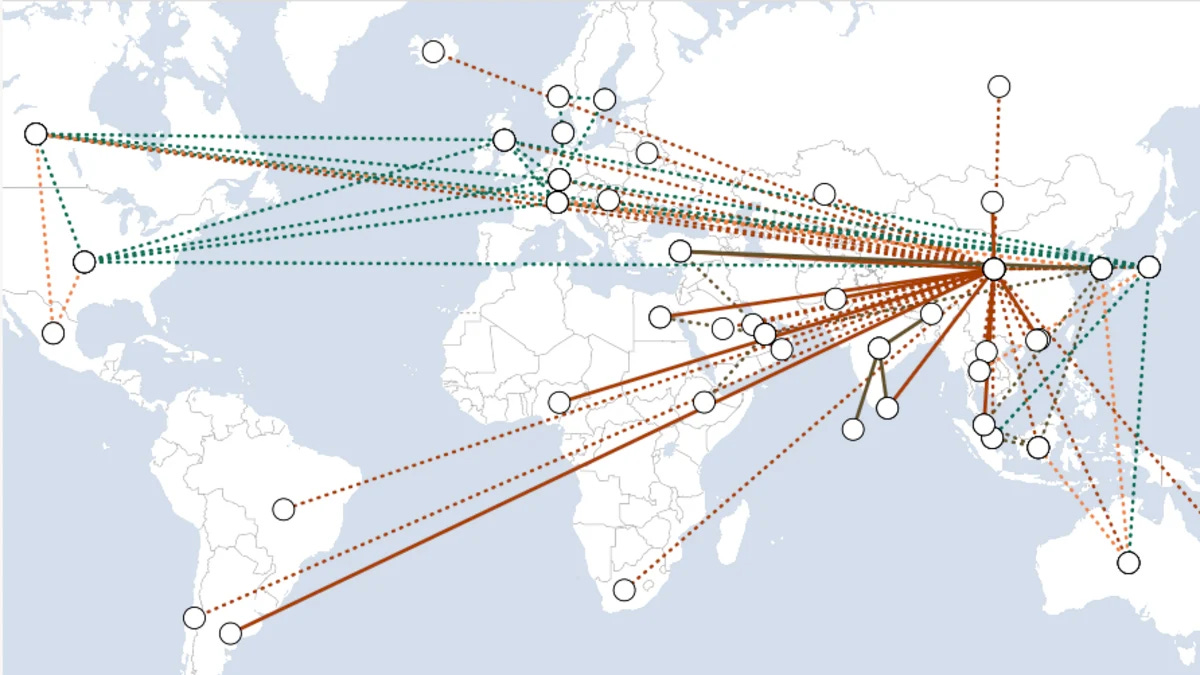
Managed disorder sounds like a destination. It is not. It is the name we give to a pressure cooker before the lid blows.
The temptation, once you have mapped the new monetary stack, is to treat it as an architecture: hydrocarbons beneath silicon, stablecoins at the outer layer, swap lines at the inner one, security deciding access, brokerage monetising passage. That map is useful. It is also comforting in a way the reality is not. Stacks suggest layers that sit quietly on top of one another. The emerging monetary order does nothing of the sort. Its layers grind, interfere, and increasingly cannibalise one another. What looks stable at a distance is, up close, a system trying to do two incompatible things at once: spread digital value frictionlessly across borders and keep that value subject to state power.
This is the conflict that matters now. Not dollar versus yuan in the abstract. Not CBDC versus stablecoin as product categories. The real conflict is between the frictionless scale demanded by the outer layers and the coercive viscosity enforced by the inner ones. Stablecoins, tokenised assets, and software agents want money to move like data: instantly, continuously, globally. States want money to remain observable, taxable, sanctionable, delayable, and, when necessary, stoppable. One side optimizes for velocity. The other survives by imposing friction. The tension is not incidental. It is the system.
That is why the stack metaphor, useful as it is, is also a lie. Or rather, it becomes a lie if taken too literally.
Take the outer dollar layer. Sean Neville’s stablecoin formulation is elegant because it makes the point without romance: a stablecoin is just an ordinary dollar placed on internet rails. That is all. But once dollars move on internet rails, they acquire properties that make them attractive precisely where states begin to lose comfort. They move faster than correspondent banking. They are available to actors the legacy banking system excluded. They can be routed by software. They can be plugged into tokenised markets. They are border-light. They are machine-readable. They are built for a world in which payment is no longer a clerical event but part of a programmable workflow.
Now consider the inner layer. A swap line is the opposite of that openness. It is not a public rail. It is a selective emergency device. It says: your central bank is trusted enough to receive dollar liquidity when markets seize. The Federal Reserve’s standing network remains limited because the whole point of the instrument is discrimination. The American system, viewed honestly, is not a universal monetary commons. It is a graded system of access: digital dollars for many, emergency dollars for the few. That is why the recent UAE swap-line discussion mattered so much. It was not about whether the UAE could get dollars in general. It was about whether it could move closer to the innermost circle of rescue and trust.
The contradiction should now be obvious. The outer layer says: use the dollar everywhere. The inner layer says: not everyone is equal once stress arrives.
That contradiction can be managed for a while. It cannot be dissolved. The more successful the outer layer becomes, the more pressure it puts on the inner one. The more stablecoins spread, the more dollar dependencies are created outside the formal political core. And the more those dependencies spread, the more often the United States will be forced to decide whether broad usage implies broad obligation. The answer, increasingly, is no. That is why stablecoins expand the perimeter while swap lines harden the centre. The system grows outward but contracts inward.
This is also why China’s strategy matters more than its reserve share.
Beijing is not, first of all, building a rival safe asset. It is building a sovereign routing layer: CIPS, mBridge, bilateral arrangements, digital-yuan infrastructure, offshore renminbi channels, and trade-linked settlement paths that reduce dependence on dollar visibility and dollar discretion. That strategy is already forcing the American system to respond. Not by giving up the dollar, but by becoming more openly selective in how it supplies it. In the same way that Europe discovered, after 2008, that partial monetary sovereignty still left it exposed to offshore dollar funding conditions, China is trying to build enough infrastructure that it need not discover the same thing too late. Kaminska’s dollaryuan argument is speculative in parts, but its central analogy is powerful: systems that appear self-contained can still be disciplined from the outside if they remain structurally dependent on foreign liquidity.
That is what makes the current world more like a cold war than a tidy transition.
Cold wars are not stable because the participants like equilibrium. They are stable because the cost of premature collision is too high. Underneath that surface, they accumulate pressure. Managed disorder is the monetary version of that logic. It names a period in which no actor can fully impose its preferred system, but all actors are preparing for the moment when they may have to. The United States wants digital-dollar scale without surrendering sanction power. China wants sovereign routing without surrendering capital control. Open financial centres want interoperability without becoming coercion targets. Markets want finality. States want reversibility. Those are not complementary goals. They are temporizing around a future collision.
What will the first snapping point look like?
Probably not a traditional bank run. Not at first. The more likely first crisis is a jurisdictional collision.
Imagine a payment legally valid under one system and illegal under another. An AI-driven treasury system operating under UAE law routes payment through a regulated stablecoin to settle a trade with a counterparty that is legal in Dubai, licit under contract, and technically final on-chain — but newly prohibited by a US executive order or secondary sanctions determination. Or a central bank using mBridge settles a transaction that never touches SWIFT or a US bank, yet still relies indirectly on collateral, stablecoin liquidity, or brokered dollar access that Washington decides falls within its jurisdiction. The crisis will not begin as a question of price. It will begin as a question of who has the right to say whether the payment really happened.
That is the point at which the whole vocabulary of settlement starts to break down.
In the old imagination, settlement was a discrete event. Funds transferred. Books updated. Done. Final. In the world now taking shape, settlement becomes a layered and contested process. A transaction may be final on a blockchain and still reversible through the issuer. It may be final for the issuer and still vulnerable to exchange blocking. It may be final for the exchange and still not legally final across jurisdictions. It may be final in one rule system and frozen in another. Sean Neville’s emphasis on the enforcement layer points in exactly this direction. Once software, wallets, issuers, banks, regulators, and sovereign legal systems all sit in the same transaction chain, finality ceases to be a moment. It becomes a sequence of conditional recognitions.
That is the death of settlement as a simple idea.
In the coming system, payment finality will look less like a stamp and more like a negotiated corridor. Multiple actors must permit the same event to count as complete: the chain, the issuer, the custodian, the wallet, the bank, the regulator, the jurisdiction, sometimes the sanctions authority, and, increasingly, the software policy layer that authorized the action in the first place. This is why arguments about “faster payments” miss the deeper issue. The relevant question is not whether value can move in milliseconds. It is whether legal authority can move at the same speed.
It cannot.
And so friction returns, not as a bug, but as the central political object of the system.
This is what open economies are beginning to discover. The same infrastructure that makes a place like Singapore invaluable in peacetime — interoperable rails, regulated stablecoins, tokenised liabilities, programmable settlement, machine-readable standards — also creates a new class of vulnerability. If confidence can move at machine speed, then so can escape. A switchboard can become a panic amplifier. A prudentially governed digital system can become the cleanest route for capital to leave. In that sense, the most frightening implication of machine-speed money is not that criminals will move faster than police. It is that ordinary users, corporates, and agents will move faster than states can decide whether they are allowed to.
That problem will not be solved by better branding, nor by louder monetary nationalism.
It will be solved, if it is solved at all, through a new politics of friction. Some of it will be legal. Some of it will be technical. Some of it will be infrastructural. More of the future of trust will be carried not just by institutions and names, but by proofs, credentials, and machine-readable permissions. That is the promise of the “enforcement layer.” But technical proof does not replace politics. It merely encodes it. Someone still decides which proof counts, which credential is sufficient, which intermediary is trusted, which jurisdiction governs the dispute, and which payment is allowed to be final.
This is where the Gulf material deepens rather than softens the picture. If the UAE or Dubai becomes a brokered dollaryuan hub as Kaminska speculates — whether under an explicit US blessing, a bilateral swap framework, or a looser English-law-style intermediation model — then the system gains a new escape valve and a new fault line at the same time. Brokerage solves problems only by concentrating them in new places. A hub that monetizes passage between systems becomes extremely valuable — until the moment one side or the other insists that passage itself is illegitimate. What looked like clever arbitrage becomes a jurisdictional battlefield.
So no, managed disorder is not a destination. It is a pressure regime.
The first essay described the geometry: a layered order of hydrocarbons, silicon, stablecoins, swaps, security, and brokerage. The geometry is real. But geometry alone does not tell you when a system breaks. For that you need physics. And the physics here are unforgiving. Outer layers demand openness, speed, and scale. Inner layers demand control, sanctionability, and conditional rescue. The more successful the outer layers become, the more often they challenge the legitimacy of the inner ones. The more the inner layers defend themselves, the more they undermine the promise of frictionless money on which the outer layers depend.
This is not a flaw to be patched. It is the core contradiction of the new order.
The first earthquake is overdue because the conditions for it already exist: competing legal authorities, partly interoperable rails, politicized liquidity, software-mediated transactions, sanction overhang, and states increasingly willing to use finance as a theater of strategic competition. The next crisis will likely not ask, “What is the price of the currency?” It will ask, “Whose law makes this payment real?”
And when that question is asked at machine speed, the answer will not arrive as a market quote.
It will arrive as a stoppage.