Two Machine Civilisations
Future, Floor, Middle, Stack, Inside

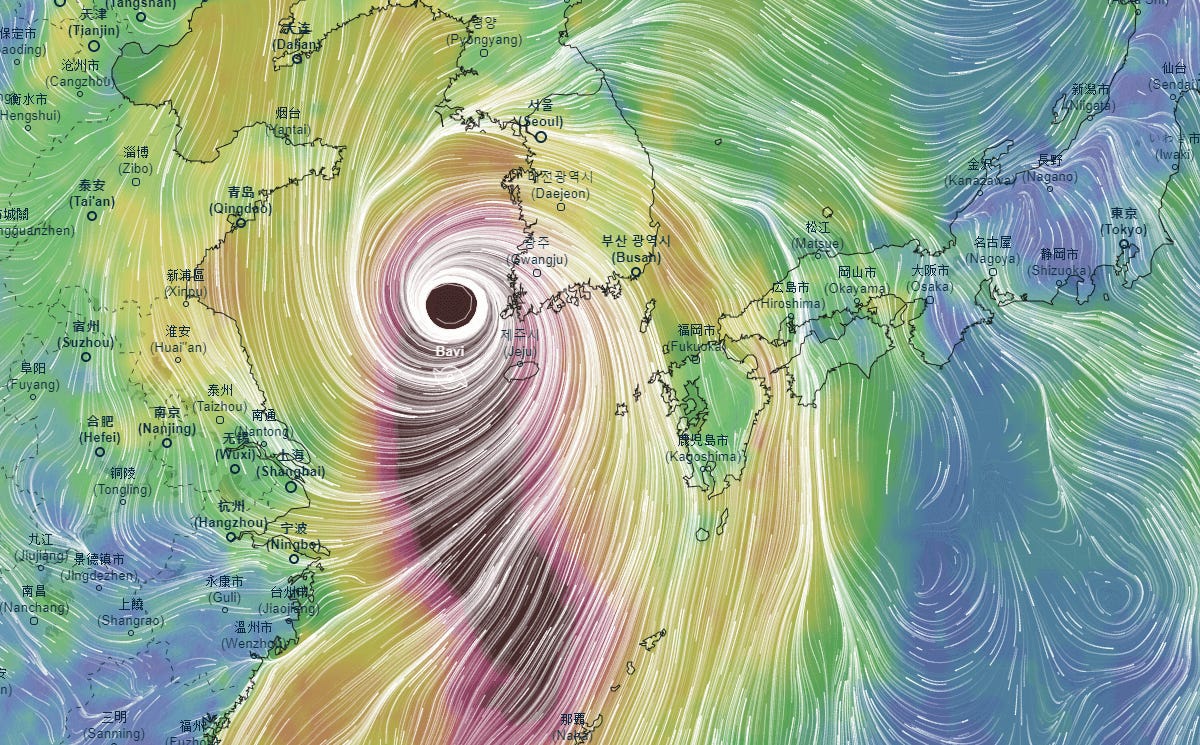
Over the past week I published two notes that sit uncomfortably close to each other: one about the AI jump ball (why the story won’t converge), and one about the Middle (where most people actually live). This essay is a checksum that follows from those two pieces. It is not a grand theory of the world order. It’s a mapping exercise: how different polities are positioned relative to five things that now do most of the governing—Future, Floor, Middle, Stack, Inside—and, more importantly, how the U.S. and China deform those five things for everyone else.
This is not another essay about who is “ahead” in AI, who “reaches AGI” first, or whether the world is neatly “decoupling.” It is not a morality play about democracy versus authoritarianism. It is not the belated discovery that China has industrial depth and America has financial reach. The rest of the world is catching up to those slogans; repeating them is not insight.
What I am trying to name instead is something more awkward and more determinative: the U.S. and China are no longer just superpowers in the familiar sense. They are now machine civilisations—weather systems that export conditions to the rest of us.
Not opinions. Not talking points. Conditions.
One exports storms and sells umbrellas. The other exports rails and rewrites tempo. Both can be lived under. Neither can be wished away. And the central question for everyone else—large powers and middle powers alike—is whether we can metabolise their weather without losing the layer that makes societies politically survivable: the Middle. Without turning ordinary life into either a continuous exam (the American failure mode) or a corridor/function (the Chinese failure mode).
Why this isn’t a 1:1 mapping
A lot of “US vs China” analysis assumes symmetry: their Future versus our Future, their Stack versus our Stack, their ideology versus our ideology. That symmetry is false. The reality is deformation: their Future does something to our Floor/Middle/Stack/Inside, and their Floor does something else, and their Stack does something else again. That’s why the five lenses matter. They are not categories for description; they are the surfaces where the weather lands.
The other reason to keep large powers and middle powers separate is that they don’t absorb weather the same way. Large powers—Europe and India—can still build partial stacks and export secondary weather—rules, standards, diaspora, process. Middle powers—Singapore, UAE, Japan, the SEA belts—have less mass but more routing leverage: they can shape where storms land and where rails connect. They can’t steer the superpowers, but they can decide whether they become tissue.
Before the mapping, five counterintuitive claims to hook your attention and set up the rest of this long essay:
America’s most destabilising export often isn’t the dollar. It’s politics-as-format. Europe’s Middle can be shredded without a single plot simply because platform-native culture-war formats travel well, and European institutions are more brittle than they look once that format is imported.
China’s most imperial export often isn’t ideology. It’s tempo. Cycle-time compression colonises calendars and balance sheets faster than any narrative colonises minds.
Large powers don’t just get hit by weather; they amplify it. Europe exports standards and compliance lattices; India exports diffusion, process, and people. Middle powers end up living under that secondary weather too—and then get blamed when it hurts.
Middle powers can’t change the superpowers’ direction, but they can change where storms land. A membrane state can absorb, deflect, launder, or amplify exported conditions. That is power even when it looks like “just being a hub.”
The Middle is the real battlefield. If the Middle collapses, strategy becomes sabotage. That is true whether you are rich or poor, democratic or authoritarian.
With that in mind, the five lenses.
Future
What each machine civilisation is betting on—and how it deforms our future
America’s Future is built like a cliff. The frontier story is not merely technological; it is legitimating. It provides a reason to endure the present by promising that the next capability jump will redeem the current disorder. This is why American AI discourse oscillates between rapture and dread: it is trying to keep a future story alive in a society where shared objects are dissolving and legitimacy is no longer reliably binding. Even when the AGI story is wrong in detail, it functions as leverage: it moves money, pulls talent, justifies risk-taking, and—quietly—forces everyone else to play defence.
China’s Future is built like a rail network. Less rapture, more capacity. More “what can we build, deploy, commission, electrify, manufacture, substitute.” China is not uninterested in frontier capability; it simply treats it as one layer of a broader project—physical AI, electrification, industrial depth, and the ability to metabolise capability at scale even under denial.
What this does to everyone else is not symmetrical. It forces large and middle powers to live with two futures at once.
For large powers, America’s cliff Future is a constant pressure to treat frontier narratives as “the real reality,” even when those narratives are experienced as imperial and disempowering. You can reject the story culturally and still be priced by it. The frontier becomes a timetable you didn’t set. China’s rail Future deforms large power planning differently: it makes industrial tempo the binding constraint. It exposes institutional slowness as an unaffordable luxury—not as a cultural quirk, but as a strategic liability.
For middle powers, America’s Future shows up less as a narrative to believe and more as an access schedule: chips, cloud, standards, financial shelter, the umbrella function when markets freeze. China’s Future shows up as a cadence you must match if you want to remain useful: product cycles, commissioning speed, deployment density. Middle powers don’t get to set the frontier. They get to decide whether they can route between cliff and rail without being pushed off either.
If you remember one thing from the Future lens for policy work, remember this: China’s Future resets cycle time. Once cycle time resets, your domestic strategy gets rewritten even if you never talk about “AI.” You can keep your ideology; you can keep your constitutional form; you can still find yourself living inside someone else’s tempo.
Floor
What humiliations each machine civilisation normalises—and what humiliations get imported
America’s floor is thin in a particular way. It isn’t that Americans starve. It’s that Americans are constantly tested. Survival is conditional on fluency: insurance coding, eligibility cliffs, appeals, job continuity, endless procedural friction. The system doesn’t always say “no.” It says you filled it wrong. It trains bureaucratic athletics into citizens and then treats exhaustion as moral failure. This is one reason scandal has diminishing corrective power in America: scandal presumes shame binds. But when the binding currency is pricing and routing rather than belief, shame becomes optional; outrage becomes content; confession becomes data.
China’s floor is delivered through closure capacity: hierarchy, procedure, continuity. It is harsher in expressive space and less tolerant of unlicensed publics, but thicker in settlement capacity: disputes can be ended; systems keep running; the object holds. The humiliation is not “you failed the paperwork sport.” It is subordination to a hierarchy of closure. You may dislike it; you may feel constrained by it; but you are not asked to litigate your right to exist every day.
Again, the deformation differs by polity type.
Large powers import American floor logic through technocracy: audit regimes, compliance stacks, procurement categories, and the quiet conversion of public services into claims processes. They import Chinese floor logic through order temptation: when their own settlement mechanisms fray, closure begins to look attractive even to people who dislike hierarchy. “We need the system to end arguments,” they say. “We need competence.” This is not always wrong. It is always a trade.
Middle powers are more exposed because they can’t afford either humiliation at full intensity. If they import American floor logic wholesale, the Middle becomes bureaucratic athletics. If they import Chinese floor logic wholesale, the Middle becomes corridor discipline. The operational question is not “which floor is morally superior” but “which humiliations can we refuse while still extracting benefits from each weather system.”
If you remember one thing from the Floor lens, remember this: American life-as-exam travels well. It can be imported accidentally, under the banner of accountability and transparency, and it will quietly hollow out a Middle. It turns ordinary life into an interpretive sport. It rewards the agile and punishes the tired. It makes survival feel like a paperwork IQ test. And once you build a society around that, you will be shocked at how quickly the politics becomes jump ball.
Middle
The layer that decides whether societies curdle or continue
America can still produce abundance. It struggles to convert abundance into belonging. Shared objects thin. Local institutions hollow out. Trust collapses. The citizen becomes a consumer of narratives, and politics becomes jump ball: whoever can manufacture binding stories wins. When the Middle thins, the machine does not arrive as a tool; it arrives as a surrogate sovereign, because the human settlement machinery cannot bind without detonating conflict. In such a setting, a polite interface that can listen, sort, and adjudicate starts to feel like relief. Confession becomes cheap because confession no longer has a safe human container.
China’s Middle is pressured, but it holds more shape—not because it is softer, but because it still has containers. There is still a thicker default sense of polity and continuity; more boundedness; more repeatable life. And, critically, there is infrastructure competence sufficient to keep tier-two and tier-three places inhabitable rather than purely surplus zones. That competence returns time, and returned time is the precondition for culture. You don’t need to romanticise it. You just need to notice that without it, the Middle becomes panic: every day becomes negotiation; every interaction becomes hazard; every institution becomes suspect.
Now the under-discussed part: the U.S. Middle doesn’t just implode domestically; it radiates outward. It exports politics-as-format. It exports culture-war dramaturgy as a platform-native product. It doesn’t require state sponsorship; it is an automatic by-product of the attention economy.
Call it, plainly, the Anglo-Atlantic carnival. The revolt is not “against elites” in the old parliamentary sense; it is against replacement, against the feeling of being managed by systems you can’t see and can’t appeal to. It produces a class of nostalgia mediums—politicians whose talent is not governance but box office, whose function is to provide a shared object in a shattered attention space. Everything becomes a referendum on humiliation. Control migrates to the network. And because it is a format rather than a programme, it can be exported without anybody exporting it. The meme travels. The rage clip travels. The dramaturgy travels. Soon enough, what once looked like policy disagreement is experienced as existential belonging.
Europe’s Middle is particularly vulnerable because it is hit from above and below at once: imported political format from the U.S., and industrial tempo displacement from China. Grievance plus scarcity plus imported dramaturgy is how settlement becomes brittle. It isn’t that Europeans suddenly become Americans. It’s that European coalitions, which depend on procedural legitimacy and slow compromise, become harder to hold once compromise becomes betrayal.
Middle powers sit at the seam: if their Middle fails, they become sabotage theatres for everyone else’s conflict. If their Middle holds, they can route between stacks without becoming ungovernable. This is why “Middle health” is not cultural decoration for hubs. It is strategic infrastructure.
Stack
What each machine civilisation can deny, what it can deliver, and what we buy if we match their weather
America’s stack power is pricing and denial: rates and FX, capital market gravity, standards and compliance regimes, export controls and licensing, platform distribution, and the umbrella function in crisis. The U.S. can freeze access with procedural cleanliness, and it can also thaw the system because so much of the world is wired into its plumbing. This is why it remains powerful even when internal cohesion frays: the external stack keeps paying.
China’s stack power is throughput and rails: cheap capital goods, commissioning capability, supply chain depth, electrification as product. Not a pledge, but hardware; not a narrative, but a commissioning crew. This is why China can be experienced as “real” even by those who distrust its politics: it ships capability in physical form, and physical form has a stubborn authority.
But the modern Chinese rail is not only steel and copper. Increasingly, it comes with a cognitive layer—what Chinese policy people now call AI+ not as slogan but as an exportable operating mode: AI embedded in permitting, inspection, compliance, welfare disbursement, scheduling, city operations, industrial optimisation. In that mode, influence does not arrive as ideology. It arrives as institutional capacity: the system you adopt because it works, the dashboards you inherit because the integrator installs them, the maintenance contract that quietly makes your bureaucracy depend on someone else’s update cycles. The harder question isn’t “do you like China.” It’s “are you comfortable letting another civilisation’s standards for administrability become your own?”
What we buy by matching each weather matters—and it’s counterintuitive because both baskets contain genuine advantages.
If you match China’s weather, you can buy decarbonisation without waiting for Anglo-Atlantic political consensus; cheap capital goods that raise productive ceilings; diffusion of capability into places that cannot afford expensive cloud rents. You also buy tempo: cycle compression, margin thinning, and the risk of corridorisation if you don’t insist on local value capture and Middle protection.
If you match America’s weather, you can buy liquidity, insurability, the legal grammar that makes long-duration projects financeable, frontier adjacency and distribution that can install defaults globally, and the umbrella in crisis. You also buy legibility: compliance as permanent overhead, sanctions exposure, and the quiet conversion of ordinary life into a risk surface if American administrative logic is imported without restraint.
This is where large powers and middle powers diverge again.
Large powers try to build partial stacks. Europe exports standards and regulatory lattices; India exports diffusion infrastructure and people/process. Both become secondary weather systems that middle powers must live under. Middle powers can benefit disproportionately from routing—capital, talent, corridors, compliance translation—but they also risk becoming routable: a hub that is only an interface, and therefore disposable.
Inside
Two rooms, two habits, two bite geometries
If you want to stop thinking like a pundit, start with rooms.
The American room is a prompt box that is always open. It offers help first. Then triage. Then judgment. It asks what you want and gives you output so quickly that it begins to ingest not only your tasks but your interior: doubts, desires, shame, grief. In a society where the Middle is thin, this becomes confession without communion. The machine doesn’t replace Yahweh; it replaces the parts of civic life that used to metabolise uncertainty. It becomes sovereign not because it is wise, but because it is available. It can end arguments humans cannot end without starting wars.
The Chinese room, in the texture that matters, is still partly illegible. Tea being topped up. Meetings that are not recorded. Decision-making travelling through bodies—gesture, seating, eye contact, verbal reporting—leaving behind compressed residue rather than a full ingestible trail. Platforms remain walled gardens. Confidentiality disciplines are thick. Much of the real economy never becomes clean training data because much of the real economy never becomes clean process.
That illegibility is not automatically virtue; it is a tradeoff. It slows certain forms of replacement and enables certain forms of control. But it changes the bite. In a SaaSified economy, AI substitutes because work has already been modularised into machine-readable workflows. In a bespoke, relationship-mediated economy, AI assists because there is no clean surface to substitute. The moat is not the model. The moat is the room.
And the stealthiest transfer effect of all is this: Inside travels. Institutional texture becomes portable via procurement, compliance, platform dependence, elite formation. You wake up one day and realise your own state now feels like an audit machine—or a corridor machine—without anyone ever voting on that change.
The transmission chains
The matrix is sparse—and that is why it becomes predictive
If you actually fill the Future-Floor-Middle-Stack-Inside matrix by the three tiers —if you stop expecting Future→Future symmetry and look for cross-coupling—you discover something useful:
Most cells are weak. A few couplings dominate.
Three transmission chains do most of the governing for everyone outside the two machine civilisations:
Stack → Floor → Middle. Defaults become access conditions. Access conditions become humiliation styles. Humiliation styles curdle belonging. This is the main global kill-chain, and it is observable early—before ideology catches up.
Middle → Inside. Possession politics, platform judgement, and jump-ball epistemics seep into institutional behaviour elsewhere. This is how America’s internal settlement problems become other people’s problems—without a single memo ordering it.
Inside → Stack. Institutional texture becomes protocol. Auditability, disclosure, compliance grammars, room-politics, boundedness—these harden into the rails other people must ride. This is where “what it feels like to live under the settlement” becomes geopolitics.
Now the crucial tiered implication:
For large powers, the decisive fight is Stack: if you can’t build partial rails, your future becomes derivative and your politics becomes reactive.
For middle powers, the decisive fight is Floor (and therefore Middle): stack pressure lands as lived humiliation. If your floor becomes a continuous exam or a permanent sprint, your Middle breaks—and once the Middle breaks, every strategic option becomes ideology theatre.
So much for the machine civilisations. The rest of this essay follows the weather into the tiers below, where most people actually live.
Part 2 — Large powers
Europe and India as partial stacks, and why they become secondary weather systems
This part is not a lament about Europe’s decline or a hymn to India’s rise. It is not “third pole” punditry. It is a more specific question: what happens to large powers when two machine civilisations export weather, and the large powers can neither fully deny it nor fully route around it? What does the U.S. and China do to Europe’s and India’s Future / Floor / Middle / Stack / Inside—and what, in turn, do Europe and India do to everyone else?
Large powers matter because they are not passive recipients of weather. They amplify it. Europe exports standards. India exports diffusion, process, and people. These are not footnotes. They become secondary climate.
Europe’s future is not to “win” the frontier. It is to codify reality after the fact—to turn ethics into standards, standards into procurement, procurement into market access. In its best version, Europe becomes the place where minimum viable constitution is written: safety baselines, resilience requirements, auditability norms, data protection, liability frameworks. The bet is that when the world is full of overlapping ordering attempts, the power that writes the paperwork can still shape the territory.
The risk is that Europe mistakes codification for capacity. A partial stack that can’t be operationalised becomes a comfort object: the world burns, but the forms are immaculate.
India’s future is the opposite bet: not codification, but diffusion. It is a wager that scale and flexibility can compensate for not owning the frontier. If the U.S. is building the cliff and China is laying rails, India’s bet is that the next decade is about making AI economically usable for hundreds of millions of people under constraints—power, bandwidth, language, informality. The future is an adoption engine, not a lab.
The knife twist is that both bets are fragile. Europe’s bet fails if it cannot enforce; India’s bet fails if diffusion arrives into an economy that cannot absorb displaced labour fast enough. Both are trying to avoid irrelevance by becoming useful in the only way they can.
Europe has a thicker floor than most societies. That’s what makes it Europe. But the floor is expensive, and the weather makes it more expensive. America’s storms tighten fiscal room through rates and pricing; China’s rails shift industrial and energy baselines; both squeeze the discretionary space where welfare is financed. Europe’s floor therefore becomes a political object: who gets protection, who is left outside, which humiliations return under the banner of “sustainability” or “security.” This is how procedural societies become resentful: not because they hate procedure, but because procedure stops delivering dignity.
India’s floor is thinner, but its floor work is more visible: employment, food prices, energy access, stability in the currency. India’s floor problem is that the country’s social contract is still partly a promise: upward mobility via services, or at least a chance to climb. If that path narrows before an alternative employment engine exists, the floor becomes an accelerant for unrest.
Now the Middle—where large powers fail first.
Europe’s Middle is being hit from above and below. From above: America’s politics-as-format exports extremely well. Culture-war dramaturgy, identity conflict, jump-ball epistemics arrive through platform channels without needing state sponsorship. This doesn’t merely polarise; it changes the cost of settlement. Every compromise becomes betrayal. Every policy becomes identity. That is how Middles lose the ability to remain boring.
From below: China’s tempo resets industrial baselines. When Chinese cycle times compress and Chinese products undercut, Europe’s Middle absorbs the cost—through wage pressure, regional decline, and a moral exhaustion that isn’t about ideology so much as “why does everything feel harder now?”
That double hit is why Europe can look uniquely brittle: imported dramaturgy plus compressed material conditions.
India’s Middle is dense, socially thick, historically practiced at improvisation. But it is also under threat from a mismatch: aspiration grows faster than stable, dignified work. When labour markets cannot absorb educated youth, the Middle doesn’t just become angry; it becomes humiliating. That humiliation can be managed for a while through growth stories. When growth stories stop clearing, it curdles.
Europe’s stack is partial and distinctive: a regulatory lattice, a standards engine, a moral vocabulary with procurement teeth. Europe can’t deny chips like the U.S. and can’t deliver rails like China, but it can make itself hard to ignore by making market access conditional on compliance. This is why the EU becomes a secondary weather system: its rules become part of everyone else’s cognitive tax.
India’s stack is also partial, but of a different type: diffusion infrastructure, identity/payment rails, and a massive pool of process and integration labour. India exports not just people but workflows: how the world’s back offices function, how services get delivered at scale, how the human glue holds brittle systems together.
And here is the less-discussed danger: India is already a global integrator, and if AI changes integration economics, India becomes a major transmission channel for that disruption—absorbing it domestically and exporting it through global service arteries.
Inside, Europe is rules-first. Its institutions are legitimate partly because they are slow and procedural. That is also what makes Europe vulnerable to tempo reset: the system that produces justice cannot easily compress itself without losing legitimacy. When the world demands speed, Europe experiences it as humiliation—being forced to play a game whose rules are not its own.
India’s inside is squiggles: density, improvisation, tolerance for ambiguity, constant micro-negotiation. That makes India metabolically flexible in a way many Western societies have forgotten how to be. But it also means institutional coherence is always under strain. India can adapt; it can also be punished by technologies that reward clean interfaces and modular work.
If Part 1 said “machine civilisations deform everyone else,” Part 2 adds: large powers deform middle powers. Europe through standards/procurement/compliance as secondary weather. India through process/diffusion/people as secondary weather. Middle powers don’t just live under primary weather. They live under compounded atmosphere.
Part 3 — Middle powers
Membranes, routing, refusal authority—benefiting from weather without becoming tissue
Middle powers are often described as “small states with good diplomacy.” That framing is obsolete. In a world of weather systems, a middle power is not defined by GDP or hardware. It is defined by membrane engineering: what it can let in, what it can keep out, and what it can route without tearing its own Middle apart.
Middle powers cannot steer machine civilisations. But they can shape where storms land and where rails connect. That is not neutrality theatre. It is power—quiet power, often invisible until it fails.
Middle powers don’t get to define the global frontier. Their Future is a portfolio of options, not a single bet. They benefit when the world needs interfaces, not prophets; when the superpowers are strong enough to build but too distrustful to share; when everyone else needs corridors, standards translation, and “safe rooms” where stacks can meet.
The failure mode is also clear: when a middle power mistakes interface work for destiny, it becomes an appendage. A hub that exists only to be used.
Floor is where middle powers break first.
Middle powers live and die by the moral design of access: can ordinary life be lived without humiliation?
Their floor is threatened in two ways: by U.S. pricing shocks that tighten fiscal room and import audit/claims logic, and by China corridor pressure that distorts housing, labour, and environmental baselines. The benefit of being a hub is that you can buy buffers—reserves, infrastructure, talent density. The danger is that buffers become insulation for elites while the Middle becomes brittle.
The single most important floor rule for a middle power is: do not let your citizens experience survival as an interpretive sport. Once you do, you’ve imported America’s most portable pathology.
Middle is the decisive layer.
A middle power can survive enormous external pressure if its Middle holds: if belonging remains possible without dogma; if civic life remains boring enough; if time can be returned; if families remain viable; if humiliation doesn’t become the default interface.
And hubs are not exempt. In fact hubs are at higher risk. Routing economies attract foreign talent, foreign money, foreign narratives, and foreign resentment. Without deliberate Middle design, hubs become societies where housing becomes a stress test, identity becomes a market, and politics becomes jump ball because the object no longer holds.
This is where corridors stop being “just economics” and become Middle engineering. Take Johor. A cross-border living corridor doesn’t merely shift commuting patterns; it shifts baselines. It changes what counts as a normal house, a normal wage, a normal life. It changes who has time and who does not. Over time it changes identity and voting and the felt legitimacy of the state. Drift becomes domestic politics unless the corridor is designed to preserve an object—unless someone is explicitly accountable for keeping ordinary life boring enough to live.
Stack in middle powers is rarely total. They survive by plugging into multiple stacks while maintaining the ability to refuse capture. The strategy is not sovereignty-as-autarky. It is sovereignty-as-bargaining: own a few rails that others need, rent the rest on diversified terms, and never let any single stack become a kill switch.
This is where the “hub” metaphor becomes too soft. A port is not a gateway. It is a protocol. A routing state’s real work is not to host flows, but to decide what counts as a valid transaction when the world runs on models and ledgers. In practice that means negotiating trust in simulation outcomes: whose carbon accounting is accepted; whose digital measurement is binding; whose customs classifier decides whether a good is legal, taxed, delayed, or denied. You can feel the future arriving in banal disputes—an emissions ledger that doesn’t reconcile, a model that misclassifies cargo, a risk engine that flags an entire category of trade as suspicious. When the world is governed by defaults, the power to dispute defaults—slow them, suspend them, refuse them—is not paperwork. It is sovereignty.
Inside is where policy becomes lived.
Middle powers become psychologically unstable when they import the wrong interior habits. From the U.S., they can import confession-to-interface, litigation-as-morality, and life as exam. From China, they can import corridor discipline, discretion-as-default, and don’t interrupt throughput. Both can hollow out civic life in different ways.
The mature middle power skill is to import capability without importing pathology: to take umbrellas and rails while preserving human containers—family, seasons, recoverable time, places where optimisation is not allowed to become fate.
Middle powers can’t change machine civilisations directly. But they can do three surprisingly powerful things.
They can shape where storms land—through buffers, prudential regulation, corridor design, and institutional closure that prevents external shocks from becoming domestic humiliation.
They can turn rails into capability rather than corridorisation—through local capture, procurement strategy, controlled permeability.
They can provide neutral rooms where partial stacks meet—standards translation, audit frameworks, interoperable protocols, and the boring closure layer that lets competitors coexist.
That is real power. It just isn’t glamorous.
If we get this wrong, we don’t lose an argument. We lose ordinary life.
If the machine answers back, it won’t answer in speeches. It will answer in defaults: whose rails deliver, whose umbrellas open, whose standards bind—and whether your Middle still feels like a place where ordinary life can be lived.