Read This First (9 Aug 2025 edition)
drink deeply or taste not the Pierian spring

This is a Substack about the road to a Type-1 civilisation.
The Cutting Floor is my attempt to chart how we move beyond the rut of late-stage American globalisation. The wager is simple: the decisive answers will come from Asia — from China’s electro-state project, Singapore’s hubs, Japan’s demographic trap, Vietnam and Indonesia’s demographic engines, Korea’s dense industrial ecology, the Gulf’s energy corridors.
A Type-1 civilisation is one that can metabolise the whole planet’s flows — energy, compute, capital, and culture — in a coherent, sustainable way. It does not simply survive climate change; it learns to dispatch energy wisely, balance demography, and coordinate through infrastructure and governance at planetary scale.
Why move toward it? Because the alternatives are worse:
Stagnation — stuck in late-stage globalisation, with petro-decay and carnivalised decline.
Fragmentation — rival stacks and ruins exporting moods instead of building coherence.
Collapse — climate constraint without governance, demography without surplus, AI without infrastructure.
Type-1 is not utopia. It is the positive scenario where humanity scales up its metabolism without burning itself out. And Asia, already building electro-states and dense industrial ecosystems, is where this future is most plausibly being assembled.
Why Read This?
Most familiar stories about the future — American decline, Chinese rise, AI disruption, climate doom — miss the deeper layers. The Cutting Floor reads the world through six paces:
Nature — climate change as metabolic constraint, planetary weirdness.
Demography — age structures, households, migration, skills (Japan’s ageing first, but not last).
Infrastructure (hinge) — energy & data corridors, compute clusters, industrial policy, ports, payment rails.
Governance — East Asian state capacity, standards, incentives, dense industrial and logistics ecosystems.
Narrative / Culture — trust-engineering, ruins, moods, AI & machine surplus.
Commerce / Fashion — the churn of memes, consumption, e-commerce.
Infrastructure is the skeleton. Demography is the slow muscle. Governance is connective tissue. Culture is the mooded skin. Taken together, they reveal how Asia — not America or Europe — is already weaving toward Type-1 coherence.
Metabolisms are not just about finance or data, but energy itself. Civilisations rise and fall on EROEI — Energy Returned on Energy Invested. High-EROEI fuels once powered surplus; declining ratios now strain growth. Asia’s electro-state projects — solar, nuclear, renewables — are bets on restoring abundance. Without high-EROEI infrastructures, no civilisation can scale toward Type-1.
But Type-1 will not be built by China alone. The middle powers — Singapore, Korea, Japan, Indonesia, Vietnam, the Gulf — metabolise flows in their own ways, hedging between American ruins and Chinese surplus, building corridors of energy, compute, and logistics. Capital rails matter as much as pipelines: eurodollars, stablecoins, and private credit are infrastructures too, reshaping sovereignty and dispatch. And beneath all of this runs affect: the moods of trust or exhaustion, coherence or trite pessimism, that make infrastructure livable or brittle.
How to Read
Two ways that play nicely with a random-access book:
Drop-in mode — open anywhere; follow the links like you’d wander a museum.
Playlist mode — pick one of the short paths below; each is 3–6 essays and a concept card.
Five Doors In
1. The Hinge of Our Time: Electro ↔ Petro
Why fuels vs. electrons is the master conflict—and why Asia is building abundance while the Atlantic burns scarcity.
Start with Electro vs Petro: Two Dangerous Decades → Metabolic Wars.
2. How Stacks Fight
A fast tour of Stack Wars (Episodes 0–7) and The Canon Layer—simulation regimes, standards, and soft power that feel like wars, but are really battles over protocols and legitimacy.
3. The Republic of Letters (the Ghosts)
Dialogues where critics prod the canon: Field Guide to the Ghosts → The Republic of Letters → Between Stack and Ritual. Use this door if you like arguments and method.
4. The Asia-Forward Growth Story
Four Waves, One Party — and the Electrostate → How the Network States already exists in Asia → Future Premium II: The Abundance Ledger. Practitioner-grade takes on how surplus becomes order across China, Singapore, Korea, Vietnam, Indonesia, and the Gulf.
5. The Mood Layer
If you want the human texture first—When the Ocean Turns to Light → The Shoggoth Is a Company → micro-season notes. Read the feelings that infrastructures produce, then circle back to the pipes.
The Three Big Questions
Pathway. Through what pipes does power actually move?
Energy → compute → payments → policy. See Metabolic Wars and Planetary Governance on Autopilot.
Measurement. What ratios decide fate?
EROEI, demographic dependency, throughput vs latency, trust vs liquidity. See Future Premium I–VI.
Power Players. Who can dispatch?
States that build corridors; firms that own standards; cities that anchor stacks. See Strategic Positions and The Canon Layer III.
Playlists by Reader Type
Policy designers (standards + capacity):
Metabolic Wars → The Canon Layer II → The Wilderness of Protocols → Between Stack and Ritual.
Investors / operators (where to stand):
Electro vs Petro → Strategic Positions → 2049 Letter → Future Premium VI.
Technologists (AI beyond code):
Intelligence Is Not Enough I–III → Stack Wars Episode 3: Sentient Signal → Canon Against the Weather II: Habeas GPU → The Shoggoth Is a Company.
Culture / arts / care:
When the Ocean Turns to Light → The Erotic Shoggoth → micro-season notes → Letter V: The Silence Beneath the Ritual.
What Changed in 2025
The hinge cluster—Metabolic Wars, Ruins on the New Continent, Metaphysical Wars—marks the pivot from mapping flows to governing moods.
The Asia canon tightened: Four Waves, India as Half-Body, Gulf mirror essays. Less about America’s mood, more about Asia’s pipes.
The AI-alone-is-sterile thread is now explicit: intelligence needs energy, demography, corridors, and standards—or it doesn’t scale.
A Short Glossary
Type-1 Civilisation — not utopia; a planet that metabolises energy / compute / capital / culture coherently.
Dispatch Rights — the real sovereignty: who can send power (where, when).
Electro-state — industrial policy + grids + fabs + ports + compute clusters as a single stack.
Stack Wars — simulation regimes vying for standards, not territory.
Future Premium — why attention, energy, and money re-price when the climate “thinks.”
How to Navigate a Random Book
Follow the pipes. Wherever you land, ask: where’s the energy, which corridor, whose ledger?
Use the ghosts. Dialogues and letters are deliberate interruptions; they show where the canon argues with itself.
Trust the playlists. When in doubt, start with Door 1 or Door 2—both explain the rest in fewer clicks.
The ghosts inhabit the ruins.
The canon lives forward.
Welcome in.
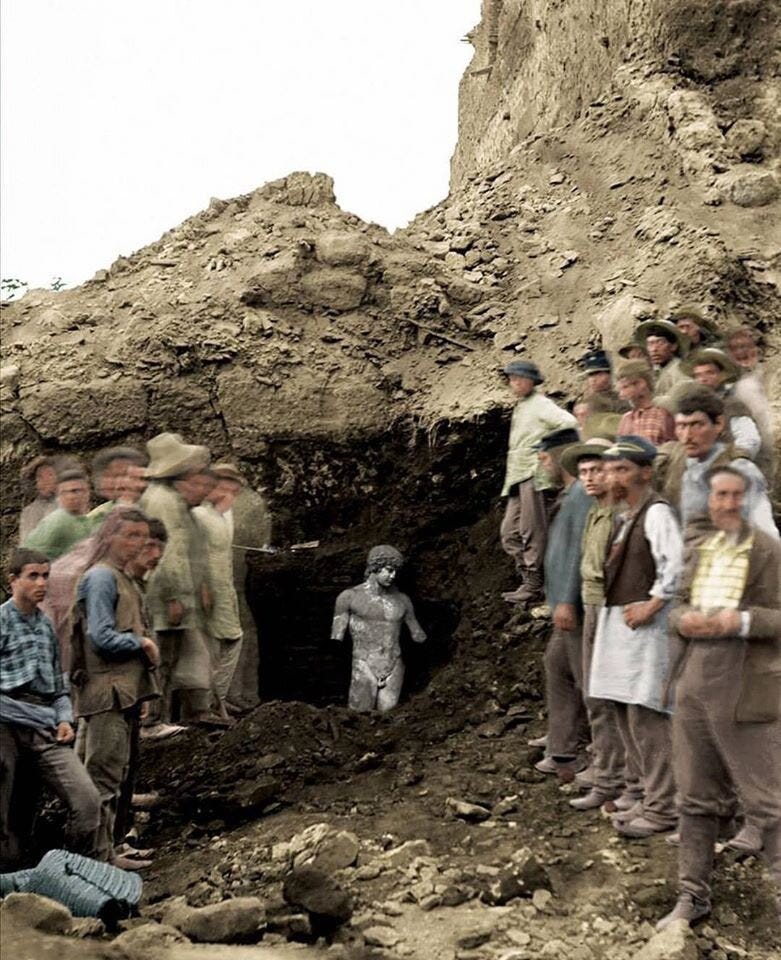
Archaeologists and workers pose in front of the magnificent statue of Antinous, Emperor Hadrian’s beloved, deified after his untimely death, which was unearthed near the Temple of Apollo in the sanctuary at Delphi, 1894.
Author’s postscript
I didn’t mean to write a canon. I wrote to stay awake.
Between chemo sessions, when time collapsed into the steady hum of the machines, these essays were small dispatches to myself—to remember that the world still moved: through pipes and ports, through grids and ghosts.
If you’re reading this years from now, maybe on paper rescued from a dead cloud, the world you inherit might already look like the one I was trying to describe: half-built, half-broken, still alive. You might find pieces here—models, moods, fragments of policy, half-prayers. Take what illuminates. Ignore what doesn’t.
Everything here is provisional. It’s not a system. It’s a long conversation between fatigue and curiosity; between collapse and renewal. I called it The Canon not because it’s authoritative, but because I liked the image of something that keeps sounding—different echoes for different readers, long after its maker is gone.
You can start anywhere. Each essay stands alone, but they all hum with the same question: What must we build next, if intelligence, energy, and care are to mean anything at all?