The Training State
China, the city, and the governance form of machine civilisation

This essay follows Four Waves, One Party - and the Electrostate, China’s AI+ Theory of Labour, The Map Starts Acting, and Empire Mind.
The Chinese mirror of SpaceX is not a state-owned company. It is a city.
In the United States, technological uncertainty is increasingly carried inside founder-controlled firms whose valuations allow them to absorb new businesses, infrastructure and state functions. The firm becomes the container. Public markets finance its continuing freedom to decide what belongs inside.
China solves the same problem differently. It does not always ask one firm to contain the future. It asks a locality to assemble the environment in which several possible futures can be tried.
A Chinese city can invest in a robotics company, provide its land and electricity, build its data-collection centre, place its machines inside an operating factory, recruit the humans who teach them, create their first customers, treat the resulting data as a local asset, and turn the factory into a public exhibition of the future. It does not merely finance the machine. It constructs the world in which the machine can learn.
Call this the training state.
State capitalism owns firms. The developmental state targets sectors. The training state enters the learning loop. It supplies not only money, infrastructure or direction, but demonstrations, trial environments, first customers, usable data, regulatory tolerance and a public prepared to live alongside the technology while it is still incomplete.
This is a governance form suited to machine civilisation because the machine cannot be fully specified before deployment. Models improve through use. Robots learn from factories. Autonomous systems require roads, users and edge cases. Industrial agents become valuable only after entering procurement, maintenance, design and production workflows. The technical object and its environment train one another.
America is learning to make command investable. China is learning to make territory trainable.
The locality is the operator
The American listed state has a visible operator. Elon Musk crosses among categories that older institutions keep separate: founder, contractor, infrastructure provider, political actor, government adviser, platform owner. His power comes partly from standing where capital, technology, law, public permission and state need converge.
The Chinese operator is usually less singular. It is a territorial coalition.
The party secretary, mayor, municipal investment fund, industrial park, state bank, university laboratory, state-owned infrastructure platform and private firm may together perform the work that one founder-controlled corporation tries to internalise in America. No participant necessarily commands the complete arrangement. But the locality can make them move together.
Where the American listed state concentrates discretion inside a founder-controlled firm, the Chinese training state distributes execution across a territorial coalition while concentrating final political sovereignty above it.
The city is shareholder, landlord, grid planner, recruiter, customer and regulator. Its industrial park is not merely a location. It is an organisational device that places factories, workers, suppliers, technical institutes, public finance and administrative permission close enough to form a loop.
This is why “local government support” understates the Chinese form. Support suggests that the firm already exists as the primary object and government stands outside it, offering assistance.
The training state does something more intimate. It participates in constructing the object.
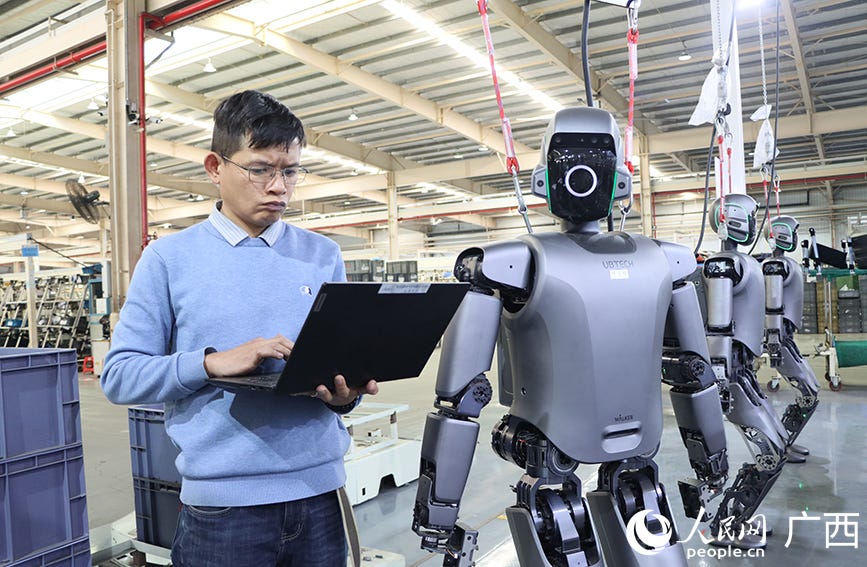
A robotics company arriving in Liuzhou does not encounter only cheaper land or a subsidy. It encounters an automotive supply chain, operating factories, a government-funded training centre, public investment, potential customers, human demonstrators and a municipality interested in turning the resulting training data into another local industrial resource.
The locality does not merely host an industry. It becomes part of the industry’s cognition.
Public capital is the search budget
China’s government-guidance funds make more sense when understood as a search system rather than merely as subsidies disguised as equity.
From an early Zhongguancun pilot, the system expanded into national, provincial and municipal investment platforms spanning semiconductors, artificial intelligence, biotechnology, advanced manufacturing, energy storage and other strategic sectors. Central funds establish broad priorities and long horizons. Provincial vehicles connect those priorities to regional industrial systems. Municipal funds recruit companies, provide infrastructure and attempt to build local clusters around them.
The Chinese search system is neither pure central planning nor free local experimentation. Its working formula is:
Central direction.
Local discovery.
Private execution.
Party sovereignty.
The centre names strategic domains and political constraints. Public capital supplies the search budget. Localities assemble competing environments. Private firms provide technical judgment, operating pressure and commercial improvisation.
The usual criticism is that the Chinese state picks winners. Sometimes it does. But the system is more interesting when the state does not yet know which winner it is picking.
The centre can identify a direction - embodied intelligence, advanced chips, autonomous vehicles - without knowing the successful company, technical architecture or business model. Public capital then finances several partially competing attempts. Local governments assemble different combinations of companies, factories, universities, supply chains and customers. Deployment generates evidence.
Public capital becomes a search budget.
The city is not merely purchasing shares in a company. It is buying an option on an ecosystem.
A company may fail while some of the engineers, suppliers, specialised facilities, operating knowledge and infrastructure remain. This is the territorial logic of the wager. The desired return is not only a successful exit. It is a denser local capability that can be recombined around the next firm.
China’s electric-vehicle rise illustrates the form. It was not simply designed in Beijing and executed below. Local governments and private manufacturers repeatedly formed alliances to navigate central restrictions, secure production permissions, attract capital and construct regional automotive systems. The centre supplied strategic priorities and entry rules; localities and firms discovered ways of operating within and around them.
SpaceX is a corporate portfolio of possible futures. Hefei, Shenzhen and Liuzhou are territorial portfolios of possible futures.
The city is the company.
Deployment is discovery
The laboratory cannot reveal everything machine civilisation needs to know.
A humanoid robot may perform well in a controlled demonstration and fail at a workshop task because the parts vary slightly, the lighting changes, the worker moves unpredictably, the floor is dirty or the production rhythm leaves no room for hesitation. A model may appear capable in testing and become uneconomic when integrated into a real workflow. An autonomous vehicle may master ordinary roads and fail at the strange exception every locality produces.
Deployment is therefore not simply the final stage after invention. It is a method of discovery.
The American system often uses valuation to discover which future should receive resources. The Chinese system more often uses installation: build, deploy, observe, modify and scale.
Rui Ma’s robotics dispatch from China describes humanoids that remain limited in capability but are already being sold, rented and installed in commercial environments. Their deployment reveals how customers use them, how the public reacts, which supplementary jobs emerge, which suppliers must adapt and where a business model might eventually hold. China’s advantage is less any individual humanoid than the closed loop surrounding it: capital, factories, data, supply chains, customers and local governments acting in the same environment.
The Liuzhou training centre makes this logic concrete. Humans repeatedly demonstrate industrial tasks. Robots collect motion and manipulation data. A nearby automotive factory supplies an actual workshop rather than an artificial test stage. The government-linked ecosystem helps finance both the firm and the learning environment.
Data here is not treated merely as the exhaust of a private product. It becomes a possible territorial asset.
The locality hopes that data generated by one generation of machines can attract other robotics companies, improve the recruiting offer and increase demand for the local industrial base. Whether the data transfers cleanly between robot architectures is almost secondary at the beginning. The immediate task is to create enough real-world experience for the next problem to become visible.
The training state does not insist upon knowing every answer before acting. It makes the unknown operational.
This also clarifies China’s AI+ approach. Its centre of gravity is not only the production of a singular frontier model. It is the diffusion of artificial intelligence into manufacturing, commerce, transportation, services and everyday consumption. The ambition is to make AI a basic productive capability rather than preserve it as an exceptional laboratory object.

The national infrastructure beneath this deployment matters as much as the model layer. East Data, West Computing joins data demand in the eastern economy to energy and computing capacity in western regions, making the grid and transmission system part of the intelligence strategy.
The developmental state built industries. The training state turns industries into learning environments.
The public must also be trained
The most easily missed part of the training state is its public theatre.
Chinese companies increasingly construct elaborate exhibition halls around their products and industrial histories. Some factories have become organised tourism sites receiving school groups, families and domestic visitors. Local governments package manufacturing plants, advanced products and robotics demonstrations as encounters with national progress.
As fewer citizens experience advanced manufacturing directly, factory tours translate public investment into visible collective achievement. Parents bring children to see the machines. Citizens become familiar with technologies likely to enter roads, workplaces and public services. Industrial deployment acquires a story, a setting and a feeling of participation.
The training state therefore trains more than the machine. It trains suppliers, workers, customers, officials and the public around it.
This has a darker implication. A society organised as a training environment can begin treating people primarily as demonstrators, users, data sources and adjustment costs. The public is taught to recognise the machine’s necessity before it has negotiated its own claim upon the machine.
A hierarchy that learns
Distributed search remains nested inside a political hierarchy.
China’s industrial successes have often depended upon a lead institution capable of coordinating procurement, standards, technology transfer, research support and firm discipline. High-speed rail possessed such a coordinating authority. Conventional automobiles, for many years, did not. The difference was not the presence or absence of state support but whether some institution could align the relevant ministries, firms, suppliers, localities and research organisations.
The centre need not dictate every technical move. But it retains the authority to decide which capabilities are strategic, which risks are tolerable and which forms of private power have become politically autonomous.
The entrepreneur may build the model, factory or platform. The locality may organise the deployment environment. But the Party retains the objective function.
It determines what kinds of capacity count as nationally important, where security overrides commercial autonomy, which firms may become strategic assets and which forms of techno-commercial authority threaten to become rival centres of meaning or command.
This need not take the form of formal nationalisation. Chinese laboratories can remain commercially dynamic while operating inside a state able to steer compute, data, standards, procurement and institutional partnerships. Paul Triolo describes this as movement towards functional rather than formal nationalisation: the firm remains privately or commercially organised, but its operating environment becomes strategically directed.
The Chinese state can therefore explore locally while pruning centrally. It can allow several technical paths, then impose standards, redirect capital, consolidate firms or close an avenue that produces unacceptable security or political consequences.
When this works, it combines discovery with coordination. When it fails, the same hierarchy produces a distinctive pathology.
Policy overfitting
The training state can overfit to its own policy signals.
The centre announces strategic importance. Provinces and cities translate the signal into performance targets. Funds are created. Parks are designated. Companies are recruited. Officials learn which sector labels, presentation formats and metrics will be recognised by the next level of government.
If every locality receives the same signal, decentralised experimentation can become decentralised imitation.
Every city needs an AI cluster. Every province needs a humanoid-robot programme. Every industrial park needs a data centre, model company or semiconductor fund.
The system appears diverse because there are many projects. In reality, the projects may be optimising against the same politically legible benchmark.
China’s reforms to government-guidance funds have begun warning against homogeneous competition and provinces poaching the same firms from one another. Funds are increasingly being pushed to co-invest with private capital and demonstrate financial performance rather than relying only upon policy importance.
This is not an external flaw imposed upon the training state. It arises from its principal strength.
The system is good at mobilisation because central signals travel quickly through finance, land, official promotion criteria and local industrial strategy. But the clearer the signal becomes, the stronger the temptation to substitute compliance with the signal for genuine technical learning.
The machine-learning analogy is exact enough to be useful.
The model performs well on the benchmark and poorly in the world. The locality secures the approved cluster, fund and demonstration project while learning little about whether a durable market exists.
Factories, training centres and installed capacity then become political facts. Closing them means admitting not only financial failure but administrative misjudgment. The local government may have invested capital, provided land, guaranteed debt and built its development narrative around the project. Failed capacity becomes difficult to retire because too many institutional identities depend upon its continuation.
The difficulty is deeper than administrative embarrassment. Local overinvestment and weak household demand belong to the same political economy. The public sector captures and recycles a large share of national surplus through land, credit, funds and infrastructure, while households retain less income and must save against illness, unemployment and old age. Local governments therefore keep searching for the next productive cluster partly because domestic consumption cannot provide an equally reliable engine of growth.
Overfitting and the settlement gap are not separate failures. One builds too much capacity because the other has built too little household security.
This also makes failed capacity harder to retire. A factory or industrial park is not only a bad investment. It may support local revenue, employment, bank assets, official careers and the municipality’s account of its own future. The machine persists because the settlement around it is too thin to absorb its disappearance.
America’s listed state has a reflexivity problem. Belief raises valuation; valuation creates capacity; falling belief can reverse the entire loop.
China’s training state has an overfitting problem. Direction creates imitation; imitation creates installed capacity; installed capacity makes correction politically expensive.
America can mistake valuation for truth. China can mistake mobilisation for learning.
The settlement limit
A training environment includes human beings.
Once the machine enters the factory, office, court, hospital or public service, employment and welfare cease to be adjacent policy questions. They become part of the deployment architecture.
A Chinese finance company recently argued that artificial intelligence had made an employee’s quality-control work unnecessary. A Hangzhou court ruled the dismissal unlawful. Commentary surrounding the case called for clearer evidentiary standards, employment assistance for displaced workers and binding rules covering algorithmic performance reviews and workplace surveillance.
This is a small case, but it reveals the larger constitutional question.
Who is allowed to use machine capability to eliminate a role? What must an employer prove? Who carries the cost of the transition? Where does the worker appeal?
The training state is highly capable of supplying capital, factories and data. It is less obviously capable of converting machine productivity into secure household claims.
Huang Yiping’s diagnosis of strong supply and weak demand reaches the heart of the problem. Chinese households save partly because social security remains incomplete and personal savings must insure against illness, unemployment and old age. At the same time, the public sector captures and saves a large share of national income, directing resources towards investment rather than household consumption.

China has socialised investment while leaving a large portion of insecurity private.
That settlement was powerful during industrial catch-up. It supplied the state and localities with resources for infrastructure, factories and strategic sectors. But machine civilisation changes the balance. If production requires fewer workers, and if households remain anxious and cautious, the system can generate enormous productive capacity without producing sufficient demand or recognised human necessity.
This is why pension reform belongs inside the training-state argument rather than in a separate welfare discussion. Liu Shijin’s proposal to raise rural pensions treats social protection as demand infrastructure. Poorer households with higher propensities to consume can sustain final demand more effectively than another investment project, while greater security reduces the need for precautionary saving.

The same applies to employment protection, retraining, healthcare and public services. They are not compensations paid after the machine has been built. They are conditions under which the machine can be deployed without hollowing out the society required to buy, legitimise and inhabit what it produces.
In machine civilisation, pensions become demand infrastructure. Employment rights become deployment constraints. Training programmes become model infrastructure. Public services become adoption environments. Social legitimacy becomes an industrial input.
The settlement is inside the loop.
The training state can build the world in which a machine learns. Its limit appears when it must build the world in which the human remainder continues to possess income, dignity and political weight.
The machine has an address
The American and Chinese systems solve uncertainty through (almost) opposite institutional movements. America permits the operator to cross boundaries. China pulls the relevant boundaries together inside a locality.
The American operator is addressless. Power is distributed across firms, contracts, platforms, advisers, procurement relationships and technical interfaces. Every institution may describe its own narrow role correctly while no one possesses complete responsibility for what the system does.
China’s machine has a territorial address.
There is a municipal government. A party committee. A local fund. An industrial park. A supervising agency. A court. A state bank. The coalition is not invisible.
But an address is not the same as an appeal.
The same locality may invest in the company, provide its land, construct its infrastructure, regulate its trials, purchase its products and depend upon its success for revenue and official prestige. Integration makes action possible. It also narrows the institutional distance between promoter, regulator and judge.
America’s problem is that there may be no door. China’s problem is that every door may open into the same room.
This is the danger of over-integration. The system can identify where the project lives but still leave citizens with little leverage over its direction. The locality experiences the factory, fund and machine programme as parts of one development project. The worker, resident or small business may experience them as several forms of the same authority.
The training state is therefore not simply more accountable because it is more legible. Its accountability problem is different.
In America, responsibility evaporates across institutional boundaries. In China, responsibility can be concentrated inside an institution too politically invested in the outcome to hear the appeal.
The Chinese mirror
The mirror can now be stated plainly.
America securitises the operator. China operationalises the locality.
America places ontological uncertainty inside a founder-controlled firm and allows the public market to finance its continuing discretion.
China places ontological uncertainty inside a territorial coalition and allows public capital, industrial infrastructure and deployment to discover what the technology can become.
America makes command investable. China makes deployment governable.
The American advantage is capital formation, corporate recombination and the speed of concentrated private command. Its danger is reflexivity, private sovereignty and the disappearance of a clear public address.
The Chinese advantage is coordinated deployment, territorial learning and the ability to join technology to factories, grids, data, customers and administrative action. Its danger is policy overfitting, soft-budget persistence and the treatment of society itself as training substrate.
Neither should be reduced to a caricature of market versus state. Both are governance responses to a technical world that cannot be fully planned before it is built.
The United States gives exceptional discretion to the institution that can keep rearranging the project. China constructs an environment dense enough for the project to keep rearranging itself.
The training state is a remarkable achievement. It makes territory capable of learning.
Its political test is whether the people living inside that territory become citizens of machine civilisation - or merely part of its training environment.
Two things struck me as I read this pair of essays.
First: both systems concentrate power, but the disguise differs and this is the game. America concentrates and codes it economic — firms, valuations, a founder who is merely a vendor to the court. China concentrates and codes it political — party sovereignty, the locality as open authority. Same desire, different costume. This is why your last line is so apt: the American form is addressless because it's dressed as the market; the Chinese form is over-addressed because it's dressed as the state.
Second, there is another consequence from all this: if risk lives in a listed firm on one side and a training locality on the other, the two are mutually illegible. Washington looks for the company and finds a city; Beijing looks for the state and finds a founder. Each hunts for an institutional object that isn't there. That may be why they talk past each other more than ideology explains — not disagreement on the answer, but no agreement on who the counterparty is. No wonder its so hard to negotiate a shared framework when the thing holding the capability is a charter on one side and a locality on the other.
brilliant as usual and should be illuminating for the non-Chinese. I saw this process with my own eyes around 2011 when I was invited to the Huangwa forum in Chengdu, in the case of wind turbines and the establishment of a new university.